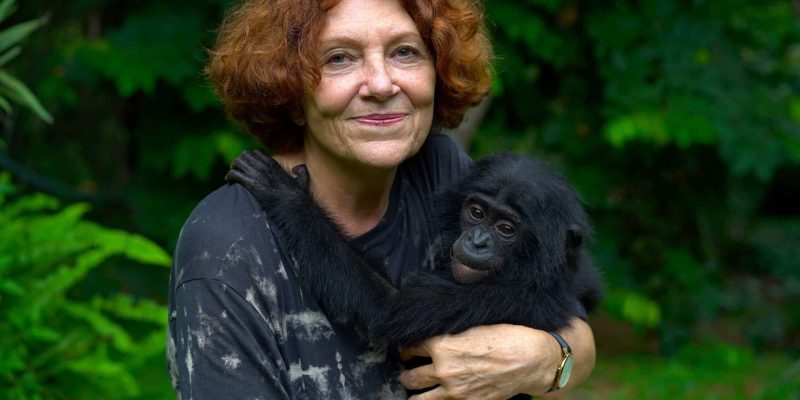
Claudine André turned 80 today, and the organization she built marked it by publishing eight things her work changed. The first one happened at a zoo.
More than thirty years ago André was volunteering at Kinshasa Zoo, where the animals were neglected and at risk of starving, when a sick infant bonobo named Mikeno was brought in. She was told not to get attached, because he would not survive.
“The Zoo director warned me not to pour my heart into it,” she has said of that moment. “It’s not an easy animal to keep in captivity. But it was like a second challenge to me, not only to save the zoo, but also to save this bonobo.”
Mikeno lived, and stayed in her care for years. Word spread in Kinshasa that someone knew how to keep orphaned bonobos alive, and people started bringing her more of them.
From one zoo enclosure to 120,000 acres
André founded Les Amis des Bonobos du Congo to give those orphans somewhere to go, and traveled by canoe into remote parts of the country looking for a site, during a period of civil war and at real personal risk. That search produced Lola ya Bonobo, which opened in 2002 and remains the only sanctuary in the world dedicated to orphaned bonobos.
The harder achievement came later. In 2009 bonobos from Lola were returned to the wild at the Ekolo ya Bonobo Community Reserve, the first successful reintroduction of the species. Establishing Ekolo meant negotiating with the Ilonga-Mpôo community over land they have an ancestral claim to, which André did by spending time there and listening before proposing anything.
Ekolo is now a protected forest of more than 120,000 acres. A second reintroduction followed in 2022, and ten bonobos have since been born there, which is the measure that counts: released animals that go on to breed.
Which zoo paid for it
This is the part of an African conservation story that usually goes unexamined, and in this case it has a clear answer, published by the funder rather than by the recipient.
The Columbus Zoo and Aquarium states on its own conservation pages that since 2000 it has provided over $500,000 to support Lola ya Bonobo’s rescue and rehabilitation work and its education programs, and that it intends to continue. It has also recently awarded Lola a three-year grant aimed specifically at preparing sanctuary bonobos for rewilding and eventual release at Ekolo, and it helps fund the education facility that serves children and adults from Kinshasa.
And in a detail that explains why today is worth marking: the Columbus Zoo named its indoor bonobo habitat after Claudine André.
For scale, the Association of Zoos and Aquariums reports that in 2025 its 235 accredited and certified facilities spent approximately $372.4 million on conservation across 139 countries. No published breakdown isolates the African share of that, so we will not invent one. What is documented here is a single institution, a single sanctuary, and a quarter of a century.
We could not find a second accredited zoo or aquarium naming itself as a funder of Lola ya Bonobo on any page we were able to open. The Badham-Evans Award for Women’s Commitment to Wildlife, one of André’s honours, is presented at Twycross Zoo in England, but an award venue is not a funder and we are not going to dress it up as one.
A Congolese organization
The team at Les Amis des Bonobos du Congo is now primarily Congolese, from the substitute mothers who raise the orphans to the people running Lola and protecting Ekolo. André has handed the organization to her daughter, Fanny Minesi, who serves as General Director and runs the sanctuary, the release site, the education programs and visitor services.
Her other honours include the Prince Laurent Foundation Prize in Belgium and the National Order of Merit in France, and she was nominated for the Indianapolis Prize in 2023.
What the species is up against
The bonobo, Pan paniscus, is listed as Endangered. We are giving the category alone and not the assessment year, criteria or population trend, because the IUCN Red List’s species pages returned an access error from both of the machines we check from on the day this was written. The category above is the one republished by GBIF alongside the IUCN taxon identifier 15932, which makes it a second party publishing the same figure rather than our account of a document we could not open.
Bonobos occur in the wild in one country only, the Democratic Republic of the Congo, south of the Congo River. The Congo Basin rainforest they depend on is among the most biodiverse and carbon-rich ecosystems on Earth.
We covered another great ape moved into the region in September, when a rescued gorilla flew from Lagos to Pointe-Noire.
Source: Friends of Bonobos, November 6, 2026.
Quick answers
- Who is Claudine Andre?
The Belgian-born conservationist who founded Lola ya Bonobo, the only sanctuary in the world dedicated to orphaned bonobos. She turned 80 on November 6, 2026.
- How did it start?
At Kinshasa Zoo, where she was volunteering more than thirty years ago. A sick infant bonobo named Mikeno was brought in and she was warned not to get attached because he would not survive. He lived, and word spread that she knew how to keep orphaned bonobos alive.
- What is Ekolo ya Bonobo?
A community reserve of more than 120,000 acres where bonobos from Lola were returned to the wild in 2009, the first successful reintroduction of the species. A second reintroduction followed in 2022 and ten bonobos have been born there.
- Which zoo funds Lola ya Bonobo?
The Columbus Zoo and Aquarium. Its own conservation pages state that since 2000 it has provided over $500,000 toward Lola ya Bonobo rescue, rehabilitation and education work, and that it has awarded a three-year grant aimed at preparing sanctuary bonobos for release at Ekolo. The zoo has also named its indoor bonobo habitat after Claudine Andre.
- Who runs the organization now?
Her daughter, Fanny Minesi, as General Director of Les Amis des Bonobos du Congo. The team is now primarily Congolese.
- What is the bonobo conservation status?
Endangered. We are giving the category alone, without the assessment year, criteria or population trend, because the IUCN Red List species pages returned an access error from both machines we check from. The category is the one GBIF republishes alongside IUCN taxon identifier 15932.
- Where do bonobos live?
In one country only: the Democratic Republic of the Congo, south of the Congo River.