
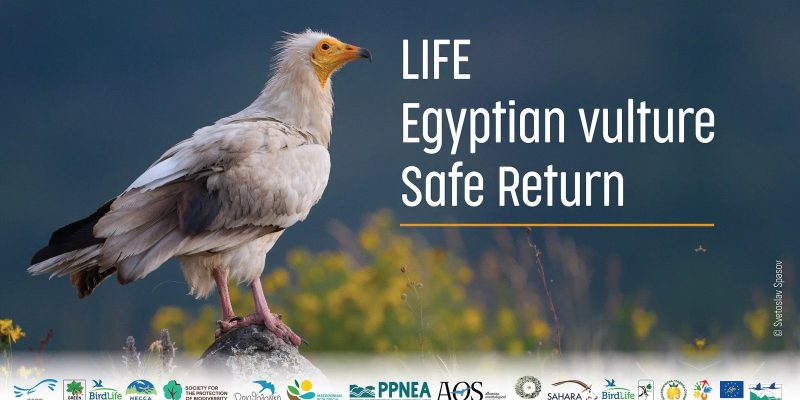
Every autumn the Egyptian vultures that breed on the cliffs of Bulgaria, Greece, North Macedonia and Albania leave for Africa, and some of them spend the winter in Chad. Around fifty breeding pairs are left across those four countries. A bird can be guarded at its nest all summer, fitted with a transmitter, and known to the people watching it as an individual, and still be poisoned four thousand kilometers later by someone who has never heard of the project keeping it alive.
On Friday, October 10, World Migratory Bird Day, Sahara Conservation announced that it had joined LIFE EV Safe Return, a fifteen-organization project built around exactly that gap. It is coordinated by the Bulgarian Society for the Protection of Birds, co-funded by the European Union’s LIFE Programme, and it runs until 2031. For the first time in this conservation program, the work includes targeted action in Chad.
Why the wintering grounds are the hole in the net
Flyway conservation is a plain idea with an awkward consequence. A migratory bird is only as protected as the least protected place it visits, so the effort that goes into a nest in the Balkans is capped by whatever happens on a Sahelian rubbish dump in January. The Egyptian vulture is a useful test of that, because its route is long, well mapped and crosses three continents.
The threats are not the same at both ends. In Europe the project works on poisoned baits, on making power poles safe, and on illegal killing. In Africa it adds something that has no European equivalent: in parts of the continent vultures are killed for use in practices tied to traditional beliefs, and the project’s answer to that is engagement with community leaders and traditional medicine practitioners rather than enforcement alone. In Chad, Sahara Conservation’s share of the work is reducing poisoning, illegal killing and trafficking, and building the community relationships that make the rest of it possible.
The organizations involved make a second argument for the species, which is that it pays for itself. An Egyptian vulture is an umbrella: a poisoned bait removed for its sake is removed for everything else that would have fed on it, and a power pole insulated on its route is insulated for every other bird that lands on it.
Which zoos are behind this
Two zoological institutions are associated partners in the project, and both are named as such in the coordinator’s own launch release: Sofia Zoo in Bulgaria and Prague Zoo in the Czech Republic. They appear in the project’s partner logo strip alongside BirdLife Europe and Central Asia, Green Balkans, Greece’s Natural Environment and Climate Change Agency, the Society for the Protection of Biodiversity of Thrace, the Hellenic Ornithological Society, the Macedonian Ecological Society, Albania’s PPNEA and Albanian Ornithological Society, DOGA in Turkiye, BirdLife Africa, the Nigerian Conservation Foundation and Sahara Conservation itself.
Their contribution is not abstract. In Bulgaria and Greece the project intends to release at least forty Egyptian vultures that were either bred in European zoos or rescued from the wild, each carrying a GPS transmitter so the teams can find the places along the route where birds stop moving. That is the part of this that only zoos can supply. A population of fifty pairs cannot spare adults for a reinforcement program, and captive breeding is the only source of birds that does not take them from the wild population you are trying to rebuild.
One institution we expected to find here is not in it. Sahara Conservation exists because the Saint Louis Zoo paid its start-up costs in 2004 and hosted its United States headquarters, which makes it the clearest case in our files of a zoo not funding a field organization but creating one. That history is real, and we have written about its results before. It is not a stake in this project. Saint Louis is not a partner in LIFE EV Safe Return, and the two zoos that have earned their place on this particular story are the ones in Sofia and Prague.
For scale, the Association of Zoos and Aquariums reports that in 2025 its 235 accredited and certified facilities spent approximately $372.4 million on conservation across 139 countries. No published breakdown isolates how much of that reached Africa, so we are not going to estimate one.
What the assessment says about the bird
The Egyptian vulture, Neophron percnopterus, is listed as Endangered on the IUCN Red List. The current assessment was carried out by BirdLife International and published on July 21, 2021. Both Sahara Conservation and the Bulgarian Society for the Protection of Birds describe the species as endangered, and on this occasion the organizations’ wording and the assessment agree, which is worth noting because it frequently does not happen.
The species is also listed on Appendix I of the Convention on the Conservation of Migratory Species, where it has sat since 2008, and the convention’s range list for it runs past seventy countries, Chad among them. We are not printing a global population figure. The Red List species account is where that number should come from and we could not open it, so it stays out. The figure that is solid is the regional one the project is actually working on, and it comes from the coordinator: about fifty breeding pairs across Bulgaria, Greece, North Macedonia and Albania, after three decades of decline, with the Balkan population now showing signs of stabilizing and the Bulgarian numbers starting to rise.
A bird people already have a name for
Adults are white with black flight feathers and a bare yellow face, small enough among vultures to be mistaken for something else at a distance, and among the few birds that use a tool: they break ostrich eggs by throwing stones at them. The older ornithological literature calls the species Pharaoh’s chicken, a reference to how often it turns up in Egyptian iconography. In Greece and Albania it is the cuckoo’s horse, said to carry spring in on its wings.
That matters more than it sounds. The project’s education work is meant to reach more than four thousand pupils, teachers and young conservationists across five countries, and a species people already have a name and a story for is an easier thing to ask a community to stop killing than an abstraction is.
“The first signs of recovery show that our efforts are making a difference. We must now secure this progress and turn it into a lasting trend,” said Dr Volen Arkumarev of the Bulgarian Society for the Protection of Birds, the project manager. “For a bird traveling more than 5,000 km between the Balkans and Africa, this means tackling threats along its entire migration route.”
The project has five years to run. The test of it will not be the birds released in Bulgaria, which are the easy part to photograph. It will be whether the ones that leave in September are still alive in March.
Quick answers
- What is LIFE EV Safe Return?
An international Egyptian vulture conservation project launched on October 10, 2026, coordinated by the Bulgarian Society for the Protection of Birds and co-funded by the European Union LIFE Programme. It brings together 15 institutions and organizations from Europe, the Middle East and Africa and runs until 2031.
- What is new about it?
It extends the work to the wintering grounds. For the first time in this conservation program, targeted action will be undertaken in Chad, one of the key countries where Balkan Egyptian vultures spend the winter. Sahara Conservation leads that part.
- Which zoos are involved?
Sofia Zoo in Bulgaria and Prague Zoo in the Czech Republic are associated partners. The project also plans to release at least 40 Egyptian vultures in Bulgaria and Greece that were bred in European zoos or rescued from the wild, each carrying a GPS transmitter.
- How many Egyptian vultures are left in the Balkans?
About 50 breeding pairs across Bulgaria, Greece, North Macedonia and Albania, according to the project coordinator. After more than three decades of decline the Balkan population has shown signs of stabilizing, and numbers in Bulgaria have begun to increase.
- Is the Egyptian vulture endangered?
Yes. The IUCN Red List lists Neophron percnopterus as Endangered. The current assessment was carried out by BirdLife International and published on July 21, 2021. The species has also been listed on Appendix I of the Convention on the Conservation of Migratory Species since 2008.
- What threatens the birds on migration?
Poisoned baits, illegal killing and electrocution on unsafe power poles are the main ones. In parts of Africa vultures are also killed for use in practices tied to traditional beliefs, which the project addresses through engagement with community leaders and traditional medicine practitioners.
- How far do they migrate?
More than 5,000 kilometers each way between the Balkan Peninsula and their African wintering grounds. That is why the project treats the whole flyway as one unit: a bird protected at its nest can still be killed thousands of kilometers away.