
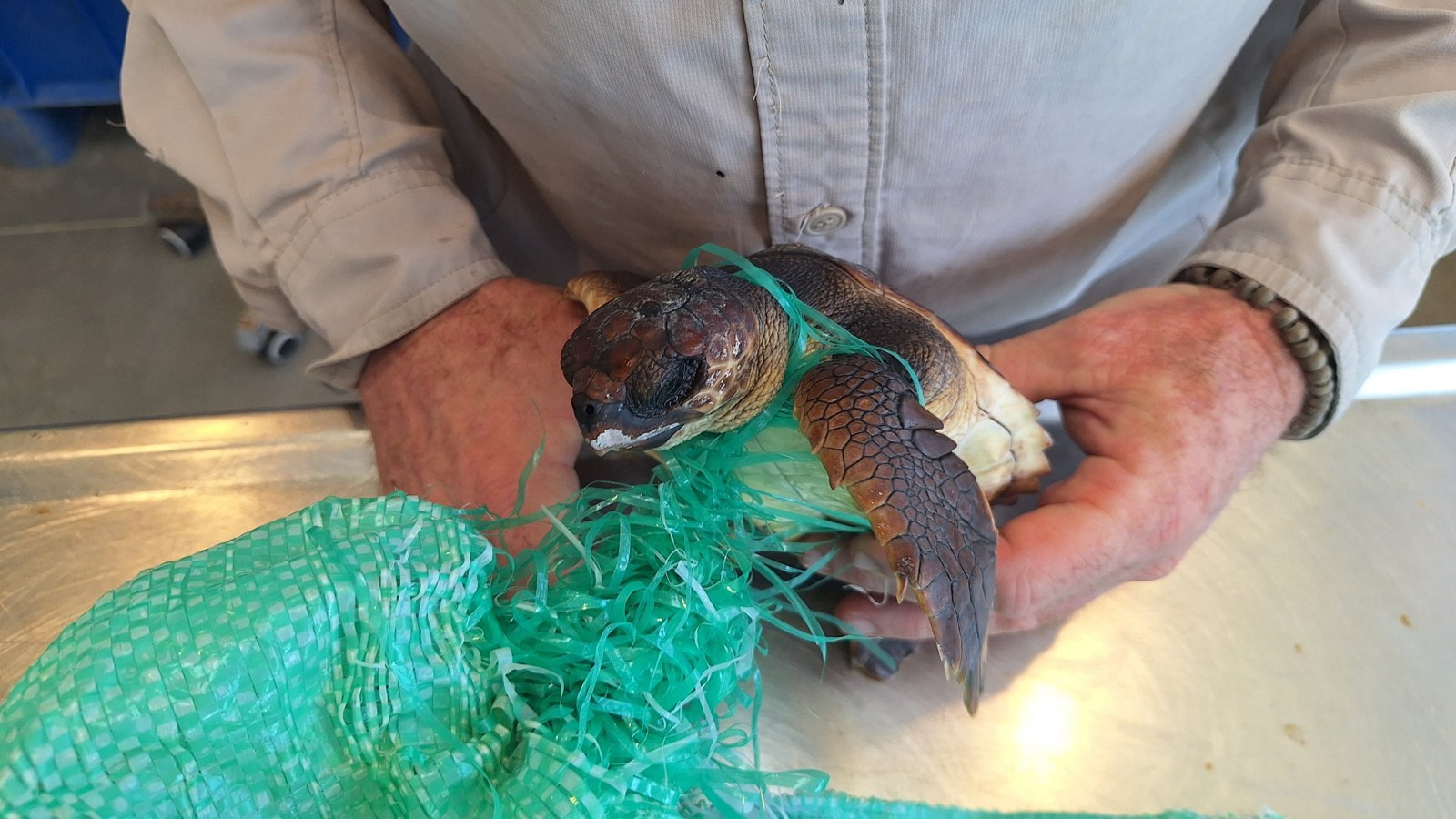
If you find a sea turtle on an Israeli beach with plastic wound around its flippers, the instruction from the people who treat them is the opposite of what almost everyone does. Do not cut it off. Bring the turtle in with the plastic still attached.
The Israel Nature and Parks Authority put that in writing on October 6, after a summer in which eight turtles came into its National Sea Turtle Rescue Center at Michmoret tangled in plastic bags, and in recent weeks a run of cases in which members of the public found entangled turtles, pulled the strings off and put them straight back in the sea. All eight of the center’s cases have now been released.
Why removing the plastic can kill the animal
The damage from an entanglement is not mainly the cut. Strings, netting and the drawstrings of plastic bags wrap around a turtle’s flippers, and sometimes its neck, and tighten, and what they do is close off the blood supply to everything beyond the wrap. The limb beyond the constriction then sits for days or weeks without circulation, and toxins and bacteria build up in the dying tissue.
Cut the wrap off at the beach and you restore the blood flow all at once. The contents of that tissue go into the bloodstream and travel to the rest of the body. The rescue center’s phrasing is blunt: immediate removal of the strings can be fatal. A turtle that looks healthy and lively on the sand is not evidence that it is fine, because the thing that will kill it is the rescue.
What the center does instead is slow. The turtle is X-rayed to see how badly the bone underneath has been damaged and to judge when the constriction can safely come off. If swelling or necrosis has started, the animal is put on antibiotics and the wrap stays on for at least another twenty-four hours. Where the necrosis is advanced, the constriction is never removed at all, and the limb is taken off surgically instead.
The public instruction that follows is a phone number. Report the animal to the Nature and Parks Authority hotline, take instructions, and bring the turtle to the center with the bag.
Eight turtles, two groups
Five of them were young loggerheads weighing between 400 and 700 grams: Moshe, Hanoch, Mor, Putzi and Gal, picked up along the coast between Ashkelon and Netanya after getting into plastic bags.
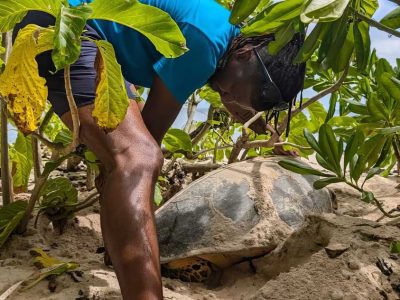
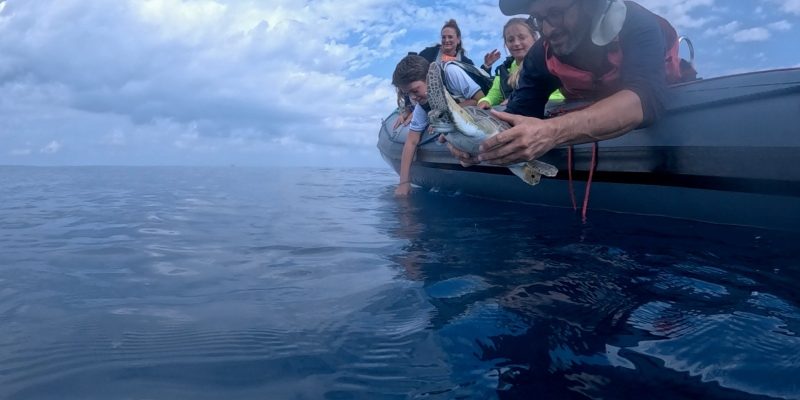
Hanoch is the one that shows what the center is asking for. Instructors from the Michmoret Emek Hefer sailing club found him with plastic bag cords wound around his neck and around every one of his limbs, and they did the right thing, which was nothing: they left the bag where it was and brought the turtle in as they found him. The five were released together in open water with the help of the club and its trainees.
The second group was three. Herzl, a sub-adult loggerhead of about five kilograms, was found entangled at Palmachim. Muriel, a young green turtle, was found in open water by a stand-up paddleboarder. Ramon, another young green turtle, was found in a bag near Ga’ash, and his case was the one that did not end tidily: the condition of his left front flipper was bad enough that the center had to amputate it.
Ramon and Muriel shared a rehabilitation pool through their recovery, and the three went back to the sea together with the help of the Frigel sailing club at Sdot Yam. Dozens of second-graders and the children of a local kindergarten came down to see them off.
Around 200 injured sea turtles arrive at the center in a typical year, from all causes. The center has been running since 1999.
What the species are, and what they are not
The loggerhead, Caretta caretta, is listed as Vulnerable on the IUCN Red List. The green turtle, Chelonia mydas, is listed as Endangered. Both are on Appendix I of the Convention on the Conservation of Migratory Species, the loggerhead since 1985 and the green turtle since 1979.
The Nature and Parks Authority does not quote a conservation category in this announcement, so there is nothing here to correct. It is worth adding one thing the global categories do not carry, though. The Mediterranean loggerheads are assessed separately from the species as a whole: there is a standing IUCN assessment of the Mediterranean subpopulation, written by Paolo Casale for the IUCN SSC Marine Turtle Specialist Group and published on August 20, 2015. We could not open that assessment, so we are not going to state what category it carries. The point worth keeping is that “Vulnerable” is the global figure, and these particular animals belong to a population the Red List tracks on its own terms.
Who funds the center
The National Sea Turtle Rescue Center is run by the Israel Nature and Parks Authority, a government body, and it was established by the Authority in 1999. The Israel Nature and Heritage Foundation, a charitable foundation rather than a zoological institution, names the center among the projects it supports.
We looked for an accredited zoo or aquarium behind this particular rescue and release and did not find one named. The nearest thing to a connection is real but it is not this story: the Gottesman Family Israel Aquarium in Jerusalem has been described, in a 2025 feature about its marine conservation work, as collaborating with the Nature and Parks Authority and the Michmoret center on rehabilitating injured turtles, and as holding several turtles too badly injured to go back. Those are not these eight. The Authority’s announcement does not name the aquarium, and the eight turtles in it went to sea rather than to Jerusalem, so we are not attaching the institution to a release it is not described as part of.
For scale on the wider question, the Association of Zoos and Aquariums reports that in 2025 its 235 accredited and certified facilities spent approximately $372.4 million on conservation across 139 countries. No published breakdown isolates a regional share, and we are not going to invent one.
The part that is easy to miss
The eight animals here were all small. Four hundred grams is a turtle that fits in two hands, and the oldest of them was a five-kilogram sub-adult. None of them were nesting females, none were the charismatic thirty-year-olds that make the news when they are released with satellite tags, and unlike a reintroduction none of this adds a species to a landscape it had left.
What it does is keep eight animals in a population that loses most of its young before they ever breed, and it does it by asking the public for something counterintuitive and slightly unpleasant: to pick up a struggling animal and carry it, still tangled, to someone with an X-ray machine. That is a harder ask than cutting a string. It is also the one that works.
Quick answers
- What should I do if I find an entangled sea turtle?
Do not remove the plastic, netting or fishing line, and do not put the turtle back in the sea. Report it, then bring the animal in for treatment with the entanglement still attached, even if it looks healthy and lively.
- Why is removing the plastic dangerous?
The wrap cuts off blood flow to the limb beyond it, and toxins and bacteria build up in the tissue that is dying. Removing it restores circulation all at once and sweeps that material into the rest of the body. The rescue center says immediate removal can be fatal.
- What does the rescue center do instead?
It X-rays the animal to assess bone damage and judge when the constriction can safely come off. If swelling or necrosis has started, the turtle is given antibiotics and the wrap stays on for at least another 24 hours. Where necrosis is advanced the wrap is not removed at all and the limb is amputated.
- How many turtles were released?
Eight, in two groups. Five young loggerheads of 400 to 700 grams named Moshe, Hanoch, Mor, Putzi and Gal, then Herzl, a sub-adult loggerhead of about five kilograms, and two young green turtles, Muriel and Ramon. Ramon lost his left front flipper to amputation and was released anyway.
- Where is the rescue center?
At Michmoret on the Israeli Mediterranean coast. The National Sea Turtle Rescue Center is run by the Israel Nature and Parks Authority, which established it in 1999. Around 200 injured sea turtles arrive there in a typical year.
- Are these species threatened?
The loggerhead, Caretta caretta, is listed as Vulnerable on the IUCN Red List and the green turtle, Chelonia mydas, as Endangered. Both are on Appendix I of the Convention on the Conservation of Migratory Species. Mediterranean loggerheads also carry a separate IUCN subpopulation assessment.
- Does a zoo or aquarium fund the center?
Not one we could verify for this rescue. The center is a government operation and the Israel Nature and Heritage Foundation, a charitable foundation, supports it. The Gottesman Family Israel Aquarium has been described as collaborating with the center on turtle rehabilitation, but it is not named in this announcement and these eight turtles went back to sea.