
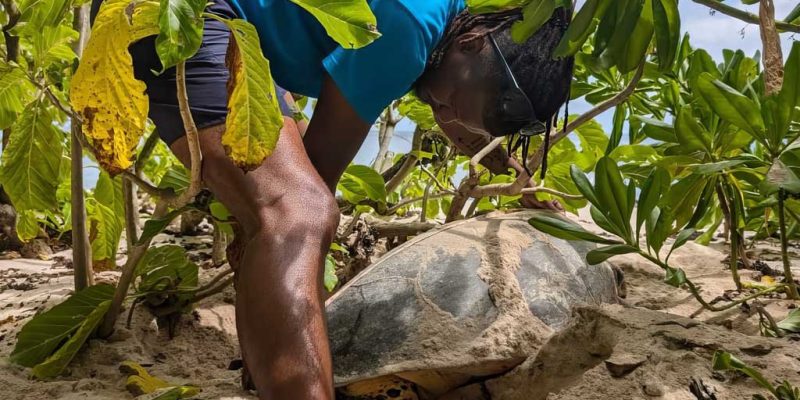
Nature Seychelles has spent decades counting hawksbill turtles coming ashore on Cousin Island Special Reserve. This autumn it handed that data set to six knitters.
The organization announced on October 8 that it has joined the third cohort of Knit for Wildlife, a residency that turns a species and its conservation problem into an open-access knitting pattern. The run goes from September to November 2026, and Nature Seychelles is one of three partners in it, alongside the Barbados Sea Turtle Project and Cooperativa Casa Carey in Nicaragua. All three are working on the same animal: the hawksbill sea turtle (Eretmochelys imbricata), which the IUCN Red List assesses as Critically Endangered.
What a knitting residency has to do with turtle monitoring
Knit for Wildlife was founded by a marine biologist, Lena Fagerwing, on a premise about reach rather than craft.
“Conservation stories rarely become part of people’s daily routines,” she says. Knitting, by her description, is a Trojan horse: it turns wildlife stories into patterns, conversations and communities that reach people who would otherwise never encounter them. “In many ways, we’re building a pop culture concept for wildlife,” she adds. “Knitters have a huge community worldwide. But the best part is everybody can join, putting a spotlight on different species from around the world.”
The format has been run twice before, first with Love The Oceans in Mozambique and then with Vega World Heritage in Norway. An open call in early August drew enough applications to fill a group of six, now called the Hawksbill Six, with ten more working alongside them in an open studio.
In early September, Chris Tagg, Nature Seychelles’ science officer, took the knitters through the Cousin Island hawksbill monitoring program: how the species nests, what threatens it, what the island contributes as a nesting ground, what data the teams collect, and what counts as an ethical interaction with a nesting turtle. Photographs and video from Cousin were shared to fill in the rest.
That teaching step is the design of the thing rather than a courtesy. “We mentor knitters in narrative textiles, teaching them how to tell stories through pattern-making,” Fagerwing says, and the residents are expected to understand the animal before they can represent it in a pattern.
Is a zoo paying for any of this?
No, and that is consistent with what we have found before. We trace the money behind every conservation story in this region, because an accredited zoo or aquarium is often the invisible funder of field work in Africa. Nature Seychelles is one of the organizations where that chain does not connect: we have looked more than once and found no verifiable zoological institution funding it. The partners named in this project are Knit for Wildlife, the Barbados Sea Turtle Project and Cooperativa Casa Carey, with Love The Oceans and Vega World Heritage behind the earlier cohorts. None of them is a zoo or an aquarium.
It is worth noting what is being funded here is not research but circulation, and the two have different economics. Nature Seychelles’ communications manager, Liz Mwambui, puts the point this way: “For centuries, people have used textiles to tell stories, preserve traditions, and bring communities together.” The partnership, she says, lets the Cousin Island story reach somebody sitting at home with a cup of tea and a pair of needles.
What comes out of it
The residency ends in November with a set of open-access patterns, due for release before Christmas and intended to travel through knitting communities, festivals and social platforms rather than sit on one website. Anyone who knits will be able to use them. The group is posting progress publicly as it goes.
Cousin Island is a small piece of the Seychelles hawksbill picture and a well documented one. Elsewhere in the archipelago, the Island Conservation Society has been logging hawksbill nesting on Ile Plate, and the species returned to Desroches Island after fifteen years. Nature Seychelles itself is better known for coral: its restoration work took a global sustainability award last month.
Source: Nature Seychelles, From turtle tracks to knitting needles, the hawksbill turtle story is being told in yarn, published October 8, 2026.
Quick answers
- What is Knit for Wildlife?
A residency program founded by marine biologist Lena Fagerwing that turns a species and its conservation problem into an open-access knitting pattern. Earlier cohorts worked with Love The Oceans in Mozambique and Vega World Heritage in Norway. The third cohort runs from September to November 2026.
- What is Nature Seychelles contributing?
Its hawksbill turtle monitoring program on Cousin Island Special Reserve, which has tracked nesting females for decades. In early September 2026 science officer Chris Tagg took the knitters through how the species nests, what threatens it, what data the teams collect and what counts as an ethical interaction with a nesting turtle.
- How is the hawksbill turtle assessed on the IUCN Red List?
As Critically Endangered, which matches the wording Nature Seychelles uses. The scientific name is Eretmochelys imbricata.
- When do the patterns come out?
The residency ends in November 2026 and the open-access patterns are due for release before Christmas. They are intended to circulate through knitting communities, festivals and social platforms rather than sit on one website, and anyone who knits will be able to use them.
- Which zoo or aquarium funds this?
None. We looked and found no accredited zoological institution behind it, which is consistent with what we have found for Nature Seychelles before. The named partners are Knit for Wildlife, the Barbados Sea Turtle Project and Cooperativa Casa Carey in Nicaragua, with Love The Oceans and Vega World Heritage behind the earlier cohorts. None of them is a zoo or an aquarium.