
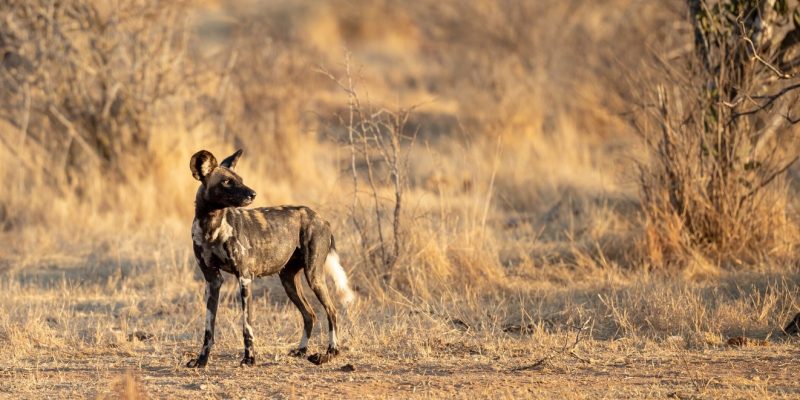
Three African wild dogs left their pack in Zambia’s Kafue National Park in July 2025. By April 1, 2026 they had covered 4,126 kilometers, the longest path ever recorded for the species, and settled in the Luano Game Management Area at the top of the Great Rift Escarpment. Over the same period four females from the same pack, plus four from another pack and three sisters who set out in 2021, walked a combined 9,863 kilometers between them. For comparison, Interstate 90 crosses the entire United States in 4,860.
The researchers who tracked all of it reach a blunt conclusion about what those journeys bought: “these four movements have yielded little genetic or demographic connectivity.” Nobody found a mate.
What the paper actually says
The record appears in Ecology, in a September 2026 paper by Scott Creel of Montana State University and the Zambian Carnivore Programme and 26 co-authors, most of them Zambian field staff. It is a Scientific Naturalist piece, which is the journal’s format for a natural history observation rather than an experiment, and it is open access.
The story opens with EWD-1355, a three-year-old female who left the Luamfwa pack in South Luangwa National Park in October 2021 with two littermate sisters. Over 11 months the three covered more than 2,300 kilometers, into Mozambique and back, repeatedly up and down the Rift Valley wall, across major rivers and highways, through national parks, game management areas, forest reserves and country with real human settlement in it. They reached the home range of a large pack in Lower Zambezi National Park, on the Zimbabwe border, and nothing happened. They did not join it. No males left it to join them. So they moved on. In June 2022 EWD-1355 died in a wire snare set for bushmeat. Her sisters were never accounted for.
Then in July 2025 four three-year-old females left the Mayukuyuku pack in Kafue, and three males of the same age followed two weeks later. The pack held 18 adults and yearlings and both groups came out of a single cohort of 19 pups that had survived to adulthood, which is the classic setup: a crowd of same-sex three-year-olds in a big pack where almost none of them will get to breed.
Why does a wild dog walk past a city instead of through it?
Both groups ended up in central Zambia, which has no clean corridor through it. They reached the outskirts of Kabwe, Kitwe and Ndola, cities of roughly 289,000, 666,000 and 628,000 people, and each time they turned around. After going north to Ndola, the males retraced their own track almost exactly for 200 kilometers back south. Later they avoided the Great North Road, the highway linking Lusaka to the Copperbelt, went around Kabwe on the east side, and skirted two reservoirs that are uncrossable for 20 to 30 kilometers.
That is not wandering. GPS collar work by the same group has shown that wild dogs outside protected areas move in a measurably different mode: a 1.7-fold increase in mean speed and a 2.4-fold decrease in mean turning angle, which is the statistical way of saying faster and much straighter. EWD-1355 and her sisters did exactly this, resting in rocky ground and small woodland patches where they were least likely to meet anyone.
The authors’ explanation is the competition-movement-connectivity hypothesis, and it is worth stating carefully because it is easy to overstate. Wild dogs are the subordinate member of the African large carnivore guild. Lions (Panthera leo) kill them and spotted hyenas (Crocuta crocuta) steal from them, and dogs have evolved to leave a dangerous area fast and in a straight line. The hypothesis is that the same equipment works on a landscape made dangerous by people. It is not a claim that a wild dog mistakes a city for a lion, and the paper does not say the behavior evolved for this purpose. It says an old adaptation turns out to be unusually transferable.
Twice they came within walking distance, and twice nothing came of it
This is the part that makes the paper a finding rather than a travelogue. On September 18 and 19, 2025, the Mayukuyuku males and females met again, in unprotected country 72 kilometers from Kitwe and 78 from Ndola, by which point the females had covered 1,404 kilometers and the males 1,203. Wild dogs locate each other by scent with real precision. The two groups stayed together for a day and separated.
On November 14 the males came within 14 kilometers of four different females, dispersers from the Kasweta pack in South Luangwa, and over six days the two tracks passed within 1.6 kilometers of one another. The Kasweta females had walked 1,538 kilometers, the males 2,356, from natal ranges 546 kilometers apart in a straight line. They did not unite either. The females stayed in the game management area; the males moved 107 kilometers southwest and kept going.
The reason is social, not geographic. Wild dogs usually fight, often fatally, when they meet strangers, so immigration into a new group is dangerous and frequently fails. Dispersal, as the paper puts it, is fundamentally a social process. Getting there is half the battle.
The snares
The Mayukuyuku females reached a small forest patch near Kabwe on October 10, having walked 1,899 kilometers. There the collared female began moving back and forth to one fixed point, over and over. That pattern has a known meaning: wild dogs will not abandon a snared packmate, and a snared animal cannot move unless the wire breaks. The team infers that an uncollared female was caught. On October 23 the collared female died too, probably in a snare; her collar had been cut off with a knife. Contact with the last sister was lost.
Wild dogs have no defense against wire. A snare is silent, nearly scentless, easily hidden on a game path and resembles nothing dangerous in the natural world, so the animals simply do not avoid it. Individual dogs have been recorded snared as many as four times, which makes it doubtful that even survivors learn. It is the same threat we have covered at the other end of the continent, in the Kenya Wildlife Service Mara vet unit’s snare removals and in a lion freed from a snare in Meru National Park.
About 40 percent of Zambia carries some form of wildlife protection, and some corridors, notably along the Luangwa Valley, are inside it. Others are not, and the routes described here run straight through them.
The Tsavo connection, and who paid for the work
Tsavo Trust picked the paper up on October 8 for a Kenyan reason. The longest cumulative wild dog movement on record is not in this study at all: it is an earlier, separately published 3,892-kilometer journey from Loliondo, on the eastern edge of the Serengeti ecosystem, to Tsavo West National Park. The straight-line distance between those two points is about 520 kilometers. The animal walked seven and a half times that. Wild dogs have been recovering in Tsavo in recent years, and a map that shows the Serengeti and Tsavo as separate systems is drawing a line the dogs do not recognize.
On the money, the answer is unusually clean. The paper’s acknowledgements run to more than thirty funders, most of them research councils, trusts, safari operators and private donors: the National Science Foundation, NERC, the National Geographic Society Big Cats Initiative, Tusk Trust, The Nature Conservancy, WWF Netherlands and Zambia, Painted Dog Conservation Inc., Gemfields, the Painted Wolf Foundation and IUCN Save Our Species with European Union money, among others. Exactly one zoological institution is in that list: ZoosSA.
Zoos SA is the not-for-profit that runs Adelaide Zoo and Monarto Safari Park in South Australia, and its side of the trace holds up. Its own conservation programs page lists, as a funded field program, “Zambian Carnivore Program and Wild Dog Conservation, Zambia,” and says Zoos SA “supports conservation activities including research, education, monitoring and mitigating human and carnivore conflict and reintroductions.” Both parties publish it, which is rarer than it should be. A 4,126-kilometer line across Zambia has an Adelaide zoo somewhere behind it.
The African wild dog (Lycaon pictus) is Endangered on the IUCN Red List, which matches the paper’s own wording.
Sources: Creel, S., et al. 2026, “Extraordinary Movements Connecting Distant Ecosystems by African Wild Dogs (Lycaon pictus),” Ecology 107(9): e70504, doi:10.1002/ecy.70504, open access; and Tsavo Trust, How far will an African Wild Dog travel to find a new pack?, October 8, 2026.
Quick answers
- How far did the wild dogs travel?
Three males from the Mayukuyuku pack in Kafue National Park had covered 4,126 kilometers by April 1, 2026, the longest path length recorded for the species. Across four dispersing groups the combined distance was 9,863 kilometers. The longest straight-line displacement in the study was 419 kilometers.
- Did any of them find a mate?
No. The paper states that despite 9,863 kilometers of combined movement, the four movements "have yielded little genetic or demographic connectivity." Two groups came within 1.6 kilometers of each other over six days and did not unite. Wild dogs usually fight, often fatally, when they meet strangers, so immigration into a new group is dangerous and frequently fails.
- What is the Tsavo connection?
The longest cumulative wild dog movement on record is an earlier, separately published journey of about 3,892 kilometers from Loliondo in the Serengeti ecosystem to Tsavo West National Park. The straight-line distance between those points is only about 520 kilometers. Tsavo Trust wrote the new study up on October 8, 2026 for that reason.
- How do wild dogs cross areas full of people?
Faster and straighter. GPS collar work records a 1.7-fold increase in mean speed and a 2.4-fold decrease in mean turning angle outside protected areas. The competition-movement-connectivity hypothesis holds that adaptations evolved for avoiding lions and spotted hyenas transfer to landscapes made dangerous by people. It is not a claim that a dog mistakes a city for a lion.
- What killed the dogs that died?
Wire snares set for bushmeat. EWD-1355 died in one in June 2022. A Mayukuyuku female is inferred to have been snared near Kabwe in October 2025, and the collared female died on October 23, probably the same way. Snares are silent, nearly scentless and resemble nothing dangerous in nature, so wild dogs do not avoid them. Individual dogs have been recorded snared as many as four times.
- Which zoo funds this work?
Zoos SA, the not-for-profit that runs Adelaide Zoo and Monarto Safari Park in South Australia. It appears as ZoosSA in the acknowledgements of the Ecology paper, and it is the only zoological institution among more than thirty funders listed there. Its own conservation programs page names "Zambian Carnivore Program and Wild Dog Conservation, Zambia" as a supported field program. Both sides publish the connection, which is unusual.
- How is the African wild dog assessed on the IUCN Red List?
As Endangered, which matches the wording the paper itself uses. No correction is owed. About 40 percent of Zambia carries some form of wildlife protection, and the authors argue that protecting the corridors between strongholds matters as much as the strongholds.