
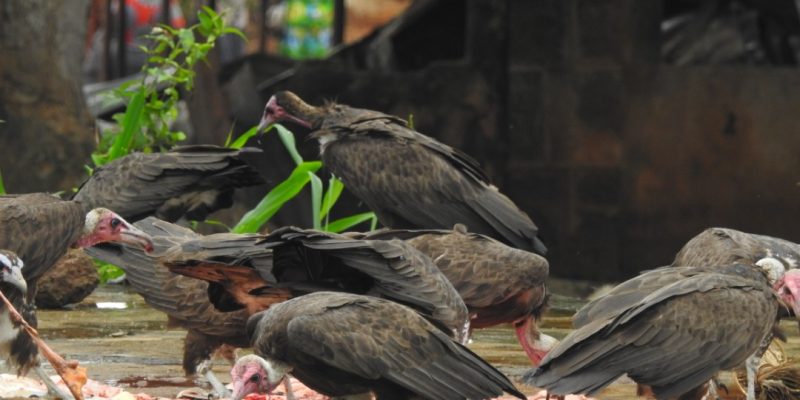
The Nigerian Conservation Foundation called on September 4, 2026 for urgent government action to stop the illegal killing and trade that it says is pushing Nigeria’s vultures toward extinction. Four of the seven vulture species found in the country are Critically Endangered on the IUCN Red List, and one of them has lost an estimated 95 percent of its population since the early 2000s.
The appeal was timed to International Vulture Awareness Day, which falls on the first Saturday in September. It is not a celebration piece. The Foundation’s argument is that Nigeria has become the place where West Africa’s vultures are sold.
Which birds are in trouble
The four Critically Endangered species are the Hooded Vulture, the White-backed Vulture, Ruppell’s Vulture and the White-headed Vulture. The Foundation singles out the Hooded Vulture, Necrosyrtes monachus, as the most serious case. It was once an ordinary sight around Nigerian cities and abattoirs, and the Foundation puts its decline at roughly 95 percent since the early 2000s.
Those four categories match the Red List rather than overstating it, which is worth saying because it does not always go that way. Across Africa as a whole, the Foundation cites declines of between 80 and 97 percent over the past five decades.
Why Nigeria specifically
Because the birds move through it. The Foundation cites research indicating that an estimated 73 percent of vulture carcasses traded across West Africa pass through Nigerian markets. The West African Vulture Conservation Action Plan, known as WAVCAP, names Nigeria and Benin as the key hubs for cross-border trade in vulture parts, and cases of killing for belief-based use have been reported across all sixteen countries the plan covers.
That makes it a regional problem with a Nigerian address. The Foundation is asking the Federal Government for three things: stronger enforcement of existing wildlife law and closer monitoring of the markets involved, actual implementation of WAVCAP, and the establishment of Vulture Safe Zones with measures against poisoning that protect key feeding and breeding areas.
“The crisis facing vultures is not happening somewhere far away. Nigeria is at the centre of this regional conservation challenge, including the illegal trade in vulture parts,” said Dr. Joseph Onoja, Director General of the Nigerian Conservation Foundation. “We cannot continue to lose these birds to poisoning, illegal killing and trafficking and expect our ecosystems to remain healthy.”
The Foundation’s own work runs to satellite tagging, population surveys, conservation education and community engagement, and it has been talking to traditional medicine practitioners about plant-based alternatives to vulture parts. Onoja has said elsewhere that this outreach has had some success and that expanding it needs more money.
We went looking for the zoo money
Accredited zoos do fund African vulture conservation, and they do it through a program with a name and a leader. African Vultures was proposed as an Association of Zoos and Aquariums SAFE program in February 2017 by Denver Zoo, North Carolina Zoo and San Diego Zoo Global, and was accepted that August. Its published action plan lists Corinne Kendall of North Carolina Zoo as program leader and Molly Maloy of Denver Zoo as vice program leader, with a steering committee drawn from Cheyenne Mountain Zoo, Dallas Zoo, St. Augustine Alligator Farm Zoological Park, Zoo Atlanta, Santa Barbara Zoo, NC Aquarium at Pine Knoll Shores, Detroit Zoo, Toronto Zoo and Tracy Aviary. The Hooded, Ruppell’s, White-backed and White-headed vultures are all on its target list.
The map is the problem. That plan puts its focus on Kenya, South Africa and Tanzania, and where it names countries for expansion it lists Angola, Mozambique, Namibia, Uganda, Zambia, Ethiopia and Zimbabwe. Nigeria is not among them, and neither is any other West African country.
So the honest finding is a negative one. We looked for an accredited zoo or aquarium funding the vulture work the Nigerian Conservation Foundation is describing, and we did not find one. The organizations that appear alongside it on this beat are BirdLife International, the International Bird Conservation Partnership, the Peregrine Fund and the CMS Raptors MOU, none of which is a zoo. The zoo sector’s African vulture money is real and it is substantial, and on the published evidence it stops well short of Lagos.
For scale on the sector as a whole, AZA reports that 235 accredited and certified facilities spent approximately $372.4 million on conservation across 139 countries in 2025. No published breakdown isolates how much of that reached Africa, let alone West Africa, so any figure at that level would be invented.
What vultures are actually for
They are the clean-up. By stripping carcasses and organic waste quickly, vultures limit the spread of disease from dead animals to people and to other wildlife. The Foundation makes the point that the birds are widely disliked because they are associated with death, which gets the relationship backward: they are the reason a carcass does not sit there.
European zoos have been running the other half of this story for years, releasing captive-bred birds into ranges where the wild population collapsed. In August a cinereous vulture named Aleksi went from ZOO Planckendael into the mountains of Bulgaria. Nigeria’s problem is not a shortage of birds to release. It is that the ones already flying are worth more dead in a market than alive in the sky, and no captive-breeding program fixes that.
The full appeal is published by the Nigerian Conservation Foundation.
Quick answers
- How many of Nigeria's vultures are Critically Endangered?
Four of the seven species found in the country: the Hooded Vulture, the White-backed Vulture, Ruppell's Vulture and the White-headed Vulture. The Nigerian Conservation Foundation's categories match the IUCN Red List.
- Why is Nigeria central to the West African vulture trade?
The Foundation cites research indicating that an estimated 73 percent of vulture carcasses traded across West Africa pass through Nigerian markets. WAVCAP names Nigeria and Benin as the key cross-border hubs.
- What is the Foundation asking for?
Three things: stronger enforcement of existing wildlife law with closer market monitoring, implementation of the West African Vulture Conservation Action Plan, and Vulture Safe Zones with anti-poisoning measures.
- Do accredited zoos fund vulture conservation in Nigeria?
We could not verify any that do. The AZA SAFE African Vultures program, led by North Carolina Zoo, focuses on Kenya, South Africa and Tanzania and names no West African country among its expansion priorities.