
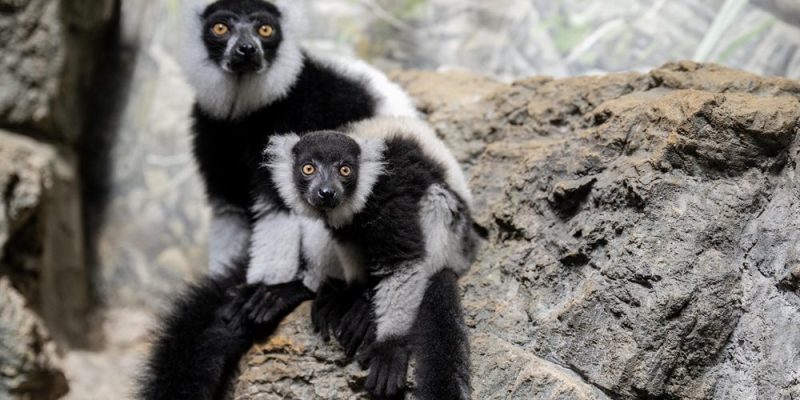
Central Park Zoo has debuted twin critically endangered black-and-white ruffed lemurs. The fraternal pair, a male named Maso and a female named Tonga, were born April 5, 2026 and went on view in July.
An SSP birth in the middle of Manhattan
The breeding was recommended under the black-and-white ruffed lemur Species Survival Plan, the AZA-managed program that maintains genetic viability across accredited institutions. Central Park Zoo first acquired the species in 2008, and eight black-and-white ruffed lemurs have been born there since.
The species is native to the tropical rainforests of eastern Madagascar and is listed as Critically Endangered by the IUCN Red List. Wild populations have fallen by at least 80 percent over three generations, driven by habitat loss and poaching.
Lemur births are having a good year at American institutions: the Tennessee Aquarium recorded its first lemur birth ever weeks later.
Ruffed lemurs do parenting differently
Two things make this species unusual among primates, and both are on display in the Central Park Zoo habitat.
The first is the litter. Most lemurs have single infants; ruffed lemurs typically produce multi-infant litters, which is why twins here are normal rather than remarkable.
The second is what the mother does with them. Most primates carry their young on their body. Ruffed lemur mothers instead build nests high in the tree canopy and park their pups there while they go off to explore and forage. It is a genuinely different strategy, and it means a visitor watching the habitat may see an adult moving alone while the pups sit elsewhere entirely.
Ruffed lemurs also stand out among primates for being uniquely matriarchal, with complex social hierarchies led by females.
Where to find them
Maso and Tonga are on view at the Central Park Zoo, which sits inside the park at Fifth Avenue and 64th Street, one of the more improbable places in North America to stand a few feet from a critically endangered Madagascan primate on a lunch break.
Black-and-white ruffed lemurs are loud, and they are worth waiting out. The species has one of the most striking alarm calls of any lemur, and a troop that decides to use it is not something a visitor forgets.