
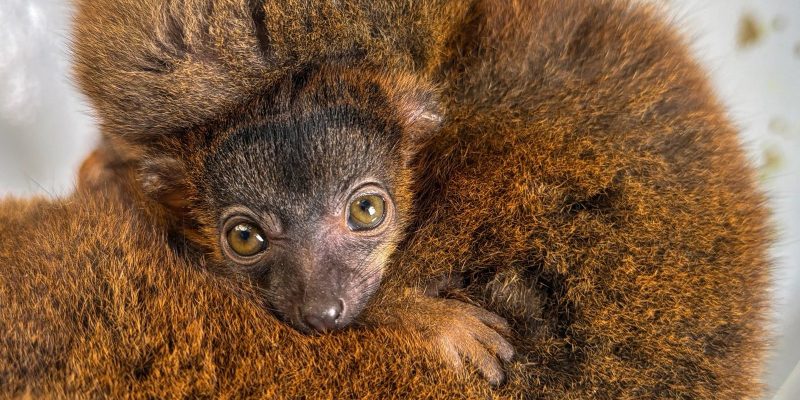
The Tennessee Aquarium has raised turtles, fish, lizards and penguins for decades. In April 2026 it added a mammal to that list for the first time: a red-collared brown lemur, now named Soleil, born in the Chattanooga aquarium’s Lemur Forest exhibit to first-time parents Kintana and John.
Nobody knew she was coming
Kintana and John were seen breeding late in 2025, but red-collared brown lemurs show almost no outward physical change during pregnancy, and confirming one would have meant putting Kintana under general anesthesia, a risk the aquarium’s team judged unnecessary. So they prepared, waited, and did not actually know.
On April 23, 2026, senior animal care specialist Sam Grote was delivering an early-afternoon snack when the question answered itself.
“I saw an arm sticking out, an additional limb that was not there prior, so that was very much a case of ‘OK, this is happening,'” Grote recalled, laughing. “It was very much a big surprise.”
Seven minutes later the baby had been delivered.
Why a first birth took nine years
Lemur Forest opened in March 2017 with ring-tailed and red-ruffed lemurs; the first pair of red-collared browns arrived in 2019. The habitat’s backup facilities were designed from the start with breeding and infant care in mind.
“This is something that we have worked for since lemurs arrived here,” said Maggie Sipe, lead animal care specialist for Ocean Journey. “We’re very proud and emotional about it, and it’s really fun to have come this far and finally see it happen.”
The team took a deliberately hands-off approach in the early days rather than separating the infant from its parents for a checkup, watching behavior from a distance instead.
“They’re just a big, happy family,” said Dr. Chris Keller, the aquarium’s director of animal health. “As a veterinarian, it’s hard to stand back and watch a young mother figuring things out as she learns to take care of a baby, but in this case, she’s been doing a great job.”
Chattanooga’s aquarium has a long record with small, difficult species; it also runs a turtle breeding program that hatched seven species in one season.
A rare animal, deliberately
Red-collared brown lemurs are found only in Madagascar, are classified as endangered by the IUCN, and are rarely exhibited. The entire population in American human care is 51 individuals across 14 AZA-accredited facilities. For comparison, more than 600 ring-tailed lemurs live at AZA institutions.
Six red-collared browns were born at AZA facilities in 2026, which Sipe called a baby boom. When the aquarium’s first collared lemurs arrived, only about 30 were in human care anywhere in the country.
“One of our goals is to work with unique animals, species that people don’t see very often,” said curator of forests Kevin Calhoon. “This is just another example of a very special species of animal people don’t see very often. And when they’re breeding, you can’t ask for more.”
Can visitors see Soleil?
Yes. The name, French for “sun,” came out of a public vote announced at a baby shower on July 9, 2026. She is female, and by late summer the aquarium was describing her as a bounding bundle of energy who can often be seen in Lemur Forest working out what acrobatic mischief she can get away with while testing the patience of Kintana and John.
Lemur Forest is in the Ocean Journey building. If you go, give the habitat more than a passing glance: a young lemur that has graduated from clinging to her mother’s belly to riding on her back to running the place is a genuinely good thing to stand and watch.