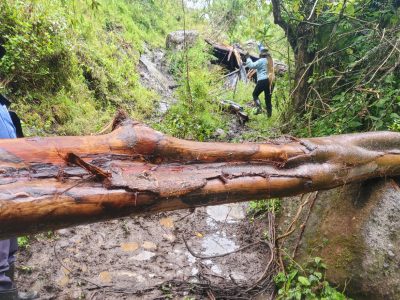

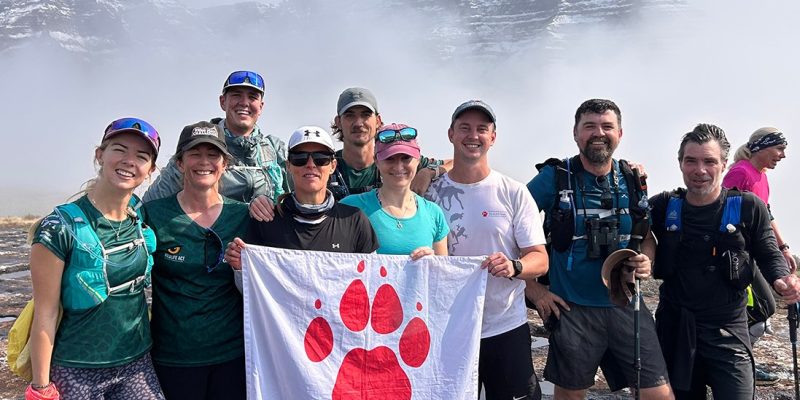
Thirty people gathered at a hotel in the Underberg in September, in cold, wet, windy weather, intending to climb Rhino Peak in the southern Drakensberg. For the second year running they did not get up it. The river crossing was too dangerous, the peak itself was under snow, and the race director spent the early morning marking an alternative route up a different summit.
They still raised R1.2 million.
What the Rhino Peak Challenge is
It is an eleven-year-old fundraising climb rather than a race, run by Spurgeon Flemington of Running Man Adventures. Participants sign on as ambassadors and each commits to a minimum target of R20,000, raised before they arrive. The Endangered Wildlife Trust’s account of the 2026 edition says every ambassador hit that minimum and some went well past it, in a year with fewer ambassadors than usual.
The money is split between three beneficiaries: the Bearded Vulture Recovery Program, Wildlife ACT and the Endangered Wildlife Trust. Chris Kelly of Wildlife ACT was the one who stood at the start line on the Saturday morning and told the field the river could not be crossed.
The 2027 date is already set for September 18.
The bird at the end of the money
The Bearded Vulture is the reason the Drakensberg is the venue rather than a scenic choice. The southern African population of Gypaetus barbatus is confined entirely to the Maloti-Drakensberg mountains that straddle South Africa and Lesotho, and Wildlife ACT puts what is left at 50 to 100 breeding pairs. It treats the bird as regionally Critically Endangered.
Two things are worth separating here, because they get run together constantly. A regional assessment and the global Red List are different documents with different vocabularies, and a species can be common somewhere and nearly gone in one mountain range. The figures above are the southern African ones, published by Wildlife ACT. We did not open the current global assessment for this piece and are not going to characterize it from memory.
Bearded Vultures are unusual animals to raise money for. They are the vulture that eats bone, which is most of the diet, and they carry large bones into the air and drop them onto rock to break them. They are slow breeders in a landscape with power lines, poisoned carcasses and a long history of persecution. A population of 50 to 100 pairs does not recover quickly from anything.
Which zoo funds this
Essentially none, with one honest qualification that does not add up to a hub.
The event’s own named sponsors are Running Man Adventures, the Ford Wildlife Foundation and Kula bars. No zoo, aquarium or zoological society is among them. Of the three beneficiaries, only Wildlife ACT publishes a zoo on its partners page: Happy Hollow Park and Zoo, the AZA-accredited municipal zoo in San Jose, California, which it says supports the protection and recovery of Africa’s most threatened species.
That is a real relationship and it is two steps away from this climb. Happy Hollow funds Wildlife ACT, which is one of three beneficiaries of a hike organized by somebody else. It did not fund the Rhino Peak Challenge, and we are naming it because it is the only zoological institution anywhere in the chain, not because it belongs to this story. We have made the same call before, most recently when the International Crane Foundation turned up on a funding line for South African lizard habitat and its actual partnership was about cranes.
The Association of Zoos and Aquariums reports that in 2025 its 235 accredited and certified facilities spent approximately $372.4 million on conservation across 139 countries. No published breakdown isolates the African share of it, and we will not estimate one. R1.2 million is roughly $69,000 at current rates. It came from thirty people asking their friends.
Two years, two diverted routes
There is a small, unglamorous point in the EWT’s write-up that is easy to skip. This is the second consecutive year the field could not reach Rhino Peak, and the challenge raised its money anyway, because the fundraising is done before anyone laces a boot. The climb is the occasion, not the mechanism.
That is a sturdier design than it looks. An event that depends on summiting a 3,000-meter peak in a Drakensberg spring would lose its funding every time the weather turned. This one does not.
We wrote last week about the same organization racing to a mass vulture poisoning in Limpopo. Different species, different province, same balance sheet, and the same answer when you ask which zoo paid.
Source: the Endangered Wildlife Trust’s “Rhino Peak Challenge 2026: Conquering the Berg for Conservation”, published September 29, 2026; and Wildlife ACT’s published partners and vulture species pages.
Quick answers
- What is the Rhino Peak Challenge?
An eleven-year-old fundraising climb in the southern Drakensberg, run by Spurgeon Flemington of Running Man Adventures. Participants sign on as ambassadors and each commits to raising a minimum of 20,000 rand before the weekend. It is explicitly not a competitive race.
- How much did the 2026 edition raise?
1.2 million rand, roughly $69,000 at current rates, from thirty ambassadors. The Endangered Wildlife Trust says every ambassador reached the 20,000 rand minimum and some went well beyond it, in a year with fewer participants than usual. The money is split between the Bearded Vulture Recovery Programme, Wildlife ACT and the EWT.
- Did they reach the summit?
No, for the second consecutive year. The river crossing was judged too dangerous, Rhino Peak itself was under snow, and the race director marked an alternative route to a different summit early that morning. Because the fundraising is completed before anyone arrives, the weather does not touch the money.
- How threatened is the Bearded Vulture in southern Africa?
Wildlife ACT treats the southern African population as regionally Critically Endangered and puts what remains at 50 to 100 breeding pairs, confined entirely to the Maloti-Drakensberg mountains of South Africa and Lesotho. Those are regional figures. A regional assessment and the global Red List are separate documents, and we did not open the current global assessment for this piece.
- What is unusual about the species?
Bone is most of its diet. Bearded Vultures carry large bones into the air and drop them onto rock to break them open. They breed slowly, which means a population of 50 to 100 pairs recovers slowly from poisoning, power line collisions and the long history of persecution in the range.
- Which zoo funds this?
None that we can attach to the event. Its named sponsors are Running Man Adventures, the Ford Wildlife Foundation and Kula bars, none of them zoological. Of the three beneficiaries only Wildlife ACT publishes a zoo partner, Happy Hollow Park and Zoo in San Jose, California, which is AZA-accredited. That is a relationship with one beneficiary, two steps from this climb, and we name it rather than claim it.