
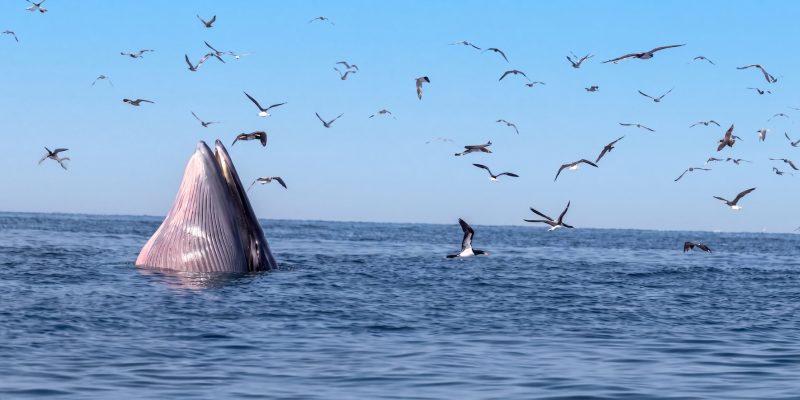
On August 18, 2026, a survey team from Saudi Arabia’s National Center for Wildlife watched a Bryde’s whale feeding off Khor Zaffaf, on the western edge of the Farasan Islands Reserve in the Red Sea. That sighting was not the news by itself. The news is that it was the latest entry in a run of sightings going back to May 2023, and that the pattern in those records has started to say something useful.
What three years of patrol records add up to
The Center published its account on August 20, 2026. Its monitoring teams have logged repeated Bryde’s whale sightings inside the reserve during routine marine patrols, and the accumulated data shows two things that a single encounter never could. The whales turn up at particular times of year, concentrated in July, August, September and October. And they turn up in particular places, with a cluster of records in a fairly tight band to the south and west of the reserve.
Dr. Mohammed Ali Qurban, the Center’s chief executive, said the value of that repetition is that it converts scattered encounters into field data: a more accurate picture of where and when the animals reliably appear, which is what management decisions can actually be built on. He added that the pattern strengthens the case for Farasan as a site for a seasonal whale-watching experience, and that experiences of that kind have to be built on knowing the species, the locations and the timing first. The Center published in Arabic and used reported speech rather than direct quotation; the wording above is our paraphrase of the original.
It is a modest claim, carefully made, and that is what makes it worth reporting. Nobody is announcing a discovery. A government agency is saying that after three years of driving boats around a reserve and writing down what it saw, it now knows roughly when to look.
Which is the Bryde’s whale, exactly?
Bryde’s whale, pronounced roughly “broo-dus,” is a tropical and subtropical baleen whale that does something most of its relatives do not: it stays in warm water year round instead of commuting to the poles to feed. That is why one turns up mid-meal off a Red Sea island in August. The animal in the Center’s photograph is lunge feeding, throat pleats flared at the surface with a cloud of seabirds working the same patch of fish.
The species is also a long-running taxonomic argument. What gets called Balaenoptera edeni has at various points been treated as one species, two, or a complex of forms that look alike and do not necessarily interbreed, and Red List assessors have had to work around that. The IUCN Red List currently lists Bryde’s whale as Least Concern, assessed in 2018 by the IUCN Species Survival Commission’s Cetacean Specialist Group. Before that update it sat as Data Deficient, which is the Red List’s way of saying nobody had enough information to place it. Moving off Data Deficient is not the same as a population recovering. It means somebody finally counted.
That is a useful frame for what the Farasan records are. A Least Concern global listing tells you very little about any particular sea, and the Red Sea’s whales are among the least documented in the species’ range. Patrol logs of the kind the Center has been keeping are how a Data Deficient corner of a map stops being deficient.
Is there zoo money behind this?
We check every conservation story in this region for the accredited zoos and aquariums funding it, because in this part of the world the funder is very often an institution in North America or Europe that never appears in the press release. On this one, we looked and we did not find any.
The National Center for Wildlife is a Saudi government body, and the monitoring described here is its own staff on its own patrols inside a reserve it manages. No zoo, aquarium or zoological society appears in the announcement, and we found none named as a partner on the Center’s marine conservation work. That is a real answer rather than a gap in our reporting, and it is worth stating plainly: the whale survey work in the Farasan Islands is publicly funded, domestically staffed, and owes nothing to anyone’s gate receipts.
It also makes a quiet point about what accredited institutions are and are not for. Zoos and aquariums underwrite an enormous amount of field conservation, and we have spent a lot of ink tracing it, including ten years of aerial survey flights over North Atlantic right whales that an aquarium paid for. But a wealthy state agency doing patient baseline monitoring in its own waters is a different and equally necessary model, and there is no version of whale conservation that does not need somebody counting.
The Farasan Islands sit in the southern Red Sea off Jazan, an archipelago of low coral islands that is already one of Saudi Arabia’s designated protected areas. If the Center is right that the whales come back to the same waters in the same months, the next thing to watch is whether anyone gets to go out and see them.
Source: the National Center for Wildlife, Bryde’s whale sightings reinforce the importance of the Farasan Islands Reserve among wildlife destinations, published August 20, 2026, in Arabic. Red List category from the IUCN Species Survival Commission Cetacean Specialist Group’s 2018 baleen whale assessments.
Quick answers
- What did Saudi Arabia's National Center for Wildlife report?
Repeated Bryde's whale sightings inside the Farasan Islands Reserve from May 2023 to August 2026, logged during routine marine patrols. The most recent was on August 18, 2026, off Khor Zaffaf on the western edge of the reserve.
- When do Bryde's whales appear at the Farasan Islands?
The Center's cumulative records concentrate in July, August, September and October, with a cluster of sightings in a fairly tight band to the south and west of the reserve.
- Is the Bryde's whale endangered?
No. The IUCN Red List lists Bryde's whale as Least Concern, assessed in 2018 by the IUCN Species Survival Commission's Cetacean Specialist Group. It was previously Data Deficient, meaning there had not been enough information to place it.
- Do any accredited zoos or aquariums fund this work?
We looked and did not find any. The National Center for Wildlife is a Saudi government body and the monitoring is its own staff on its own patrols. No zoo, aquarium or zoological society is named in the announcement or on the Center's marine conservation pages.