
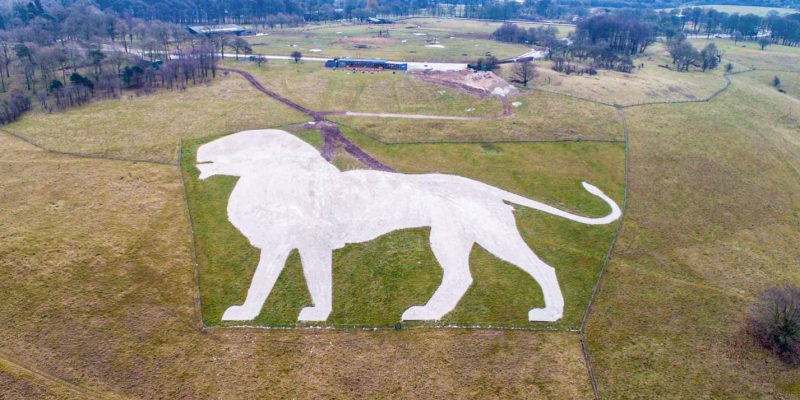
Whipsnade Zoo will light its chalk White Lion on September 23, 2026, the autumn equinox. It will be only the third time the hillside figure has been illuminated since it was cut in 1933, and the first in 45 years.
The lighting marks the bicentenary of the Zoological Society of London, the conservation charity founded in 1828 that runs both Whipsnade Zoo in Bedfordshire and London Zoo.
How big is the White Lion?
The figure measures 147 meters from nose to tail, roughly 482 feet, and covers 6,500 square meters of hillside, about an acre and a half. It was cut into the chalk of the Dunstable Downs in 1933, and it is visible for miles across the Bedfordshire countryside.
It has been lit twice before, both times for anniversaries of the zoo itself: in 1952 for its 21st, and in 1981 for its 50th.
“The White Lion has watched over Whipsnade, the surrounding countryside and its wildlife for generations and we know how much it means to everyone in the community.”
Owen Craft, Director of Zoo Operations at Whipsnade Zoo
Who gets to switch it on
Whipsnade opened a competition for one local resident to join staff and volunteers at the sunset ceremony and light the lion. Entry was limited to residents of Bedfordshire, Buckinghamshire and Hertfordshire, and the winner is being drawn at random by the zoo’s lion keepers.
Entries opened on August 19 and closed on September 2, 2026, so the competition itself is no longer open. The lighting is still ahead, on September 23.
Why a chalk figure matters to a zoo
Britain has a long tradition of hill figures cut through turf into the chalk beneath, most of them centuries or millennia old. The Whipsnade lion is a modern entry in that tradition, and an unusual one in that it was made as advertising: a zoo announcing itself to the landscape in the years it was finding its feet.
Ninety-three years later the same figure is being used to mark two centuries of the organization that cut it. ZSL was founded in 1828 as a scientific society, and London Zoo followed the same year. Whipsnade opened in 1931 on the then novel idea that animals should be kept on open acreage rather than in city-center cages, and it remains one of the largest zoos in Britain.
ZSL has been marking the bicentenary across both sites through 2026. King Charles III and Queen Camilla visited London Zoo in July, and in June the charity took a Guinness World Records title for a painting-by-numbers artwork with more than 14,000 contributors.
It is a strong season for illuminated evenings at British zoos. Edinburgh Zoo is running Giant Lanterns: Space Safari this winter, and on the continent Tiergarten Schonbrunn recently reopened its restored Engelstor, another case of a historic zoo feature being brought back into use rather than replaced.
Source: Whipsnade Zoo, August 19, 2026.
Quick answers
- When will Whipsnade's chalk White Lion be lit?
September 23, 2026, the autumn equinox, at sunset. It marks the bicentenary of the Zoological Society of London, founded in 1828.
- How many times has the White Lion been illuminated?
Twice before. In 1952 for the zoo's 21st anniversary and in 1981 for its 50th. The 2026 lighting is the third, and the first in 45 years.
- How big is the White Lion?
147 meters from nose to tail, roughly 482 feet, covering 6,500 square meters of hillside. It was cut into the chalk in 1933.
- Can I still enter the competition to switch it on?
No. Entry was open to residents of Bedfordshire, Buckinghamshire and Hertfordshire from August 19 to September 2, 2026, and has closed. The winner is drawn at random by the zoo's lion keepers.