
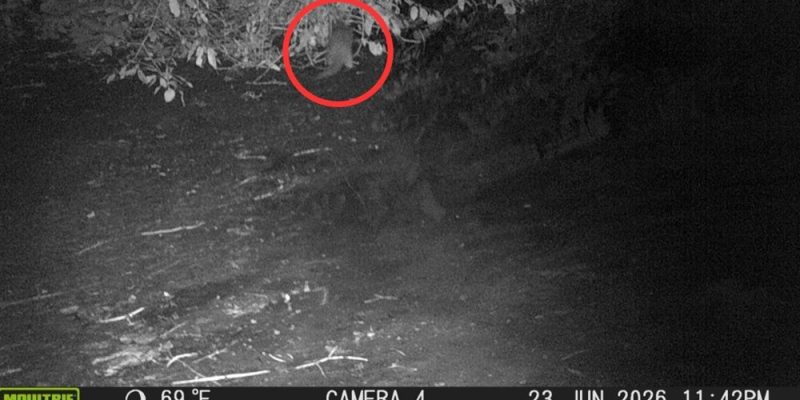
A North American river otter has been photographed along the Bronx River, the first documented in the Bronx in roughly 100 years. The Bronx Zoo announced the sighting on August 19, 2026, and it is being read as evidence that decades of work on one of New York City’s most abused waterways has actually paid off.
Camera 4, 11:42 p.m.
The animal was caught by a motion-activated camera set by local scientist RJ Hawkins, working under the Wildlife Conservation Society’s Education Department, which is based at the Bronx Zoo. Hawkins is a graduate of the Miami University of Ohio Advanced Inquiry Program hosted at the zoo, and captured the image during long-term camera-trap monitoring along the river.
The image itself is a grainy black-and-white night frame with a timestamp in the corner. It is not a beautiful photograph. It is a decisive one.
“When I first reviewed the images, I could hardly believe what I was seeing,” Hawkins said. “Knowing this may be the first documented river otter in the Bronx in generations was an incredible moment. It shows why long-term wildlife monitoring and environmental restoration efforts matter.”
WCS has had a strong run in New York this year; its Central Park Zoo also debuted twin critically endangered ruffed lemurs.
Why an otter is the measure
River otters once ranged across New York’s waterways and vanished from much of it through pollution, habitat degradation and unregulated trapping. They are now treated as indicators of healthy freshwater ecosystems, which is what makes this particular animal worth a press release: an otter does not move into a river it cannot feed itself in.
“There are moments in conservation that remind us why this work matters, and this is one of them,” said Craig Piper, WCS’s interim executive vice president of zoos and aquarium and director of the Bronx Zoo. “Thanks to a broad coalition of public and private partners, we can celebrate the return of an otter as a result of decades of restoration work to provide cleaner water and healthier habitat. It’s a win for both wildlife and people.”
The zoo’s other river
Worth remembering where this happened. The Bronx River runs through the Bronx Zoo itself, and the stretch of restored waterway that produced this photograph is the same river visitors cross on their way to the animals. Long-term camera monitoring of a city river is not the kind of work that draws crowds, and it just produced the single most encouraging wildlife result New York City has had in a century.
Quick answers
- What was found along the Bronx River?
A North American river otter was photographed by a motion-activated camera, the first documented in the Bronx in roughly 100 years. The Bronx Zoo announced the sighting on August 19, 2026.
- Who took the photograph?
Local scientist RJ Hawkins, working under the Wildlife Conservation Society's Education Department, which is based at the Bronx Zoo. He captured the image during long-term camera-trap monitoring along the river.
- Why does a single otter matter?
River otters once ranged across New York's waterways and vanished from much of it through pollution, habitat degradation and unregulated trapping. They are now treated as indicators of healthy freshwater ecosystems, so one returning is read as evidence that decades of restoration work on the river have paid off.