
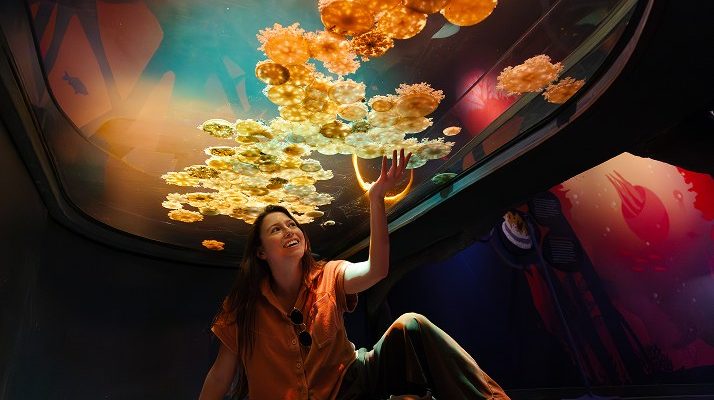
SeaWorld San Diego opened Jewels of the Sea: The Jellyfish Experience on March 15, 2025, the first dedicated jellyfish aquarium at any SeaWorld park and one of the few American exhibits built entirely around animals that have no brain, no blood and no bones.
It runs as three galleries, and the sequence is doing something deliberate: it starts with biology, moves to the animals at scale, and ends inside a room that stops pretending to be an aquarium at all.
Realm of Jellies
The first gallery is subtitled “A Story of Water and Light,” which is close to a literal description of jellyfish husbandry.
Guests meet upside-down jellies, which lie bell-down on the bottom and farm algae in their tissues rather than hunting, and a cascading water globe of moon jellies. There are displays on anatomy and life cycle, and, more unusually, a window into the propagation area where the park grows its own.
That last part is the exhibit’s real foundation. These jellies were cultured on site rather than collected from the ocean. A moon jelly spends part of its life as a polyp fixed to a surface, and under the right conditions a polyp buds off stacks of tiny discs that swim away and become the adults visitors recognize. A facility that can run that cycle never needs to take an animal from the ocean, and SeaWorld says its jellies come through a conservation-focused propagation program.
The Jellyfish Passage
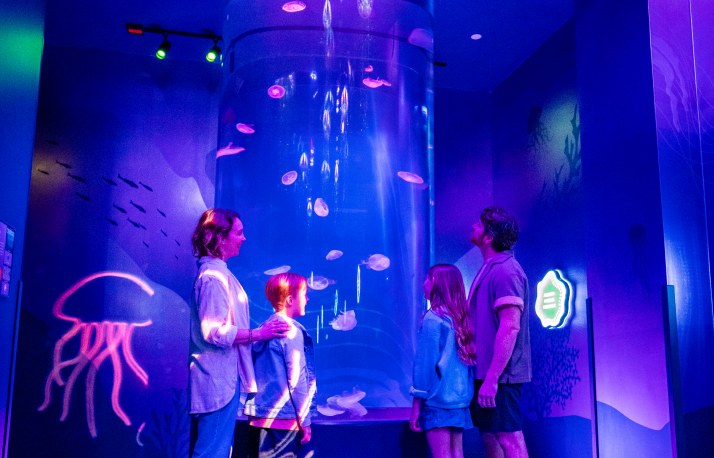
The middle gallery is the one people photograph. A living archway about ten feet tall, filled with moon jellies, arcs over the walkway so visitors pass underneath them. Beyond it stands a 14-foot cylinder that SeaWorld describes as one of the tallest jellyfish aquariums in the country.
When the exhibit was announced in September 2023 for a 2024 opening, the release promised an 18-foot cylinder. What opened in March 2025 is 14 feet. Attractions change between announcement and ribbon; the delivered tank is still among the largest of its kind in the United States.
Other habitats along the passage hold Pacific sea nettles, the long-tentacled orange species familiar from the California coast, and comb jellies.
Why the tanks are round
The habitats have circular sections at their centers that push the water into a slow rotating current. This is not decoration, and it is the single most important thing about keeping jellyfish alive.
A jellyfish cannot swim against a current or push itself off a wall. In a conventional square tank with a corner intake, animals get drawn against the filter screen and shred. The circular-flow design, worked out decades ago and refined since, keeps them suspended in a gentle rotation so they drift without ever contacting anything hard. Every jellyfish display in the world depends on some version of it.
It also has to be tuned per species, which is why a gallery like this one is harder than its water volume suggests. Moon jellies, sea nettles and upside-down jellies do not want the same flow rate or the same temperature, and the upside-down jellies barely want flow at all, since they spend their lives lying on the bottom with their algae turned toward the light. A room of jellyfish habitats is not one system with several windows. It is several systems sharing a wall, each one dialed to an animal that will tell you it is wrong only by slowly coming apart.
Medusa Gallery
The last room has LED panels across the walls and ceiling running a 360-degree sequence, alongside panoramic windows showing moon jellies at different life stages.
The bioluminescence content is where the exhibit quietly corrects a common confusion: most of what glows in the deep ocean is not a jellyfish, and much of what people call a jellyfish is not one either. Comb jellies, on display here, are ctenophores, a separate phylum. They do not sting. The rainbow that runs along their bodies is not bioluminescence at all but light diffracting off rows of beating cilia.
What the exhibit is for
Aquarists work inside the exhibit rather than behind it, which is a design choice about who the audience talks to. The same park’s rescue team released a cold-stunned loggerhead off the San Diego coast in 2024 after a rehabilitation that started in British Columbia.
“Visiting the new Jellyfish Experience is an amazing opportunity like no other, a chance for our guests to see up close the spectacular details of these underwater marvels and witness how they live their lives in astonishing clarity,” said Dr. Chris Dold, chief zoological officer of SeaWorld Parks & Entertainment, when the project was announced.
“This exhibit represents a true milestone for SeaWorld, showcasing our commitment to innovation, conservation and education,” said Tyler Carter, president of SeaWorld San Diego, on the opening.
Go see it
Jewels of the Sea is, straightforwardly, one of the loveliest rooms in any American aquarium. Moon jellies drifting over your head in an archway you walk under. A cylinder two storeys of nothing but slow gold light. A gallery that goes dark and then goes electric.
Take your time in the first room, though, because that is where the surprise is: the propagation window, where the animals in every tank around you were grown from polyps the size of a pinhead. Most aquariums keep that behind a staff door. Standing in front of it changes what the rest of the exhibit means.
These are among the oldest animals still in the ocean, they have been doing this for something like 500 million years, and SeaWorld San Diego has built them a very beautiful place to do it in.