
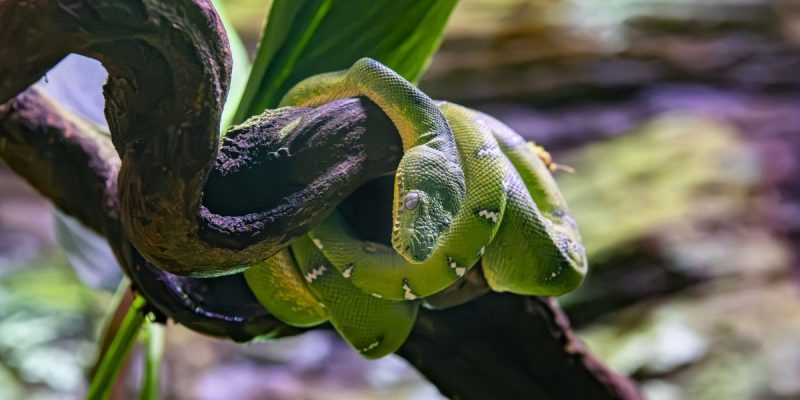
The Milwaukee County Zoo has an emerald tree boa on exhibit for the first time. Ziggy, three years old, arrived from the National Mississippi River Museum & Aquarium in Dubuque in late May, cleared the zoo’s standard 90-day reptile quarantine, and is now publicly viewable in the Aquatic & Reptile Center. It is a new species for the collection.
Ziggy’s sex is not currently known, which is ordinary for a snake and harder to resolve than most visitors assume. The zoo’s animal care team describes the animal as very easy-going.
The color is the thing to know
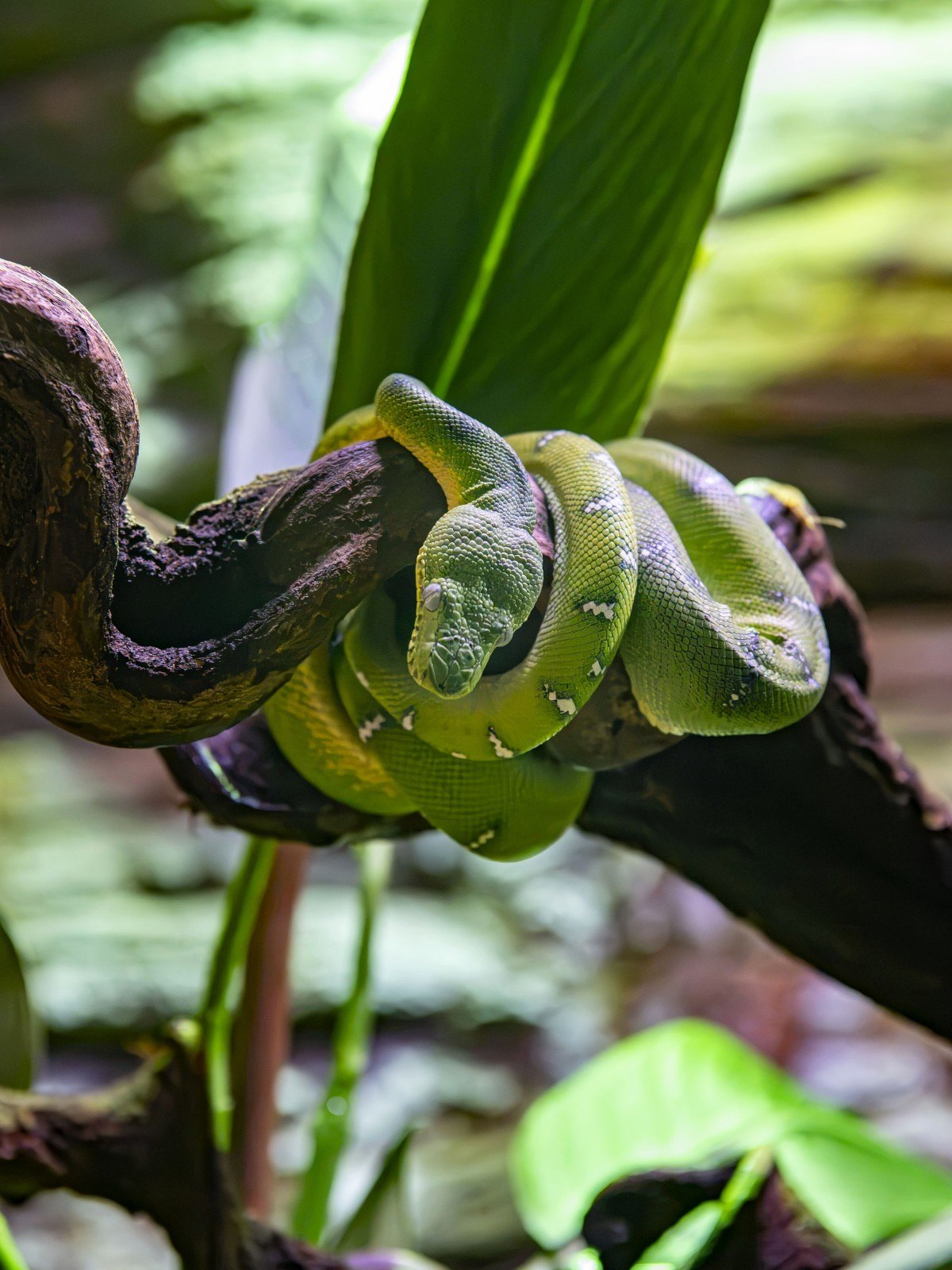
An adult emerald tree boa is a startling green with a broken row of white markings down the spine, which reads as decoration in a zoo habitat and is camouflage in a South American rainforest canopy. Draped in flat coils over a branch, a green snake in green leaves at thirty feet is effectively invisible from below.
The animals do not start that way. Emerald tree boas are born red to yellow-orange and turn green inside their first year. A young boa lives lower in the forest, in the understory where the light is browner and the leaf litter is not green at all, and the color change tracks the move upward into the canopy. It is one of the clearest cases in the reptile world of an animal wearing the habitat it currently occupies rather than the one its species is named for.
Built for a branch
The posture is as specialized as the color. An emerald tree boa arranges itself in even coils across a horizontal branch and anchors with a prehensile tail, meaning a tail that grips rather than merely balances. From there it hunts without leaving the branch, striking down at prey and constricting it while still suspended, which is why the coil is loose and draped rather than tight.
The zoo notes that the species has the largest teeth of any non-venomous snake in the world. The teeth are long and recurved for a specific reason: a snake hanging from a branch has to catch and hold an animal in mid-air with nothing bracing it from below, and it only gets one grip.
On the IUCN Red List, Corallus caninus is assessed as Least Concern, so this is not a conservation story. It is a collection story, and those are worth telling too.
Where to find it
Ziggy shares a habitat with two other residents of the Aquatic & Reptile Center: a red-tailed boa named William Snakespear and an eyelash viper called Gray Worm. Three arboreal snakes in one space is a sensible piece of exhibit design, because it lets a visitor compare three different solutions to the same problem of living in a tree, and it gives the reader of the sign a reason to look twice at each one.
The zoo’s own announcement has the fast facts and a second photograph. Milwaukee has had a good run of additions lately, including a set of scimitar-horned oryx calves earlier this year. Finding Ziggy, though, is the point. Look up, and look for the one piece of green that is the wrong shape for a leaf.
Quick answers
- What is new at the Milwaukee County Zoo?
Ziggy, an emerald tree boa, is now publicly viewable in the Aquatic & Reptile Center. The emerald tree boa is a new species for the collection.
- Where did Ziggy come from?
The National Mississippi River Museum & Aquarium in Dubuque, Iowa, in late May 2026. Ziggy then went through the zoo's standard 90-day quarantine period for reptiles before going on view.
- Why are emerald tree boas born orange?
They are born red to yellow-orange and turn green within their first year. Young boas live lower in the forest understory, where the light and the background are browner, and the color change tracks the move up into the green canopy.
- How does an emerald tree boa hunt?
It arranges itself in even coils over a horizontal branch, anchored by a prehensile tail, and strikes downward at prey, constricting it while still suspended from the branch. The zoo notes the species has the largest teeth of any non-venomous snake in the world.
- Is the species threatened?
No. On the IUCN Red List, Corallus caninus is assessed as Least Concern.
- What else is in the habitat?
Ziggy shares the space with a red-tailed boa named William Snakespear and an eyelash viper called Gray Worm.