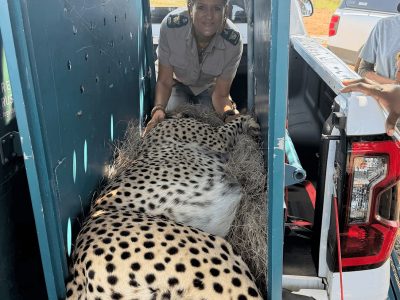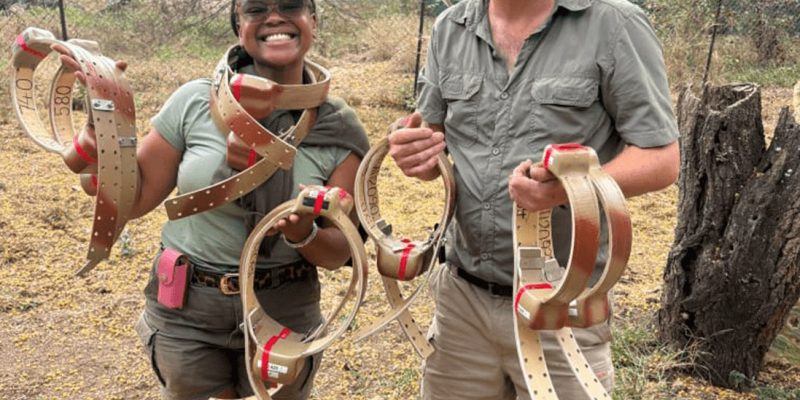
Between 21 and 29 September 2026, a team from the Endangered Wildlife Trust, SANParks and the Greater Kruger Environmental Protection Foundation worked the Nxanatseni North region of Kruger National Park, looking for lions. They found 30, across every age class: adult males and females, sub-adults, juveniles and cubs. A selection of them went home wearing GPS collars.
The operation’s purpose is narrower than a census and more useful. Northern Kruger is losing lions to snaring, poisoning, targeted poaching and conflict with people, and all four of those threats share a property: they happen in particular places, at particular times, to particular animals. A collar is how you find out which.
What a collar tells you that a count does not
The EWT’s project manager for the Carnivore Conservation Unit, Marnus Roodbol, describes the collars as a tool for monitoring movement, survival and behavior across a landscape too large to patrol continuously. The data will build a picture of pride movements, dispersal, habitat use and the survival of individual animals, including lions that have been translocated into the area.
But the sentence worth pulling out is the operational one. Collar data can show when a lion moves into a high-risk area, or when its movement pattern turns unusual, and either signal lets conservation and ranger teams respond in a targeted way rather than a general one. A lion that stops moving is a lion worth driving to. That is the difference between knowing a population is in trouble and being able to do something on the day.
How the lions were processed
Selected animals were processed, branded and fitted with the collars. The EWT thanks SANParks along with the veterinary and field teams who supported the operation, which in practice means darting, examining and releasing large carnivores over nine days in the field.
The release ends on an unglamorous note that is more informative than a clean success line would have been. Not all of the collars deployed during the operation are fully operational yet. The team is working through activation and communication checks to confirm the remaining units are transmitting, and the data starts arriving as each one comes online. Collars fail, and an organization that says so in its own announcement is easier to trust on the numbers it does publish.
Who paid for the collars?
This one has a trace, and it is worth following to the end rather than stopping at the first name.
The EWT thanks Painted Wolf Wines and the Lion Recovery Fund for supporting the GPS collars for the northern Kruger program. The Lion Recovery Fund is run by the Wildlife Conservation Network, and its published supporter list is where the zoological world turns up. Eight accredited institutions appear on it: Cincinnati Zoo and Botanical Garden, Detroit Zoological Society, Heidelberg Zoo, John Ball Zoo, The Living Desert Zoo and Garden, Oklahoma Zoological Society, Reid Park Zoological Society, and the Zoological Society of Buffalo. The Walt Disney Company is on the same list.
So zoo money is in this. What we cannot do is say whose. The Lion Recovery Fund pools what its donors give and makes grants from the pool, and it publishes no grant-level attribution, so no single institution can be credited with the collars that went onto these lions. Naming one would be a guess dressed as a fact. We have named all eight instead, said what they support, and left it there.
That is a more honest answer than either of the alternatives, and it is also the more interesting one. A pooled fund is how a mid-sized zoo in Michigan or Oklahoma ends up inside a lion operation in northern Kruger at all.
How many lions are left?
The IUCN Red List assesses the lion as Vulnerable under criterion A2c. The current global assessment was carried out on 6 May 2025 by Nicholson and colleagues, and it records a decreasing trend, a severely fragmented population and a continuing decline in mature individuals.
What it does not record is a global population figure. The field is blank. This is worth stating plainly, because the previous global assessment, from February 2023, gave 23,000 mature individuals, and that number is still circulating and is still easy to find. It belongs to an assessment the Red List has superseded. Where the current assessment is silent, we are going to say it is silent rather than reach back for a figure that reads as current and is not.
There is a newer number, from a different instrument. The lion’s IUCN Green Status assessment, completed on 18 September 2024, puts the species recovery score at 30 percent, with a range of 23 to 33 percent. Green Status measures how far a species has come back toward what it could be, rather than how close it is to extinction, and 30 percent is the kind of figure that makes the case for work like this without anybody having to inflate it.
Why northern Kruger
Nxanatseni North sits in the far north of a park that most visitors experience much further south. It is large, it is remote, and the pressures on its lions come from outside its boundaries. Collars do not stop a snare. What they do is tell a ranger team where to be, and turn a park too big to watch into a landscape that can be watched one animal at a time.
The EWT’s work on the other end of the same landscape, counting vulture nests along the Olifants River, runs on the same principle: you cannot protect what you have not measured.
Quick answers
- How many lions were observed in the northern Kruger operation?
Thirty lions were observed between 21 and 29 September 2026 in the Nxanatseni North region of Kruger National Park, including adult males and females, sub-adults, juveniles and cubs.
- Who ran the lion collaring operation?
The Endangered Wildlife Trust ran it with SANParks and the Greater Kruger Environmental Protection Foundation, supported by veterinary and field teams.
- What do the GPS collars actually do?
They let the team track lion movements, survival and behavior remotely, and flag when a lion enters a high-risk area or moves unusually, so ranger teams can respond before a snare or a poisoning takes it.
- What threats do lions in northern Kruger face?
The EWT names snaring, poisoning, targeted poaching and human-wildlife conflict as the increasing threats in that part of the park.
- What is the conservation status of the lion?
The IUCN Red List assesses the lion as Vulnerable. The current global assessment, carried out on 6 May 2025, reports a decreasing and severely fragmented population and publishes no global population figure.
- Which zoos fund this lion monitoring work?
The collars were paid for by Painted Wolf Wines and the Lion Recovery Fund. Eight zoological institutions appear on the Lion Recovery Fund’s own supporter list, but the fund pools donations and credits no single institution with these collars.