Everyone who works on North Atlantic right whales from a boat has noticed the same thing: how the boat moves changes how the whale behaves. Experienced captains hold a slow, steady speed because of it. What nobody had was a way to measure the effect, and this spring a New England Aquarium team went to Cape Cod Bay to find out whether it can be measured at all.
The aquarium published an account of the pilot study on November 2, 2026. It is deliberately a small question, asked first.
Why start with the method
Vessel strikes are one of the two leading causes of injury and death for the species. Of the 70 documented right whale deaths since 2000 where a cause was determined, 30 were vessel strikes.
Working out how to reduce that number means knowing how a whale actually responds to a ship coming at it, and that is tangled. Speed, hull size, propulsion type and whatever the animal happened to be doing beforehand all feed into the response. So the Kraus Marine Mammal Conservation Program did not try to answer the whole thing.
“What our research this spring focused on was assessing whether or not we can actually measure right whale response to vessel approaches in a reliable and objective way,” said Hansen Johnson, a research scientist in the program who leads its right whale fieldwork. “The focus is on establishing that first, and then once we’re confident in this methodological approach we can start adding other variables like engine speed or vessel type.”
How you watch a whale being approached
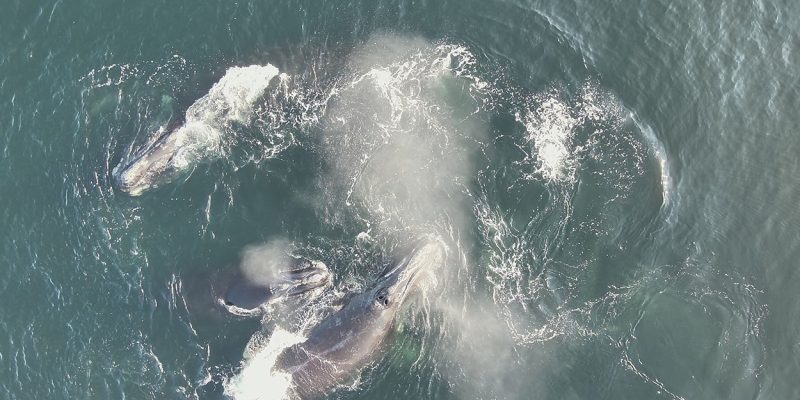
The design borrows from the aquarium’s Ecology, Mapping, and Assessment of Marine Populations team and its senior scientist John Durban, who has spent decades on drone-based photogrammetry. Photogrammetry uses calibrated aerial photographs to measure an animal’s length and width, which converts into an estimate of body condition that can be tracked year over year. Durban also developed spatially explicit photogrammetry, which tags every frame with precise altitude and position so a run of images can be stitched into an objective record of where an animal went, how fast, how sharply it turned and how often it surfaced.
A trial ran like this. Spot a whale at distance. Put a drone up more than 150 feet, high enough that the animal does not know it is there, and film for eight to 10 minutes while nothing is happening. Only then does the research vessel begin a normal photo-identification approach, moving slowly alongside to photograph the callosity pattern that identifies the individual. That takes two to five minutes, with the drone still overhead, and the drone keeps filming for about 10 minutes after the boat pulls away.
Three phases, before and during and after, and the question is whether the movement, breathing and turning differ measurably between them. All of it runs under a federal research permit with strict approach and reporting rules. Without one it is illegal to come within 500 yards of a right whale in United States waters, by boat or by drone.
The second data stream is sound
Underneath, the team dropped custom drifting acoustic recorders that Johnson designed and built in-house and has used since 2025. They log underwater sound levels and their own drifting positions, which captures both what the whales were saying and what they were hearing.
That second part may matter more than the first. “They’re more likely responding to the boat’s noise, rather than being able to see it,” Johnson said. If that is right, the variable worth regulating is not how close a vessel comes but how loud it is while it does.
What the season actually gave them
Cape Cod Bay in spring is usually the best place on the East Coast to find right whales close to shore in weather you can work in. This spring was not usual. “There were fewer whales than usual, and the weather was tough,” Johnson said. The team got six days on the water and completed 12 behavioral response trials, which they count as a good result.
The whales were behaving oddly too: a higher share of mothers with calves than in past years, and almost none of the surface skim feeding that normally defines the bay in spring. Whether that is a trend or a bad April is a question that waits for next season.
Twelve trials should be enough to say whether the method works. The harder problem is natural variability. If a whale’s response to a vessel ranges from nothing at all to an immediate dive, then detecting something subtle, like the effect of a change in engine speed, may need a much larger sample or a different design altogether.
The imagery is not wasted either way. The aerial frames feed the long-term photogrammetry record used to track body condition and pregnancies, and the boat-based photographs go into the North Atlantic Right Whale Catalog, which the program manages and which underpins the population estimate and the tracking of human-caused scarring.
An oil company has been paying for this since 1998
The study was supported by Irving Oil, which is an unusual sentence to write and has a long history behind it. In 1998 the company approached right whale scientists to ask how it could help reduce vessel strikes. In 1999 it funded a vessel strike working group that petitioned to move the Bay of Fundy shipping lanes clear of right whale habitat. The International Maritime Organization approved the change in 2002 and the lanes moved in 2003, which set the precedent for the Boston lane shift in 2007 and the Area to Be Avoided in Roseway Basin off Nova Scotia.
The aquarium’s Anderson Cabot Center for Ocean Life has studied the species since 1980, more than 45 years of fieldwork on distribution, behavior, health and human impacts.
How many are left
The aquarium puts the population at about 380 animals. The IUCN Red List lists Eubalaena glacialis as Critically Endangered under criterion C2a(ii), assessed on January 1, 2020, with a decreasing trend and 200 to 250 mature individuals.
Those two numbers are not in conflict and it is worth being clear about why, because the smaller one gets quoted as a contradiction. The aquarium’s roughly 380 is every living animal of any age, the figure the North Atlantic Right Whale Consortium maintains. The Red List’s 200 to 250 counts only animals capable of reproducing, which is the quantity that governs whether a population can replace itself. Either way the arithmetic is the same and the aquarium states it plainly: at this size, each individual matters to the survival of the species.
The aquarium’s right whale work runs on several fronts at once. In August it published ten years of aerial survey data settling a question about offshore wind, and in October its rescue side put a Kemp’s ridley turtle in a hyperbaric chamber.
Quick answers
- What was the New England Aquarium studying in Cape Cod Bay?
Whether a North Atlantic right whale's response to an approaching vessel can be measured reliably and objectively at all. The spring 2026 pilot deliberately answered the method question before adding variables such as engine speed or vessel type.
- How do researchers measure a whale's reaction to a boat?
A drone is flown more than 150 feet up, high enough that the whale is unaware of it, and films for eight to 10 minutes before anything happens. The research vessel then makes a normal slow photo-identification approach lasting two to five minutes, and the drone keeps filming for about 10 minutes afterward. The before, during and after phases are compared for changes in movement, breathing and turning.
- How many right whales are killed by vessel strikes?
Of the 70 documented North Atlantic right whale deaths since 2000 with a determined cause, 30 were caused by vessel strikes.
- How many North Atlantic right whales are left?
The New England Aquarium puts the population at about 380 animals of all ages. The IUCN Red List records 200 to 250 mature individuals, which counts only animals able to reproduce. Both figures describe the same population and measure different things.
- Why is an oil company funding right whale research?
Irving Oil approached right whale scientists in 1998 to ask how it could help reduce vessel strikes. In 1999 it funded a vessel strike working group that petitioned to move the Bay of Fundy shipping lanes away from right whale habitat. The International Maritime Organization approved the change in 2002 and the lanes moved in 2003.
- Is it legal to fly a drone near a right whale?
Not without a permit. It is illegal to come within 500 yards of a North Atlantic right whale in United States waters, by boat or by drone. The aquarium's work is carried out under a federal research permit with strict approach and reporting requirements.