
There may be 200 Somali wild asses left in the wild. There may be fewer. Nobody has counted since 2014.
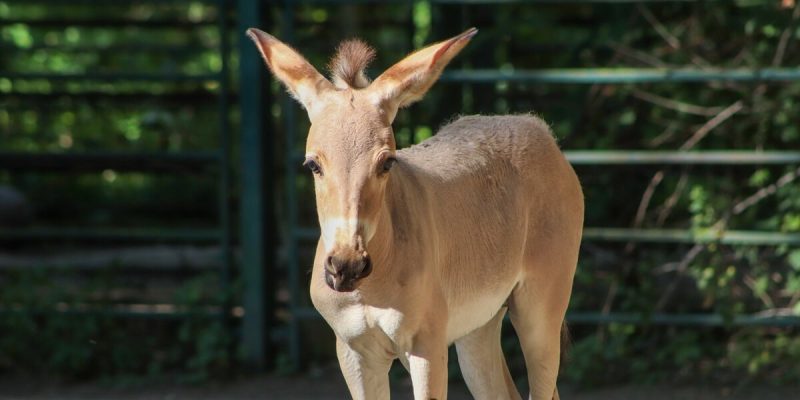
Between July 27 and August 5, 2026, Tierpark Berlin had three foals.
- Bruce, a colt, born July 27 to the mare Beatrice
- Amy, a filly, born July 30 to Kitara
- Suzan, a filly, born August 5 to Suri
All three were sired by Stan, a 22-year-old stallion. A fourth foal is expected within weeks. Visitors can already see the three with the herd.
How bad the numbers are
The Somali wild ass is listed by the IUCN as Critically Endangered, the last category before extinct in the wild. The most recent population estimate, from 2014, put the wild population at perhaps 200 animals, possibly considerably fewer. There has been no survey of the species’ range since.
Around 150 Somali wild asses live in European zoological institutions. Set those two figures next to each other and the situation is stark: the managed population in European zoos is roughly the same size as the wild one, and it is the better documented of the two.
The African wild ass has a second subspecies, the Nubian wild ass, which specialists consider probably extinct, though there are hints a few animals may survive in Sudan.
The comparison the director reached for
“Moderne Zoos tragen eine besondere Verantwortung fuer Arten wie den Somali-Wildesel, deren Zukunft in der Natur am seidenen Faden haengt… Wir hoffen, dass ihnen das Schicksal der Przewalskipferde, die Ausrottung in ihrem natuerlichen Lebensraum, erspart bleibt.”
Modern zoos bear a special responsibility for species like the Somali wild ass, whose future in the wild hangs by a thread… We hope they are spared the fate of the Przewalski’s horse, extinction in its natural habitat.
Dr. Andreas Knieriem, director of Zoo and Tierpark Berlin, in a statement translated from German
He picked that comparison deliberately, and it cuts both ways. Przewalski’s horse did go extinct in the wild, and it survived only because zoos held a founder population through the decades when there was nothing left outside. This year a foal was born on the Kazakh steppe to reintroduced parents, one of them from Tierpark Berlin’s own herd.
So the fate Knieriem hopes the wild asses avoid is also the proof that a reserve population works. It is not a happy sentence. It is an accurate one.
The foals themselves
“Der kleine Bruce wuerde seine beiden Halbschwestern am liebsten schon zum Spielen auffordern, doch ihre Muetter bremsen den verspielten Hengst noch etwas aus.”
Little Bruce would love to invite his two half-sisters to play already, but their mothers are still holding the playful colt back a bit.
Martin Kraenzlin, curator, Tierpark Berlin, in a statement translated from German
Kraenzlin expects that to change within a week or two, at which point the three will be running the enclosure together.
Source: Tierpark Berlin. Quotations translated from the German.