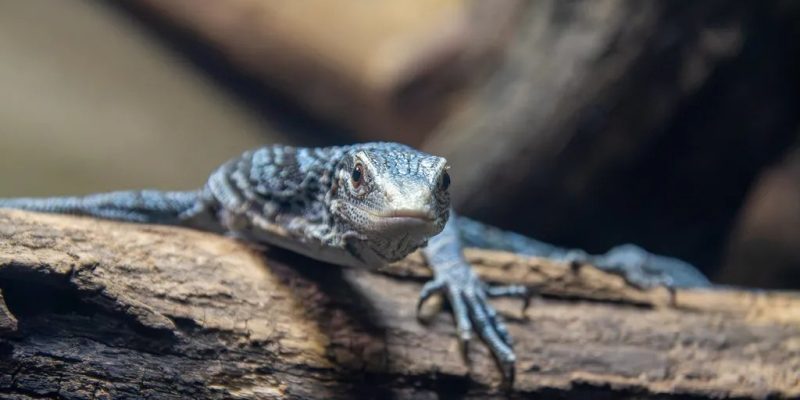
Three lizard species are moving into the Dragons! habitat at the Cincinnati Zoo and Botanical Garden, two are moving out, and the best news in the announcement is not a move at all. The zoo’s pair of blue tree monitors, both eight years old, produced eggs this year for the first time, which the zoo marked alongside Reptile Awareness Day.
Cincinnati is one of only ten zoos in the United States holding Varanus macraei, a slender, long-tailed lizard whose gray-blue scales carry a scatter of paler blue spots and bands. The zoo’s announcement does not say how narrow its range is, and that is the number that makes the eggs matter. ZSL, which also keeps the species, records it as endangered and as living in the wild only on Batanta Island and the islets around it, in Indonesian New Guinea. Batanta covers 455 square kilometers, about 176 square miles. That is the whole wild population of the species, on one island.
A first clutch from an established pair does not guarantee hatchlings. It does mean the pair is behaving the way a breeding pair is supposed to, which across ten institutions is most of the ballgame.
Who is leaving, and where they are going
The armadillo lizard (Ouroborus cataphractus) is on its way out, and the zoo is unusually candid about why: the animal spends most of its day hidden. In its place come ocellated skinks (Chalcides ocellatus), small lizards native to southern Europe, the Middle East and parts of Asia that are active in daylight, which is when guests are there. Three zoos in the country keep them.
The Solomon Island prehensile-tailed skinks (Corucia zebrata) are also moving, but not away. They relocate to Night Hunters, elsewhere on the grounds, so anyone who came to see them still can. Their old space goes to a Solomon Island spiny monitor (Varanus spinulosus), a species on habitat at five American zoos. That animal is in the Reptile House now and can be seen there until the move.
What is a monitor lizard?
It is worth pinning down, because the word is doing real work here. Monitors are the genus Varanus: long-necked, long-tailed, active, forked-tongued hunters that run from a few ounces to the largest lizard alive. When these moves are finished, Dragons! will hold four of them at once, which is an unusually good place to see how much variation one genus can carry.
The fourth is still on its way. A perentie (Varanus giganteus), among the longest lizards in the world and a native of the Australian outback, is coming to the habitat. Cincinnati’s is a juvenile and weighs just over two pounds, so the thing to picture is the adult it is going to become rather than the animal arriving.
The habitat’s headline resident stays put. Aegon, the zoo’s eight-year-old Komodo dragon (Varanus komodoensis), is not going anywhere.
Why a roster change counts as news
Because this is the layer of zoo work that almost never gets written up. A new building gets a ribbon and a press conference. A decision about which lizard belongs in a particular glass box, taken by a curator weighing visibility against husbandry against what the other nine institutions in the country are holding, gets a blog post on Reptile Awareness Day and nothing else. It is the same discipline as a reptile head-start program, run at a smaller scale and in public.
It also means the habitat will look different on your next visit than it did on your last, which is more than can be said for most reptile houses. Dragons! is open now, with the spiny monitor a short walk away in the Reptile House until it moves.
Quick answers
- What is changing in the Dragons! habitat?
Armadillo lizards are being replaced by ocellated skinks, and Solomon Island prehensile-tailed skinks are moving to Night Hunters and being replaced by a Solomon Island spiny monitor. A perentie is also coming. Komodo dragon Aegon stays.
- Why did the blue tree monitor eggs matter?
The Cincinnati Zoo is one of only ten zoos in the United States holding the species, and its eight-year-old pair produced eggs this year for the first time. A first clutch does not guarantee hatchlings, but it is the behavior a breeding pair is supposed to show.
- Where do blue tree monitors live in the wild?
ZSL, which also keeps the species, records it as living in the wild only on Batanta Island and the surrounding islets in Indonesian New Guinea, and gives its status as endangered. Batanta covers 455 square kilometers, about 176 square miles.
- What is a monitor lizard?
A lizard of the genus Varanus: long-necked, long-tailed, active and forked-tongued, ranging from a few ounces to the Komodo dragon, the largest living lizard. Once the moves are done, Dragons! will hold four species of them at once.
- Why replace the armadillo lizards?
The zoo says they spend much of the day hidden from view. Ocellated skinks are active in daylight, which is when guests are there. Three zoos in the United States keep ocellated skinks.
- Can I still see the prehensile-tailed skinks?
Yes. They are relocating to Night Hunters rather than leaving the zoo. The incoming Solomon Island spiny monitor can be seen in the Reptile House until it moves across to Dragons!