A veterinary team in Tsavo got a wire snare off a wild giraffe in 150 seconds. The Sheldrick Wildlife Trust, which published the operation on October 16, had to slow its own footage down to make the work legible.
Two and a half minutes sounds like a boast. It is closer to a constraint. Almost everything unusual about treating a giraffe in the field comes from the fact that the clock is the limiting factor, and the reason the clock is the limiting factor is the animal’s own physiology.
Why can a giraffe not simply be put under?
The trust puts it plainly: giraffe operations are always a race against time, because the animals are powerful and at the same time physiologically fragile, and they cannot undergo full anesthesia. A giraffe being treated has to remain semi-lucid throughout.
That single sentence rewrites the whole procedure. There is no sedated patient lying still while a team works at a comfortable pace. There is a partly conscious animal of enormous strength and long, loaded limbs, held by people, for as short a period as the job can possibly be compressed into. Everything that would normally be done carefully and sequentially has to be done at once, by more hands.
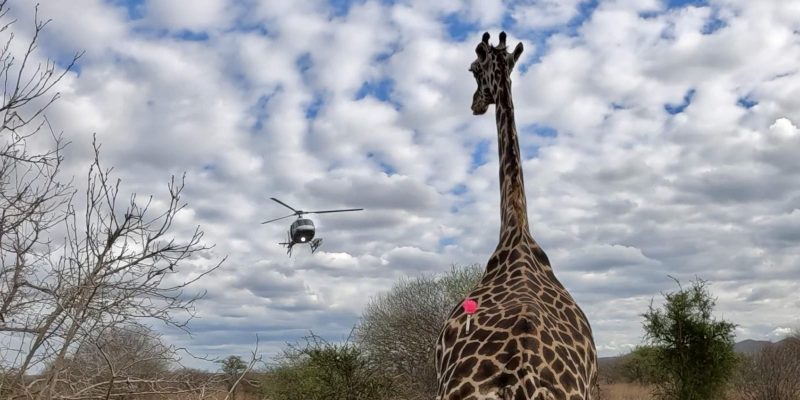
So the sequence here was: Dr Limo of the SWT/KWS Tsavo Mobile Veterinary Unit darted the giraffe from the air, and ground teams sprinted in to restrain her manually and cut the snare away. From the first rope to the finish was 150 seconds.
The calf was the reason for the hurry
The patient was a mother with a young calf nearby, which raised the stakes on an operation that is already unforgiving. A giraffe cow separated from a calf for long, or lost altogether, takes the calf’s chances with her.
The outcome was the good one. The wire had not yet caused serious injury, and roughly two and a half minutes after the treatment began she was free of the snare and back with her baby.
Snares are the ordinary danger here rather than the exotic one. They are cheap, silent, untargeted and set in enormous numbers, and a giraffe is not the animal most of them are meant for. The same trust freed a wildebeest and a zebra from snares in Kenya earlier this month, and the Kenya Wildlife Service’s Mara unit cut a wire off an adult female Maasai giraffe at the end of September. A loop of wire around a hind leg is not a minor wound on an animal that rests, sleeps and escapes standing up.
The trust says its emergency field care has reached more than 14,000 wild patients to date.
Who pays for the two and a half minutes
We traced the money behind Kenya’s mobile veterinary units in detail at the end of September, and the answer has not changed: it is not a zoo. The units are a joint arrangement in which the Kenya Wildlife Service supplies the veterinarian and the legal authority, and the Sheldrick Wildlife Trust supplies the vehicle, the drugs, the equipment and the driver that get that veterinarian to an animal in time. The Tsavo unit named in this operation is one of those. We have looked for accredited zoo or aquarium funding behind the trust more than once and have not been able to verify any, and that remains the position.
It is a real finding and not an absence. A large share of the veterinary response to snaring in Kenya runs on money with no connection to the zoo and aquarium sector, and reporting that is more useful than reaching for a link that is not there. For scale on the sector’s own spending, the Association of Zoos and Aquariums reports that 235 accredited and certified facilities spent approximately $372.4 million on conservation across 139 countries in 2025. No published breakdown isolates a regional share of that figure, and we are not going to estimate one.
What the footage is for
A trust that slows down its own video is making a point about the work rather than about the animal. At full speed the operation reads as a scramble. Slowed, it is visible as a sequence: dart, approach, restraint, cut, release, withdraw, all of it rehearsed, all of it timed against a physiological ceiling that nobody in the picture can negotiate with.
One small note on what this piece does not say. The trust’s account names no species, identifying the patient only as “this mother giraffe,” so neither do we.
Source: Sheldrick Wildlife Trust, field update of 16 October 2026.
Quick answers
- How long did the snare removal take?
150 seconds from the first rope to the finish, and roughly two and a half minutes from the start of treatment to the giraffe being free of the wire and back with her calf. The Sheldrick Wildlife Trust slowed its own footage down so the sequence could be followed.
- Why can a giraffe not be given full anesthesia?
The trust describes giraffes as powerful and at the same time physiologically fragile, and says they cannot undergo full anesthesia and must remain semi-lucid during treatment. That is why the work has to be compressed into as few seconds as possible rather than done at a comfortable pace.
- Who carried out the treatment?
Dr Limo of the SWT/KWS Tsavo Mobile Veterinary Unit darted the giraffe from the air, and ground teams moved in to restrain her manually and cut the snare away.
- Was the giraffe injured?
Not seriously. The wire had not yet caused significant injury when the team reached her, and she was reunited with her calf after the treatment.
- Which zoo funds this work?
None that we have been able to verify. Kenya’s mobile veterinary units are a joint arrangement in which the Kenya Wildlife Service supplies the veterinarian and the legal authority and the Sheldrick Wildlife Trust supplies the vehicle, drugs, equipment and driver. We have looked for accredited zoo or aquarium funding behind the trust more than once and have not found any.
- How many animals has the trust treated?
The trust says its emergency field veterinary care has reached more than 14,000 wild patients to date.
- What species of giraffe was it?
The trust’s account does not say. It identifies the patient only as a mother giraffe, so we do not name a species either.