
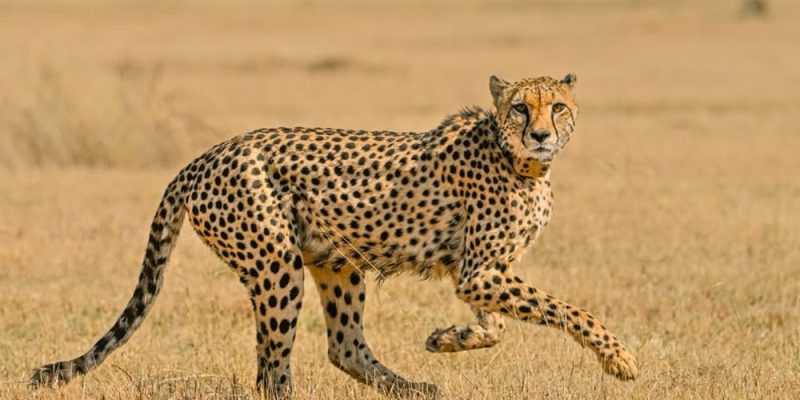
In August 2025 a male cheetah began appearing on camera traps on part of the Cheetah Conservation Fund’s reserve in Namibia, and then in reports from the farms next door. He was doing what a wild cheetah should do, hunting wild prey and learning the country, but the country he was learning took him closer and closer to his neighbors’ livestock kraals. For a Namibian farmer that is a problem arriving on four legs.
The fund’s veterinary, ecology and animal husbandry teams immobilized him together, gave him a full health assessment, fitted a GPS collar and entered him in the Early Warning System, part of the fund’s human and carnivore coexistence program. The collar turns one cheetah into a message service: farmers hear when he is approaching stock, and, just as usefully, when he has gone. The neighbor who had been reporting him named him Tupuka, which in Herero means to run.
That much is conflict prevention, and the fund publishes that sort of thing often. What came next is why this one is worth reading.
A farmer’s trap cages, and seven blood samples
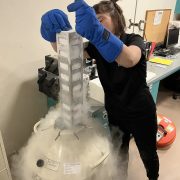
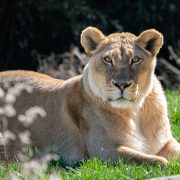
For about a year the fund had been aware of an adult female cheetah and five cubs moving across the farms directly to its north, picked up in occasional camera trap frames and in sightings people called in. In June 2026 a neighboring farmer caught all six of them in trap cages. The fund used the opportunity rather than simply turning them loose on the spot: the six were brought to the center for veterinary examinations, and the female, Astrid, was collared and added to the same Early Warning System.
Every immobilization of a cheetah, wild or captive, is also a blood draw, for blood counts and biochemistry and for DNA. With Tupuka’s samples already on file and Astrid’s and her cubs’ newly taken, the team had seven profiles and one obvious question. Was the male they had been tracking for months the father of these five cubs?
Seventeen markers, zero mismatches
Cheetah family life is mostly invisible. Females are solitary and range widely to find food and mates, and a camera trap can only tell you that an animal passed a particular spot on a particular night. Relatedness is the thing field observation almost never delivers.
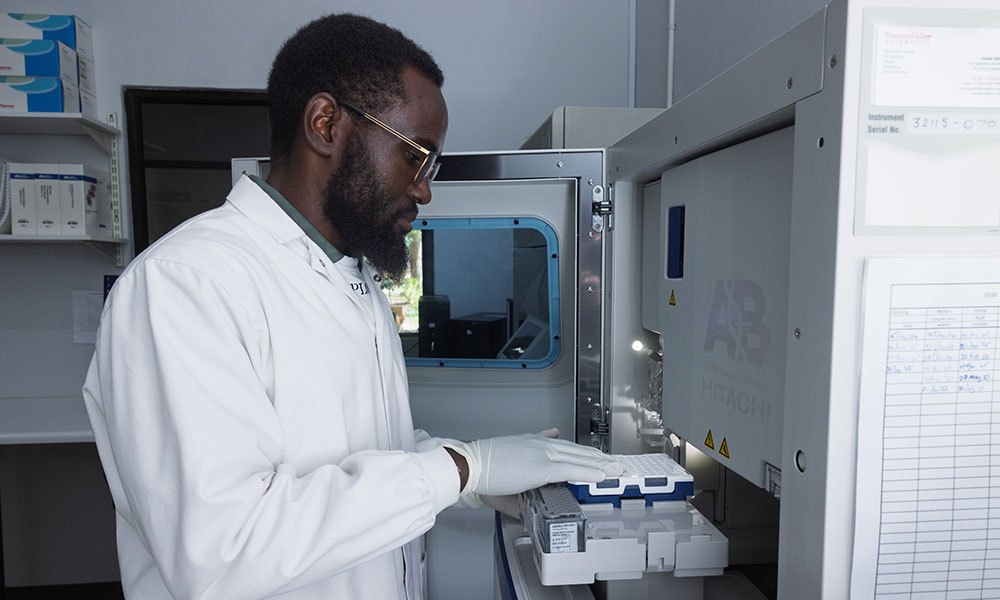
The fund’s genetics laboratory in Namibia runs an ABI 3500 genetic analyzer and PCR machines, and the team worked with microsatellite markers, the same class of marker used in human forensic casework. DNA was extracted from all seven cheetahs, amplified by polymerase chain reaction, and run on the analyzer to build a profile for each animal across 17 markers.
There were no mismatches between the cubs and Tupuka at any of the 17 markers, and his profile sat alongside Astrid’s for all five cubs. The fund states the result the way a careful laboratory should, as strongly suggesting that Tupuka is the father rather than as proof beyond argument.
The genetics then explained something the ecology had already half shown. In late May 2026, several weeks before the family was caught, Astrid and the cubs passed through Tupuka’s territory and visited a play tree the team had been monitoring since his release. Over the following two weeks his visits to that tree became markedly more frequent, the gap between them falling from several days to less than a day, and his usual daily activity pattern changed. At the time that was an unexplained blip in a collar dataset. It is now a male responding to the passage of his own litter.
Which zoos paid for this
We look for the accredited zoological institutions behind field conservation work, and here the answer is partial rather than clean.
The Cheetah Conservation Fund says on its own research pages that it keeps close ties with zoos and wildlife parks specifically to collaborate on projects involving captive cheetah populations and genetics, and it lists them. Four of the institutions on that list also appear on the fund’s published supporter list: the Columbus Zoo and Aquarium, the Dallas Zoo, the Indianapolis Zoo and the Little Rock Zoo. The Indianapolis Zoo’s money has turned up in the fund’s science before in a form anyone can check, because the funding statement of the fund’s 2026 wildfire paper names the Indianapolis Zoo Global Conservation Grant outright.
What we cannot tell you is which of them, if any, paid for this particular analysis. The fund names no funder for the Tupuka work, and we are not going to assign one. The honest version is that the laboratory these seven profiles were run in is supported in part by American zoos, and that nobody has published a line connecting a specific zoo to these specific seventeen markers.
For the scale of the sector’s spending overall, the Association of Zoos and Aquariums reports that in 2025 its 235 accredited and certified facilities spent approximately $372.4 million on conservation across 139 countries. No published breakdown isolates the African share of that figure, and we are not going to estimate one.
On the numbers
The fund makes no population claim in this piece, which is worth noting because facilities often do. For context, the IUCN Red List assesses the cheetah, Acinonyx jubatus, as Vulnerable under criteria A4b and C1, with 6,517 mature individuals and a decreasing population. The current entry is a 2024 amended version of a 2023 assessment by Durant, Groom, Ipavec, Mitchell and Khalatbari, and the underlying assessment date is May 17, 2021. The fund’s own framing, that southern Africa is the last stronghold and that many of its cheetahs live outside protected areas, sits comfortably with that assessment.
The same organization gave us the Omaheke wildfire occupancy study this month, which measured what happened to 31 species after a 650-square-kilometer fire. Put the two together and the shape of the fund’s argument is visible: collars tell you where an animal goes, cameras tell you who else was there, and the laboratory tells you how they are related. One program, three instruments, one landscape shared with farmers.
Source: the Cheetah Conservation Fund’s September 30, 2026 account, written by Hafeni Hamalwa with Dr. Rob Cook, together with the fund’s published research and supporter pages.
Quick answers
- What did the Cheetah Conservation Fund find?
That a collared male cheetah called Tupuka is almost certainly the father of five cubs born to a female called Astrid on the farmland north of the fund's Namibian center. Genetic profiles for all seven animals were compared across 17 microsatellite markers and there were no mismatches between the cubs and Tupuka at any of them.
- Why were the cheetahs handled at all?
Both adults were immobilized because of livestock conflict rather than for research. Tupuka was collared in 2025 after he began moving close to neighbors' livestock kraals, and Astrid and her five cubs were brought in after a neighboring farmer caught them in trap cages in June 2026. Every immobilization is also a health check and a blood draw.
- What is the Early Warning System?
Part of the fund's human and carnivore coexistence program. A collared cheetah's movements are monitored so that farmers can be warned when the animal approaches areas where livestock are kept, and told when it has left. The point is to let a farmer act without killing the cheetah.
- What are microsatellite markers?
Short repeating stretches of DNA that vary a great deal between individuals, which makes them useful for telling animals apart and for establishing parentage. They are the same class of marker used in human forensic casework. The fund's Namibian laboratory runs an ABI 3500 genetic analyzer and PCR machines and built a profile for each cheetah across 17 of them.
- Did the genetics explain anything the collar did not?
Yes, and the reverse as well. In late May 2026 Astrid and the cubs passed through Tupuka's territory and visited a play tree the team monitors. Over the next two weeks his visits to the tree became far more frequent, the interval falling from several days to under a day, and his activity pattern changed. That was an unexplained signal until the DNA showed whose cubs had walked past.
- Which zoos fund this work?
The fund lists the zoos it collaborates with on captive cheetah populations and genetics, and four of them also appear on its published supporter list: the Columbus Zoo and Aquarium, the Dallas Zoo, the Indianapolis Zoo and the Little Rock Zoo. The Indianapolis Zoo Global Conservation Grant is named in the funding statement of the fund's 2026 wildfire paper. No funder is named for this particular analysis, and we are not going to assign one.