
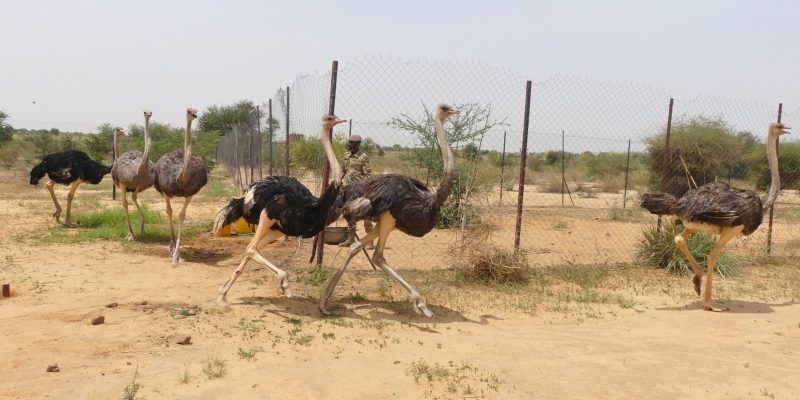
At 2:02 in the afternoon on September 2, 2026, eight North African ostriches walked out of an enclosure in the Gadabedji Biosphere Reserve and into open country in central Niger. Five females and three males. The species had not been seen in the wild in that reserve since 1955, and Niger’s last wild ostrich of any kind disappeared in 2004, in the Air and Tenere National Nature Reserve.
Sahara Conservation announced the release on September 8, 2026, having published the French version the day before. It is the first reintroduction in a program meant to rebuild a self-sustaining wild population of Struthio camelus camelus in Niger, and the birds that made it possible were bred in fenced compounds by a national captive-breeding program that has been quietly failing and recovering for a decade.
Who bred these birds
Niger did, with help. Dozens of ostriches of confirmed genetic origin, tested in a laboratory, are spread across breeding sites at Iferouane in the Agadez region, Kelle in Zinder and Maine-Soroa in Diffa. Private site managers have carried much of that work, and Sahara Conservation has managed the Kelle and Maine-Soroa sites in partnership with the Nigerien authorities, working on hatching success, breeding infrastructure, transfers between sites, feeding, veterinary care and the management of genetic diversity.
The organization is unusually frank about how hard this has been. Its own account of the species notes that the North African ostrich does not breed easily in captivity, and that over the past decade the Niger facilities have run into egg fertility problems, poor chick survival and predation by crows.
Which zoos paid for this
Three can be named, and one of them created the organization doing the work.
The Saint Louis Zoo paid Sahara Conservation’s start-up costs in 2004 and hosted its United States headquarters. The zoo’s WildCare Institute Saharan Wildlife Recovery Center lists, among its own program of work, supporting a local ostrich recovery program in Niger through captive breeding. Lisa Kelley, the zoo’s Vice President for Conservation, Education and Science and director of the WildCare Institute, sits on Sahara Conservation’s US board. Saint Louis appears on Sahara Conservation’s partner list twice, as a strategic partner and as a technical and delivery partner. We have written about that relationship before, when the scimitar-horned oryx was downlisted: it is the cleanest example we have of a zoo not funding a field organization but founding one.
The Kolmarden Foundation, the conservation arm of Kolmardens Djurpark in Sweden, is more specific still. Its published description of the project it funds names the Kelle breeding center as the place the work happens and the Gadabedji Biosphere Reserve as the place the birds go, and lists what the money does: daily health and behavior checks on the birds at Kelle, controlled reproduction using both natural and artificial incubation, exchange of eggs and chicks between centers to spread the genetics, Newcastle disease vaccination for every chick, employment of local people to care for the birds and maintain the facilities, and the movement of birds to Gadabedji. Eleven were moved into an acclimatization pen at the reserve in 2021 and 2022.
Marwell Wildlife supplied expertise rather than animals. At a 2016 workshop of Sahara Conservation’s international partners, which also included Hannover Zoo and the Saint Louis, San Diego and Smithsonian zoos, it was agreed that Dr. Marie Petretto, a field biologist and wildlife veterinarian at Marwell working on ostriches in Tunisia, would make an advisory visit to Kelle. She ran a training course there from July 12 to 18, 2017, for the Kelle staff, the managers of the other Nigerien breeding sites, five ecology master’s students and the head of environment services for Kelle. A new artificial hatching unit was about to come online.
None of the three is named in the release about this release. The funding line on September 8 credits the NaturA Niger project, co-funded by the European Union, along with the Nigerien authorities, protected-area managers, local communities, private stakeholders and scientific experts. The zoo money is in the birds, not in the ceremony.
What happened on the day
A workshop the day before brought the country’s ostrich conservation stakeholders together to validate the national species conservation action plan. On the day itself the Director General of Water and Forests, the Governor of the Maradi Region, the Prefect of Bermo and the delegated administrators of Bermo and Gadabedji came, along with a crowd from the surrounding villages, and the release was marked by a ribbon cut by the governor and the director general.
Hassane Mahamane, Conservator of the Gadabedji Biosphere Reserve, spoke first. “La ceremonie qui nous reunit ce matin ne consacre pas seulement le relacher des autruches dans la nature, mais marque un autre retour attendu depuis plus de 50 ans,” he said, which Sahara Conservation renders in its own English-language release as: “The ceremony bringing us together this morning is not only about releasing ostriches into the wild; it also marks a long-awaited return after more than 50 years.”
Dr. Maimounatou Ibrahim Mamadou, Sahara Conservation’s ostrich site manager, spoke before opening the pens. “Voir aujourd’hui ces autruches retrouver leur milieu naturel est une grande emotion,” she said, in the organization’s English version: “Seeing these ostriches return to their natural habitat today is deeply moving.” Both translations are Sahara Conservation’s own; the release was published in French and in English.
The reserve had been prepared for them in a way that has nothing to do with birds. Working with the reserve’s management unit and with local administrative and traditional authorities, Sahara Conservation ran an awareness campaign that reached nearly 260 people across nine villages, covering what the ostrich is, what it does in the ecosystem, why it is being brought back and how to live alongside it.
Why Gadabedji
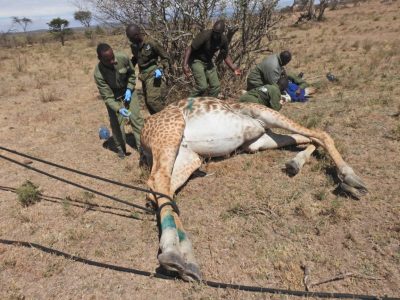
Because it has done this before. Gadabedji is inside the ostrich’s historical range, and it is the site where West African giraffes were translocated in 2018 and again in 2022 as part of a wider wildlife restoration program. A reserve that has already absorbed one reintroduced species and kept it has infrastructure, monitoring and community relationships that a new site would not.
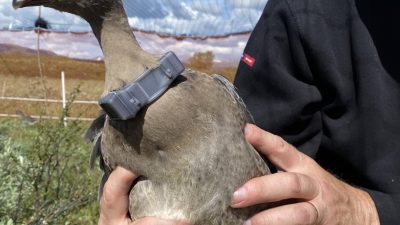
Teams will now track the eight birds for adaptation, survival, movement and, in time, breeding.
“The true measure of our success will not simply be the number of birds released today, but their ability to survive, adapt, reproduce and, ultimately, establish a viable wild population,” said Abdoul Razack Moussa Zabeirou, Sahara Conservation’s country representative in Niger.
Sahara Conservation has published nothing further about the released birds since September 8, and that release remains the newest item in its newsroom.
A note on the listing
Sahara Conservation’s species page gives the North African ostrich an IUCN Red List status of Vulnerable. The Red List returns a single global assessment covering the whole species: the Common Ostrich, Struthio camelus, was assessed by BirdLife International on May 27, 2025 and is Least Concern with a decreasing population, and there is no separate global assessment for Struthio camelus camelus. Where the Red List is silent about a subspecies, we say it is silent rather than promote or demote it, and we default to the global assessment that does exist.
None of which changes the substance. Niger protects the species outright under national law, it sits in Appendix I of CITES, the country’s national conservation strategy for it has been in place since 2016 and was updated this year, and the last wild bird in the country died more than twenty years ago. A subspecies can be in serious trouble inside a species that is not.
Source: Sahara Conservation’s September 8, 2026 press release, in English and in French, and the partner pages of the three institutions named above.
Quick answers
- What happened at Gadabedji?
At 2:02 p.m. on September 2, 2026, eight North African ostriches, five females and three males, were released into the Gadabedji Biosphere Reserve in central Niger. The species had not been seen in the wild in that reserve since 1955. Sahara Conservation announced it on September 8.
- Where did the birds come from?
A Nigerien national captive-breeding program. Dozens of ostriches of laboratory-confirmed genetic origin are spread across breeding sites at Iferouane in Agadez, Kelle in Zinder and Maine-Soroa in Diffa. Sahara Conservation manages the Kelle and Maine-Soroa sites in partnership with the Nigerien authorities. Eleven birds were moved into an acclimatization pen at Gadabedji in 2021 and 2022.
- Which zoos are behind it?
Three. The Saint Louis Zoo paid Sahara Conservation's start-up costs in 2004, hosted its US headquarters and appears on its partner list twice. The Kolmarden Foundation, the conservation arm of Kolmardens Djurpark in Sweden, funds the Kelle breeding center by name, down to vaccination and local staffing. Marwell Wildlife sent Dr. Marie Petretto to run a training course at Kelle from July 12 to 18, 2017. None of the three is named in the release itself, which credits the NaturA Niger project and the EU.
- Why Gadabedji?
It is inside the ostrich's historical range and it has absorbed a reintroduction before: West African giraffes were translocated there in 2018 and again in 2022. The infrastructure, monitoring and community relationships already exist.
- What is the Red List status?
The Red List holds one global assessment covering the whole species. The Common Ostrich, Struthio camelus, was assessed by BirdLife International on May 27, 2025 and is Least Concern with a decreasing population. There is no separate global assessment for the North African subspecies, Struthio camelus camelus, so where the Red List is silent we say it is silent. Sahara Conservation's own species page calls the subspecies Vulnerable.
- Is the species protected in Niger?
Yes. It is fully protected under Nigerien national law and listed in Appendix I of CITES. A national conservation strategy has been in place since 2016 and was updated in 2026.