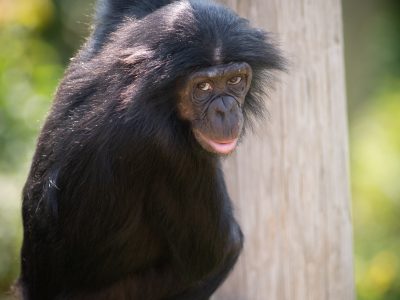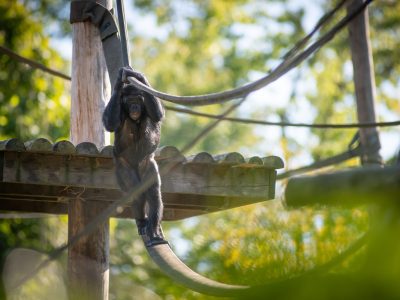

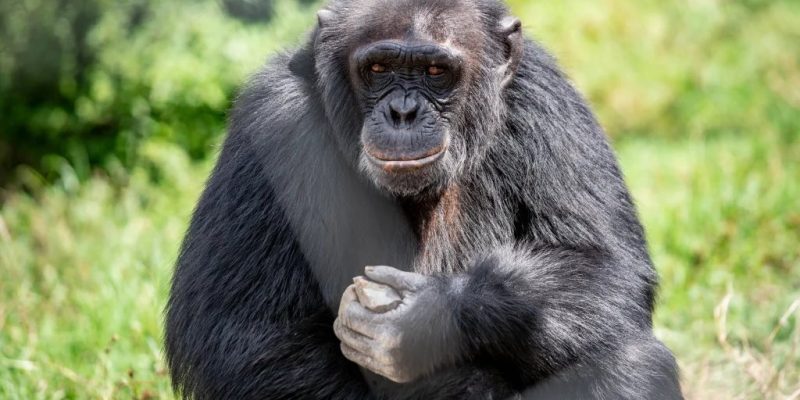
The chimpanzee who taught Manno how to be a chimpanzee is called Uruhara, and what he did was sit down near him.
That is the account Sweetwaters Chimpanzee Sanctuary in Kenya gives of how one of its residents came into the group. Manno had arrived at the sanctuary in 2016 unable to do the things chimpanzees do with each other, and Uruhara approached him without force and without hesitation, sat nearby, watched, tested the distance, and over time drew him into grooming, proximity and shared space. For most young chimpanzees those behaviors are learned in infancy without anybody noticing. For Manno they were lessons, and Uruhara gave them.
Why did a chimpanzee need to be taught that?
Because he had never had the chance to learn it. Manno’s life began at the Damascus Zoo in Syria. He was born in captivity and spent his early years apart from other chimpanzees, in an environment with no family group in it, so the whole apparatus of chimpanzee social life, the communication, the play, the alliances, the reading of who is who, went untaught.
By the time he reached Kenya he was healthy and socially unformed. The sanctuary’s description of him in that period is that he was quiet, withdrawn, and uncertain how to exist among his own kind. He kept his distance and watched. Belonging was not something he was returning to. He had never had it.
Years later, the sanctuary reports a different animal on the western side of its grounds. Manno runs and claps to get attention. He throws sticks and stones when he feels challenged. He pushes at his position in the hierarchy. Sweetwaters is careful to say that the point is not that he has become dominant: the point is that he moved, from isolation to participation.
What Sweetwaters is, and why it exists in a country with no wild chimpanzees
Chimpanzees are not native to Kenya. Their range runs from Senegal across the central African forest belt to Uganda, and the sanctuary exists in Kenya because of an emergency somewhere else: when a rescue center in Burundi had to close as civil war broke out in 1993, Ol Pejeta Conservancy took the animals in.
The sanctuary was set up by agreement between Ol Pejeta, the Kenya Wildlife Service and the Jane Goodall Institute, to give lifelong refuge to orphaned and abused chimpanzees from West and Central Africa. It is the only place in Kenya where chimpanzees can be seen. Its residents arrive confiscated from the black market or from cramped private captivity, and many arrive injured.
It is also, deliberately, not a waypoint. Most of the chimpanzees at Sweetwaters will never go back to the wild, because they were orphaned, trafficked or held in captivity too long to survive on their own. That changes what success has to look like. It cannot mean release. It has to mean a life worth living in the place where they are, which is why a story about one chimpanzee learning to sit near another is the sanctuary’s idea of a result.
The IUCN Red List assesses the chimpanzee, Pan troglodytes, as Endangered under criteria A4bcde, in an assessment dated March 24, 2016 and published with errata in 2018, with the population trend listed as decreasing.
The part we could not verify
We trace the accredited zoos and aquariums that fund conservation and rescue work in this region, because the connection is often real and almost never in the press release. On this one we came up empty.
Sweetwaters names three founding parties and they are a conservancy, a government wildlife agency and a research and conservation institute. Ol Pejeta’s published account of the sanctuary names no zoo as a funder. The sanctuary is a member of the Pan African Sanctuary Alliance, whose own listing for it repeats the same three names and no others. We found no accredited zoological institution paying for this work, and we are not going to imply one.
What is worth saying instead is that the failure runs in a particular direction. Manno’s first years were spent in a zoo in Syria, which is where the harm was done, and the repair was carried out by a Kenyan conservancy, a Kenyan government agency and the Jane Goodall Institute. The zoological world’s fingerprints are on the beginning of this story and not, as far as we can document, on the end of it.
For a case where the trace does hold, see our report on Columbus Zoo’s long-running funding of Lola ya Bonobo.
Sweetwaters published its account of Manno and Uruhara on June 26, 2026, written by Dylan Habil. Manno is still listed among the chimpanzees the sanctuary invites the public to sponsor.
Quick answers
- Who is Manno?
A chimpanzee at Sweetwaters Chimpanzee Sanctuary in Kenya. He was born in captivity at the Damascus Zoo in Syria and spent his early years apart from other chimpanzees, so he arrived at the sanctuary in 2016 without having learned chimpanzee social behavior.
- What did Uruhara do?
Another chimpanzee at the sanctuary, Uruhara approached Manno without force, sat near him, watched him and tested the distance between them, then gradually drew him into grooming, proximity and shared space.
- Why is there a chimpanzee sanctuary in Kenya?
Chimpanzees are not native to Kenya. Ol Pejeta Conservancy took in the animals from a rescue center in Burundi that had to close when civil war broke out in 1993, and the sanctuary was established by agreement between Ol Pejeta, the Kenya Wildlife Service and the Jane Goodall Institute.
- Do the chimpanzees ever go back to the wild?
Most will not. They were orphaned, trafficked or held in captivity too long to survive independently, so the sanctuary is a permanent home rather than a transit point.