
The coral spawning laboratory that Nature Seychelles and its partners built on Praslin Island has won international recognition, with Canon taking the Tech and AI Award at the Global Sustainability Awards 2026 in London on September 8 for its part in the work.
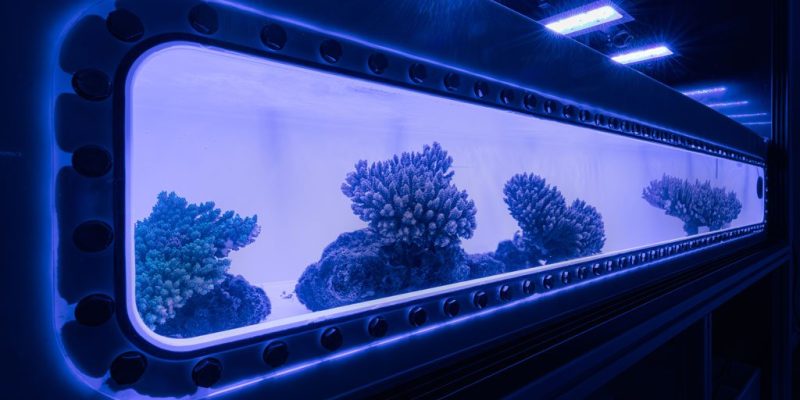
The award went to Canon rather than to the conservation organization, which is worth stating plainly, but the thing being recognized sits on a Seychelles island and belongs to a Seychellois project. It is the first coral spawning lab in Seychelles and in the wider region, housed at Nature Seychelles’ Assisted Recovery of Corals facility, known as ARC, on Praslin.
What is a coral spawning lab actually for?
It exists to get coral to reproduce sexually in a tank, which is harder and more valuable than it sounds.
Most reef restoration to date has worked by coral gardening: take a fragment from an existing colony, grow it out, plant it back. That works, and Nature Seychelles has done a great deal of it, but every fragment is a clone of the colony it came from, so a restored reef built that way carries the genetic hand it was dealt. Sexual reproduction is the alternative. Spawning and fertilization produce genetically diverse offspring, and diversity is what gives a reef a chance of containing corals that can take the heat the next marine heatwave brings. It also opens the door to a wider range of species than fragmenting does.
Canon Europe came into the partnership in 2025, alongside Coral Spawning International, through an initiative Canon calls World Unseen: Coral Matchmaking. Its contribution was imaging: high-resolution cameras, macro lenses and equipment for photomicrography and photogrammetry, so that scientists can watch and document what coral larvae do in the first hours and days of their existence. Those early stages are where restoration succeeds or fails, and they are extremely small.
In November 2025 Nature Seychelles and Coral Spawning International recorded ex situ coral spawning for the first time in Seychelles and in the Western Indian Ocean.
What the people involved said
Dr. Nirmal Shah, the chief executive of Nature Seychelles, framed the award as momentum rather than as an arrival. His organization announced the award on September 14.
“We are absolutely delighted that work taking place here in Seychelles is yet again in the international spotlight,” Shah said. “When Canon, Coral Spawning International and Nature Seychelles began working together, we dared to dream that the solutions developed here would help save coral reefs. The challenges facing reefs in Seychelles are part of a global crisis. We need innovative ways to monitor, protect and restore our marine environment.”
He added that the award recognizes “that Eureka moment when technology, science, conservation and leadership are blended into a superpower,” and that “there is no time to lose; it is now or never for coral reefs.”
Canon, in a post on its own channels, called the recognition a marker of “innovation, science and conservation coming together to create meaningful impact for our oceans.” The Global Sustainability Awards are run by Sustainability Magazine and BizClik.
Why this matters beyond one island
Seychelles lost more than 90 percent of its live coral cover in the 1998 El Niño event, according to Nature Seychelles’ own account of the region’s reefs, and a further major bleaching event in 2016 took roughly half of what had come back. A restoration method that produces corals with the genetic range to survive what is coming is not a nice addition to that picture. It is the only version of the work with a future in it.
We have covered the ARC lab and that first spawning before. This is the follow-up, and it is a good one: the project that documented something new in the Western Indian Ocean has now been noticed outside the conservation world.
A note on zoo funding
We look for the accredited zoos and aquariums behind conservation work in Africa and the Middle East, because the money often comes from institutions that never appear in the story. We looked here, and we did not find any.
Nature Seychelles publishes a full list of its funders, strategic partners and supporting entities, and it runs to more than forty names: government ministries, the European Union, the Global Environment Facility, the World Bank, USAID, UNDP, BirdLife International, the IUCN, the RSPB, WWF, Huawei, Seacology, the Jensen Foundation, several island resorts and the Seychelles Conservation and Climate Adaptation Trust. Not one accredited zoo or public aquarium appears on it. The spawning lab’s own named backers are Canon Europe, a camera manufacturer, and Coral Spawning International, a specialist commercial laboratory. On the record available, no zoological institution funds this project.
That is a real finding rather than a gap. Zoos and aquariums do fund an enormous amount of this kind of work worldwide: the Association of Zoos and Aquariums reports that in 2025, 235 accredited and certified facilities spent approximately $372.4 million on conservation across 139 countries. No published breakdown isolates what any region received, and we are not going to invent one. What we can say is that on Praslin, this particular lab was paid for by other people.
Quick answers
- What won the award?
Canon took the Tech and AI Award at the Global Sustainability Awards 2026, held in London on September 8, for its role in the coral spawning lab at Nature Seychelles' Assisted Recovery of Corals facility on Praslin Island.
- What does a coral spawning lab do?
It gets corals to reproduce sexually in a tank. Conventional coral gardening replants fragments, which are clones of the colony they came from. Spawning and fertilization produce genetically diverse offspring, which is what gives a restored reef a chance of holding corals that can survive the next marine heatwave.
- What did Canon contribute?
Imaging. Through its World Unseen: Coral Matchmaking initiative it supplied high-resolution cameras, macro lenses and equipment for photomicrography and photogrammetry, so scientists can document the earliest stages of coral development.
- Which zoos or aquariums fund this project?
None that we could find. Nature Seychelles publishes a list of more than forty funders and supporting entities and no accredited zoo or public aquarium appears on it. The spawning lab's named backers are Canon Europe and Coral Spawning International.