
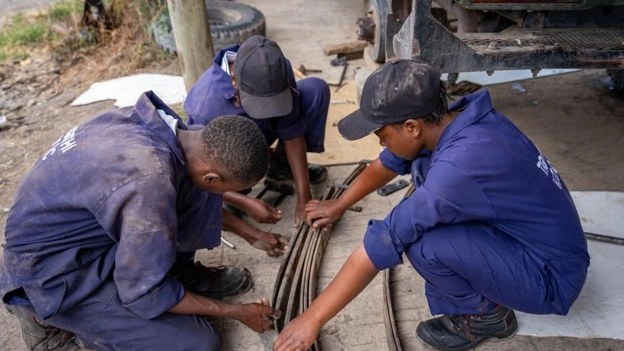
Ten trainee mechanics are currently working out of the Kamok garage at Ol Pejeta Conservancy in Laikipia, Kenya, servicing the fleet of vehicles and heavy machinery that the conservancy runs on. They are not conservation interns. They are technical college students on industrial attachment, learning to diagnose engine faults and replace suspension components alongside the conservancy’s own mechanics, and the program they are part of is one of the more interesting answers a conservation organization has given to the question of what it owes the people living against its fence line.
The gap the scholarships did not close
About 56,000 people live in the 21 community areas neighboring Ol Pejeta, and more than a third of them are between 15 and 34. Most households depend on rain-fed farming and livestock, both of which recurring drought has made unreliable, and the local poverty rate of nearly 58 percent runs at almost twice the national figure.
Ol Pejeta has been funding secondary education there since 2006 and has awarded more than 800 secondary school scholarships. What the conservancy found was that finishing secondary school was not the finish line it looked like. Only about 22 percent of secondary graduates go on to university, so for most students secondary school is the end of formal education, and the jobs available want a trade rather than a transcript.
Those jobs exist. Nanyuki, a few kilometers away, is growing quickly, and the new housing, businesses and infrastructure there need artisans, mechanics, welders, electricians and construction workers. Much of that work has been going to skilled people from outside the region, because local young people have not had access to quality technical training or to modern equipment.
What an attachment at a conservancy actually looks like
Technical and Vocational Education and Training, shortened to TVET, is Kenya’s practical-skills track: hands-on preparation for a specific trade rather than an academic qualification. Ol Pejeta’s contribution is a working garage with real vehicles in it and experienced mechanics willing to teach.
“When I started the attachment, I had only worked on training models in school,” said Alice Njeri, one of the trainees. “Here, I’ve learnt how to troubleshoot real vehicle problems, work safely as part of a team and understand what employers expect from us. Despite being a girl, every day gives me more confidence that I can build a career as a mechanic.”
Paul Tanui, the workshop supervisor, described the part of the training that is not mechanical. “We don’t just teach them how to repair vehicles; we teach them how to think through problems, work professionally and embrace team work,” he said. “Watching their confidence grow over the course of their attachment is incredibly rewarding to me.”
In August 2026 the conservancy launched a second, more structured version for masonry: a six-month apprenticeship enrolling 15 students, split evenly between classroom time at accredited technical and vocational colleges and practical training on the conservancy. Apprentices finish with government-recognized qualifications rather than an informal reference.
Why is a wildlife conservancy running a garage apprenticeship?
Because the skills it needs and the skills the region needs are the same skills. Safari vehicles, machinery, wildlife fences and tourism infrastructure all have to be maintained by somebody, and a conservancy that trains its neighbors to do that work converts people living beside protected land into people employed by it.
“Technical skills create dignity, independence and opportunity,” said Kelvin Gitau, Ol Pejeta’s senior education officer. “Not every young person will attend university, but every young person deserves the chance to build a meaningful career.”
Ol Pejeta is explicit that it wants the model copied, and describes the garage as a pilot whose real measure is whether other Kenyan wildlife conservancies adopt it. That is a claim worth checking in a few years rather than accepting now, but the structure is sound and the numbers behind it are small enough to be honest: ten attachments and fifteen apprenticeship places, not a press-release thousand.
Which zoos pay for this?
We trace the accredited zoos and aquariums funding African conservation work, and on this one we looked and did not find any. The conservancy credits the attachments to donors without naming them, its partners page publishes partnership reports rather than a supporter list, and no accredited zoological institution appears anywhere in the account of the education program. That is the finding, and it is the same result we reached when we looked at who is funding Kenya’s rhino documentary premiere.
For scale on the wider category, AZA reported that in 2025, 235 accredited and certified facilities spent approximately $372.4 million on conservation across 139 countries. No published breakdown isolates an African share, so we do not print one. The program is described in full on Ol Pejeta’s own news page.
Quick answers
- What is Ol Pejeta's TVET program?
Technical and Vocational Education and Training placements run on the conservancy itself. Ten students are currently on industrial attachment at the Kamok garage, servicing Ol Pejeta's vehicles and heavy machinery alongside its own mechanics.
- What was launched in August 2026?
A structured six-month masonry apprenticeship enrolling 15 students, split evenly between classroom time at accredited technical and vocational colleges and practical training at Ol Pejeta. Apprentices finish with government-recognized qualifications.
- Why is a conservancy doing this?
About 56,000 people live in the 21 community areas bordering Ol Pejeta, more than a third of them aged 15 to 34, with a local poverty rate near 58 percent. Only about 22 percent of secondary graduates reach university, while nearby Nanyuki needs mechanics, welders, electricians and builders.
- Do any accredited zoos fund it?
We looked and did not find any. Ol Pejeta credits unnamed donors, and its partners page publishes partnership reports rather than a supporter list.