
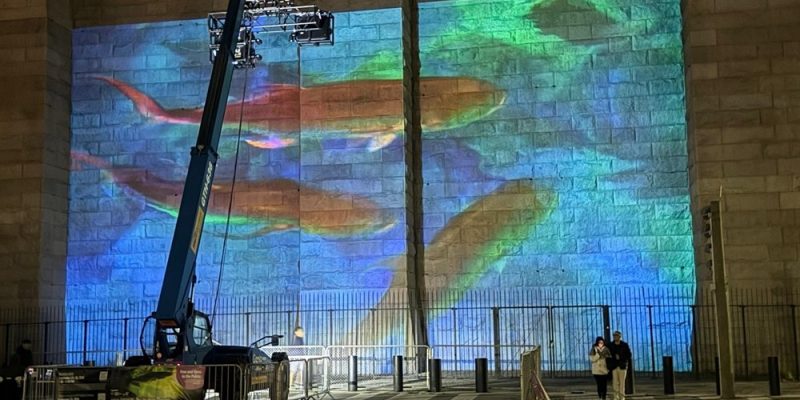
For three hours on Friday, September 25, the eastern pylon of the Brooklyn Bridge will stop being masonry and start being seawater. AQUA COSMOS: The Hudson Canyon, an 18-minute video work by the multimedia artist Anita Glesta, runs on a continuous loop from 7 to 10 p.m., free, viewed from Emily Warren Roebling Plaza in Brooklyn Bridge Park. It is the first time art has been projected onto that pylon.
One thing to know before planning around it: there is now only one night. A second projection had been set for Saturday, September 26, and the Wildlife Conservation Society has canceled it because of the storm forecast. Friday is the whole run.
What is actually on the wall
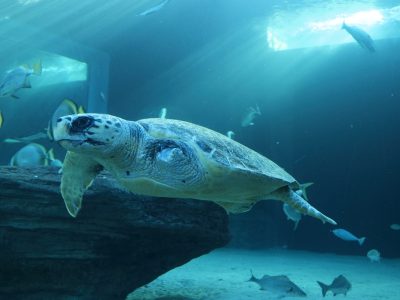
The subject is the Hudson Canyon, a submarine canyon about 100 miles off the coast of New York. A submarine canyon is a valley cut into the edge of the continental shelf, the same shape as a canyon on land and formed by much the same processes, except that the whole thing sits under the Atlantic. The Hudson Canyon is the largest on the Atlantic Coast, rivals the Grand Canyon in depth and scale, and provides habitat for whales, sea turtles, sharks, tuna, cold-water corals and a long list of species that commercial and recreational fisheries depend on.
Glesta built the piece out of historic scientific illustrations, animation, painting, sound and footage recorded in the canyon by the National Oceanic and Atmospheric Administration in 2025. The audio includes calls from fin whales, humpback whales and North Atlantic right whales, recorded by WCS scientists in the New York Bight, the wedge of ocean between Long Island and the New Jersey coast where the canyon begins.
“Art can take us somewhere we cannot easily go ourselves, and for one night I want the Brooklyn Bridge to become a portal into this astonishing world beneath the Atlantic,” said Glesta. “My hope is that people experience the wonder of the Hudson Canyon, its movement, its creatures, its mystery, and come away feeling that this remarkable place is part of their world and worth protecting.”
Why a conservation organization is projecting art onto a bridge
The Wildlife Conservation Society nominated the Hudson Canyon for consideration as a National Marine Sanctuary in 2016, and NOAA is running the public process that will decide it. If the designation goes through, it would be the first national marine sanctuary off the coasts of New York and New Jersey. WCS is working the question alongside a coalition of scientists, conservation groups, fishing interests, businesses and community organizations.
“New Yorkers will look at one of our city’s most iconic landmarks and see an extraordinary ocean wilderness that has been largely invisible to them until now,” said John F. Calvelli of the Wildlife Conservation Society. “The Hudson Canyon is part of New York’s natural heritage, and it deserves lasting protection.”
A hundred years of looking at the same ocean
The work also marks the centenary of the 1925 Arcturus Expedition, the WCS voyage led by the naturalist William Beebe. Beebe is the name that survived, but the expedition’s artists and scientists included Isabel Cooper, Helen Damrosch Tee Van, Ruth Rose, Marie Poland Fish, Lillian Segal and Elizabeth Trotter, and their illustrations and journals are cut into the projection alongside the 2025 NOAA footage. A century of ocean work, in one loop, on one wall.
Marjorie Martay, executive director of ArtW, the nonprofit presenting the piece with WCS through the New York City Department of Transportation’s public art program, said the point was partly the lineage: “It is important to support forward thinking women artists like Anita Glesta who has connected women, art, science, public space and history.”
If you want to see it, the plaza is open and the projection is free. Look east from the Brooklyn side after dark on Friday, and the bridge that every visitor photographs will be full of whales.
More from the beat: the New York Aquarium’s Kemp’s ridley release and the WCS-led study that moved the origin of bats to Europe.
Quick answers
- When and where is AQUA COSMOS being shown?
Friday, September 25, 2026, from 7 to 10 p.m., projected onto the eastern pylon of the Brooklyn Bridge and viewed from Emily Warren Roebling Plaza in Brooklyn Bridge Park. It is free. The second night, Saturday, September 26, has been canceled because of the storm forecast.
- How long is the piece?
Eighteen minutes, running on a continuous loop across the three hours.
- What is the Hudson Canyon?
A submarine canyon about 100 miles off the coast of New York, and the largest on the Atlantic Coast. A submarine canyon is a valley cut into the edge of the continental shelf. This one rivals the Grand Canyon in depth and scale and provides habitat for whales, sea turtles, sharks, tuna and cold-water corals.
- Is the Hudson Canyon a marine sanctuary?
Not yet. The Wildlife Conservation Society nominated it for consideration in 2016 and NOAA is running the public process that will decide it. Designation would make it the first national marine sanctuary off the coasts of New York and New Jersey.
- Who made it and who is presenting it?
The artist is Anita Glesta. It is presented by the Wildlife Conservation Society and ArtW through the New York City Department of Transportation's public art program.