
Twenty-nine beehives now hang along the boundary between farmland and forest reserve in three Ugandan parishes, and they are there to keep chimpanzees and baboons out of the maize. The Chimpanzee Sanctuary & Wildlife Conservation Trust, the Ugandan organization better known for running the Ngamba Island Chimpanzee Sanctuary on Lake Victoria, installed them across Kasongoire, Bulyango and Kasenene parishes in Masindi and Hoima districts, working with the Uganda Biodiversity Fund and a commercial apiary called Kaakyo Home of Bee Products. The trust published the results of the first round of training on September 18, 2026.
Why hang beehives on a farm boundary?
Because bees do a job that a fence does badly and a person does dangerously. Farms in this part of the Bunyoro landscape press directly against forest reserve, and the animals on the other side of that line treat a maize field as an unusually convenient forest. Chimpanzees and baboons raid crops. The household loses food and income. The traditional answers to that problem run from shouting and dogs through to snares and poison, and every one of them puts a farmer in close contact with a large primate that has every reason to defend itself.
A line of occupied hives changes the arithmetic without anybody having to be brave. The trust reports that wild animals, chimpanzees and baboons among them, avoid active beehives, so a row of them along the boundary works as a barrier the animals decline to cross rather than one they cannot. Nothing is injured on either side of it, which is the whole point.
What is a Kenya Top Bar hive?
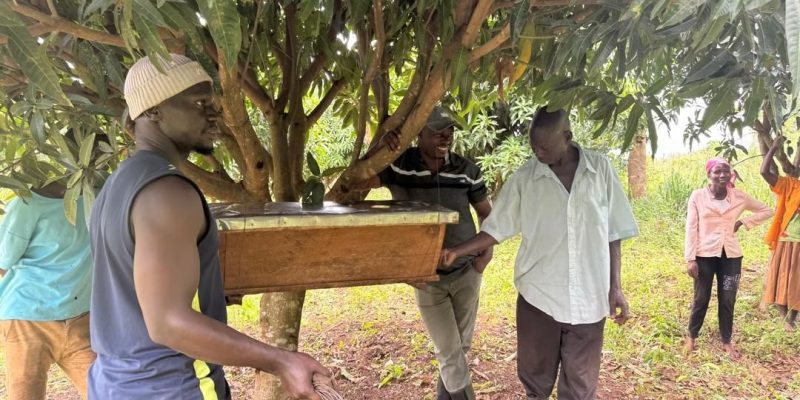
It is a long wooden box with a row of removable wooden bars laid across the open top, each bar a strip the bees build a single comb down from. That design matters here for a practical reason: because each comb hangs from its own bar, a farmer can lift out one comb at a time and harvest honey without dismantling the colony or buying the centrifugal extractor that a frame hive requires. That keeps the cost of getting started low, which is why it is the model the trust chose for all twenty-nine.
Getting bees into an empty box
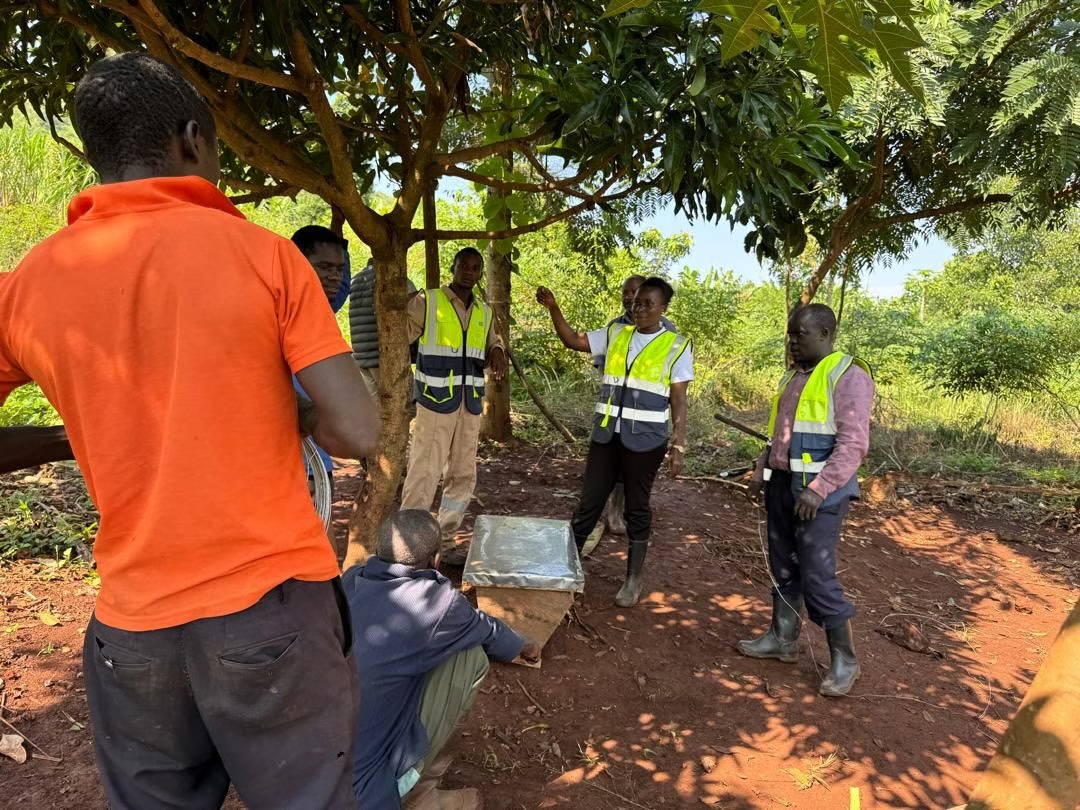
Nobody delivered colonies. The hives were baited to catch wild swarms already moving through the landscape, which is the cheap way to stock an apiary and the reason the training sessions mattered more than the carpentry. Farmers were shown how to rub the top bars with natural beeswax and fresh lemongrass, both of which smell to a scouting swarm like a site another colony has already approved.
The siting instructions were just as specific. Hives are suspended roughly one meter off the ground between mature trees, high enough to keep ground predators out, and turned so that the sun hits them in a way that speeds up colonization without cooking the colony. Hang a hive badly and it stays an empty box.
What the households get out of it
Honey, beeswax and propolis, on a harvest cycle that does not compete with the farming calendar. The trust is explicit that the income is the point and not a side effect: a buffer that costs a household money will be quietly dismantled, and one that pays will be defended. The hives sit along the forest edge, so the high-value product comes off the boundary rather than out of the reserve, and there is no reason to go in and cut.
The twenty-nine hives are demonstration sites rather than the finished program. Farmers gather at them to check on colonization and practice swarm handling, and the trust reports that the first cohort has started mentoring neighboring households, which is how twenty-nine hives become a boundary rather than a pilot. The corridor they are meant to protect is the Budongo to Mukihani to Kasongoire landscape, a stretch of forest connection that eastern chimpanzees depend on to move between blocks of habitat.
Which zoos fund this work?
We looked for a zoo or aquarium behind this project and did not find one. The trust names two funding and technical partners for the beehive work, the Uganda Biodiversity Fund and Kaakyo Home of Bee Products, and neither is a zoological institution. No accredited zoo or aquarium is named as a supporter of this intervention on either side of the relationship, so this article carries no facility hub, which is the honest answer rather than a gap in our reporting.
That is worth setting against the scale of what zoos do spend. The Association of Zoos and Aquariums reports that in 2025 its 235 accredited and certified members spent approximately $372.4 million on conservation work across 139 countries. No published breakdown isolates how much of that reached Africa, and we are not going to estimate one. What we can say is that this particular twenty-nine-hive buffer in Masindi and Hoima was paid for by a Ugandan biodiversity fund and staffed by a Ugandan apiary business.
The animals on the other side of the hives
Chimpanzees, Pan troglodytes, are listed as Endangered on the IUCN Red List, in an assessment published on March 24, 2016, with a decreasing population trend. The animals using the Budongo corridor are eastern chimpanzees, Pan troglodytes schweinfurthii, which the IUCN Species Survival Commission’s primate specialists also class as Endangered and declining.
That listing is what makes a beehive a conservation tool rather than a farming one. An Endangered subspecies cannot spare the individuals that a snare line removes, and the chimpanzees crossing these parishes are doing so because the corridor is the only route between one piece of forest and the next. A buffer that stops them entering a field without stopping them crossing the landscape is doing two jobs at once.
It is a different instrument aimed at the same problem we covered in Kenya this week, where the Sheldrick Wildlife Trust and the Kenya Wildlife Service moved two fence-breaking elephant bulls out of a farming community and into Tsavo. A helicopter and a low-loader for an elephant, a wooden box and a handful of lemongrass for a chimpanzee. Both are attempts to make the boundary between people and wildlife something other than a place where one of them loses.
Quick answers
- What did the Chimpanzee Trust actually install?
Twenty-nine Kenya Top Bar beehives, hung along the boundary between farmland and forest reserve in the Kasongoire, Bulyango and Kasenene parishes of Masindi and Hoima districts, Uganda. The work was published on September 18, 2026.
- How does a beehive keep chimpanzees out of a field?
The trust reports that wild animals, chimpanzees and baboons among them, avoid active beehives. A line of occupied hives along the boundary works as a barrier the animals decline to cross, so crop raiding falls without anybody setting a snare or confronting a large primate.
- What is a Kenya Top Bar hive?
A long wooden box with removable wooden bars across the open top. The bees build one comb down from each bar, so a single comb can be lifted out and harvested without dismantling the colony or buying a centrifugal extractor.
- Which zoo funds this work?
None that we could verify. The trust names the Uganda Biodiversity Fund as the funding partner and Kaakyo Home of Bee Products as the technical partner, and neither is a zoological institution. This article carries no facility hub for that reason.
- How threatened are the chimpanzees using this corridor?
Chimpanzees, Pan troglodytes, are Endangered on the IUCN Red List in an assessment published on March 24, 2016, with a decreasing population trend. The animals crossing these parishes are eastern chimpanzees, Pan troglodytes schweinfurthii, also classed as Endangered and declining.