
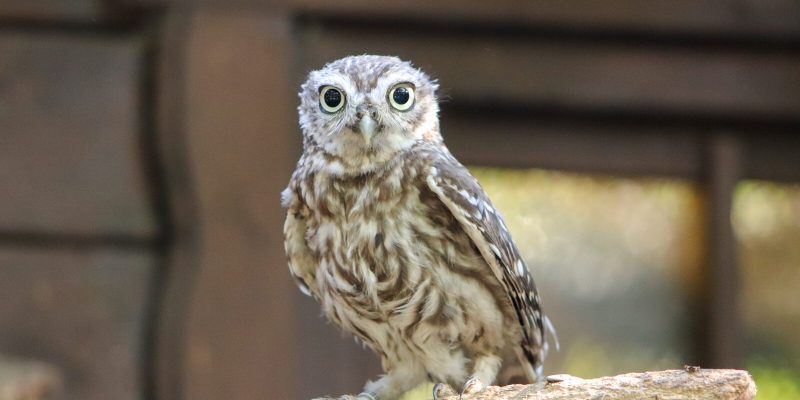
In 2000, the northern Harz foreland had zero breeding pairs of little owls. The bird had gone from a landscape it once occupied, and it was not coming back on its own.
There are about 16 pairs there now. Four young owls raised at Tierpark Berlin are being added to them, and it is the first time the park has contributed birds to the project.
Why they could not return by themselves
The little owl vanished from the northern Harz foreland with the loss of the habitat it depends on and the intensification of farming around it. That is the ordinary version of this story.
The part that decides whether reintroduction is necessary is distance. Tierpark Berlin’s account is blunt about it: natural recolonisation of the area is hardly to be expected, because the nearest existing populations are too far away. A little owl is not going to cross that gap on its own initiative.
So since 2000 the reintroduction project in the northern Harz foreland and the Großes Bruch in Saxony-Anhalt has been releasing young birds. In 2026 the little owl work there enters its 34th year.
The habitat work is the larger half
Releasing birds into the landscape that emptied of them is pointless, and the project treats it that way. Alongside the releases it has been buying and leasing traditional orchard meadows, clearing scrub off them, fencing them, and replanting trees. Goats and sheep graze extensively to keep the ground in the state the owls need.
Orchard meadows are the thing to understand here. A little owl nests in cavities, and in this landscape that historically meant old fruit trees. When the old orchards go, the nest sites go with them, and no amount of releasing solves that.
What Berlin actually contributed
Four young birds, reared at Tierpark Berlin and prepared for release, then acclimatised gradually in the project area before being let go.
Christian Kern, chief zoologist of Zoo and Tierpark Berlin, put the institution’s role this way:
“Als Tierpark Berlin verfügen wir über die Möglichkeit, mit der Zucht bedrohter Tierarten einen direkten Beitrag für konkrete Naturschutzprojekte in der Natur zu leisten.”
Christian Kern, chief zoologist, Zoo and Tierpark Berlin
In English, in a translation by ZooReviews: as Tierpark Berlin, we have the ability to make a direct contribution to concrete conservation projects in the wild through the breeding of threatened species. He added that supporting this owl’s return to the northern Harz foreland shows how important strong partnerships are for species conservation.
How threatened is a little owl, really?
This is worth getting right, because the answer is more interesting than the shorthand.
Globally the little owl is Least Concern on the IUCN Red List, assessed in 2019, with a population believed to be stable and somewhere between 560,000 and 1.3 million breeding pairs in Europe alone. Tierpark Berlin describes it as a threatened owl species, which is true of Germany rather than of the world: the park’s own figure is roughly 7,500 to 8,000 breeding pairs left nationwide, and the species is red-listed in many German regions.
That distinction makes the project better, not worse. This is not a global rescue. It is a regional extirpation being reversed, one landscape at a time, by people who bought the orchards back.
A bird you can actually see
Unlike most owls, the little owl is often out in daylight, watching for prey from fence posts, telephone poles and stone walls. It is one of the few European owls an ordinary person has a real chance of seeing without going looking at night.
Which is part of why an empty landscape was noticed at all.
Tierpark Berlin has turned up here before, for its Somali wild ass foals. For a comparable European release program measured over decades, Durrell’s lesser night gecko translocations follow the same logic: move the animal, then fix the ground it lands on.
Sources: Tierpark Berlin press office, September 8, 2026; BirdLife International Data Zone, Athene noctua.