
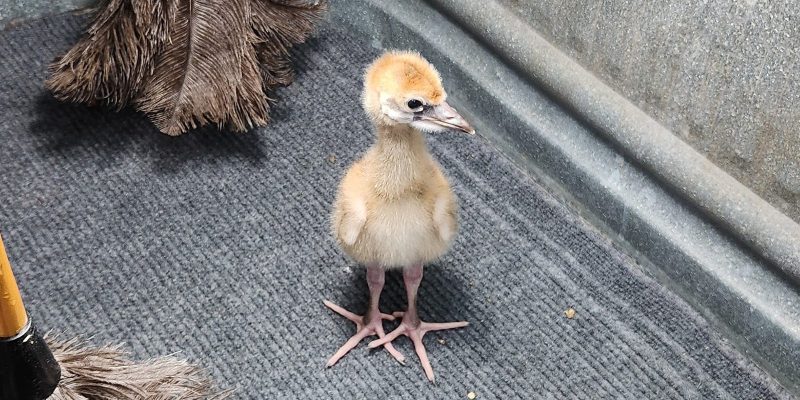
An endangered West African crowned crane chick has hatched at Brevard Zoo in Melbourne, Florida, the first chick for a pair the zoo has been waiting on since 2022. The chick, named Pip, is being reared by the zoo’s Africa team with the help of a hand puppet, a speaker playing its parents’ calls, and a baby chicken for company.
Four years of waiting on one pair
Royal and Goose were formally paired in 2022 under the Association of Zoos and Aquariums Species Survival Plan for West African crowned cranes, a species listed as endangered in its native range because of habitat loss and other pressures. Como Park Zoo went through a similar first with a related species when it raised its first gray crowned crane chicks earlier this summer. Every hatching counts, which is why the zoo’s veterinary team has been running routine radiographs on each egg Royal lays, which come out a distinctive green-blue, to check whether any of them are viable.
None of the most recent clutch appeared to show any sign of life on the images. One egg, though, gave the team enough of a reason to put it in the incubator anyway. A little beak came through the shell. “Pip” is the word for exactly that moment, and it stuck as a name.
Raised by a puppet, on purpose
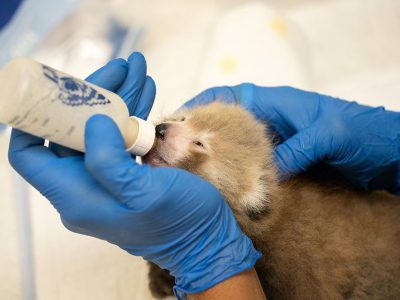
This is the part of the story that shows what modern bird husbandry actually looks like. A chick that learns to associate food and safety with human keepers is a chick that will struggle to behave like a crane later on. So for the first couple of weeks, Brevard Zoo’s team fed Pip using a crane look-alike hand puppet, played recordings of Royal and Goose vocalizing so the chick would learn its parents’ voices, and gave it a companion chicken chick so it would not grow up alone.
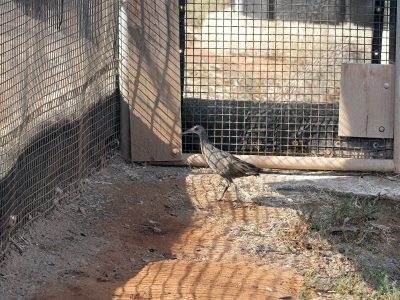
Once Pip was big enough, the team began “howdies,” introductions through sight and sound with no physical contact. Royal and Goose behaved well, but their parental instincts had not switched on far enough for them to take over the feeding. So the arrangement now is a shared one: the trio spend their days in adjoining stalls separated by mesh, where Pip can watch and learn good crane behavior from its parents while keepers continue to do the hands-on work until the chick is independent.
What the team learned
Hand-rearing a chick without letting it imprint on people is a technique other bird programs lean on hard: the Virginia Zoo used comparable care to hatch its first green oropendola. Brevard Zoo says its animal care teams are already adjusting their processes based on this hatch, so that Royal and Goose are set up better if they produce more chicks. That is arguably the most valuable thing to come out of a first successful hatch: a documented playbook for the next one.
When can guests see the chick?
Not yet, but the zoo expects to get there. If things keep going well, the plan is for the family to be out walking around their habitat in Expedition Africa, and Brevard Zoo has said it will announce when guests can look for them. Anyone visiting the Melbourne park this autumn should keep an eye on that section of the zoo.
Brevard Zoo is an independent, not-for-profit organization that receives no recurring government funding for its operating costs.