
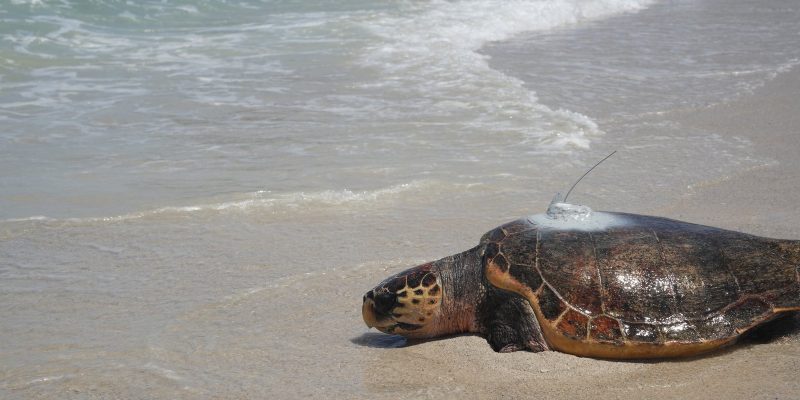
Four rehabilitated sea turtles went back into the ocean at the De Hoop Marine Protected Area on November 19, and one of them had to be helped through the shorebreak because he only has three flippers. The Two Oceans Aquarium Foundation’s Turtle Conservation Centre in Cape Town published the full account of the release on November 26, together with the first week of satellite data from the turtle in question.
The count matters, because the headline number and the species number are not the same. Four turtles went in: Habanero, an adult male loggerhead; Sage, a subadult olive ridley; and Amber and Bellatrix, two hawksbills. That is four animals and three species, and each one arrived at the center by a different route.
The turtle who lost a flipper
Habanero washed ashore at Witsand in February 2025 weighing about 75 kilograms, so covered in marine leeches that he was severely anemic. The barnacle on his shell turned out to have come from the Gulf of Mexico, which is how he got his name. The real problem was in his left elbow: a bone infection that months of targeted antibiotics and surgical debridement failed to clear. In December 2025 the center’s turtle veterinarian, Dr Bernice van Huyssteen, amputated the flipper.
We covered that recovery in October, when a clean CT scan put him in the last phase of rehabilitation. He went back into the aquarium’s I&J Ocean Exhibit to rebuild strength and agility on three limbs, and by September 2026 the scans showed no infection at all. He left the beach at 100 kilograms, having arrived at 75.
Amber is a second animal this site has followed. She stranded at Betty’s Bay in September with her front right flipper missing and long healed, and the veterinary team read that healed stump as evidence rather than damage. She arrived at 7.1 kilograms. She was released at 8.3.
Bellatrix, the second hawksbill, came out of a tidal pool on Strand Beach in April 2026 weighing 5 kilograms, weak, covered in algae and carrying a fresh wound on her left shoulder. Kareema Salie and Lauren Abrahams of the False Bay Underwater Club brought her in. The Grade 5 class at St Cyprian’s School adopted her with money raised at their annual swimathon and chose the name, which means female warrior. She went back at 7.5 kilograms.
What release day actually looks like
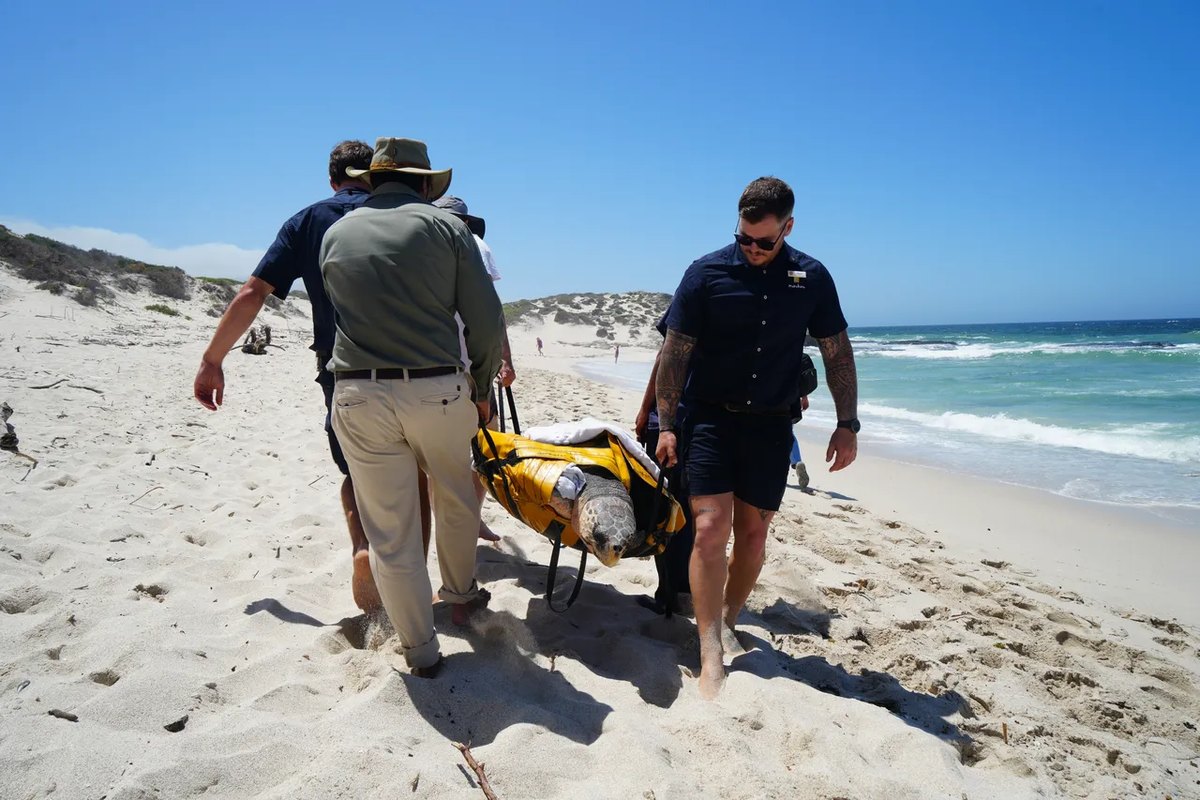
The four turtles traveled to De Hoop in temperature-controlled containers and were carried onto the beach in purpose-made stretchers. Before each animal went in, the people who had been part of its rescue or its rehabilitation said something about it, which is why the release took most of a morning rather than a few minutes.
Amber was carried into the surf by Dr van Huyssteen and by Corné Lamprecht, a marine ranger at Morukuru De Hoop, representing her adopters. Bellatrix was seen off by a St Cyprian’s teacher with some of the Grade 5 class watching. Habanero needed two Morukuru staff and turtle aquarist Siyolise Bezu to manage the waves, because of his size and the missing flipper. Three flippers did not appear to slow Amber down at all: the aquarium reports she went straight into the surf.
Sage got the detail that is hard to improve on. She was carried into the water by Corné Lamprecht, the same ranger who had carried her several kilometers off a De Hoop beach almost a year earlier, when she was found drowning in a ghost net.
Why the olive ridley is the news
Olive ridleys do not nest in South Africa and the Turtle Conservation Centre rarely sees one. When Sage arrived in December 2025 the team identified her from the seven lateral scutes on her shell, the plates along each side of the carapace, which is a count that separates her species from the loggerheads and greens that make up most of the intake.
The ghost net had cut deep into her shoulders, and it had done worse inside: a tear in the lining of her lung let air leak into her body cavity, which had to be treated with antibiotics and drained repeatedly. She came in at 9.6 kilograms and left at 15.9.
Sage is the first acoustically tagged olive ridley the center has ever released. An acoustic tag is not a satellite tag, and the difference decides what each animal can tell us. A satellite transmitter sends a position whenever the animal surfaces, so it maps long-distance travel; an acoustic tag emits a coded ping that is only heard when the animal swims within range of a moored underwater receiver, so it answers where an animal goes along a coast that has receivers on it. South Africa has that coastal network, and this site has written before about what acoustic tags showed about released spotted gully sharks. Nobody has had an olive ridley on it before.
Eighty kilometers in the first week
Habanero carries the satellite tag, and his first update is already in. He covered 10 kilometers on his first day at sea, heading for the southern side of the bay near Skipskop, then turned and looped back toward De Hoop. One week after release he had traveled roughly 80 kilometers, mostly in coastal water, which is what the team expected of an animal readjusting after nearly two years in rehabilitation.
The aquarium has reason to watch that track closely. Kai, a loggerhead who spent almost six years in rehabilitation with buoyancy problems, was released into the same marine protected area in May 2026, and he has since covered 8,815 kilometers on the Agulhas Return Current, navigating it the way turtles who were never in a tank do. The open question with Habanero is narrower and more interesting: how a three-flippered adult male handles the same ocean.
Who paid for this?
We trace the accredited zoos and aquariums behind conservation work in this region, because the funding is usually the only part of the chain anyone publishes. Here the answer is unusually simple: the zoological institution is the one doing the work. The Turtle Conservation Centre is run by the Two Oceans Aquarium Foundation, the aquarium’s own non-profit arm, and the veterinary care, the rehabilitation space, the staff and the release were all its own.
The outside support named in the release is not zoological. The Morukuru Goodwill Foundation, a private foundation attached to a lodge group, adopts turtles at the center and sponsored Habanero’s satellite tag; it also adopted Amber. The Southern African Polar Research Institute donated the three acoustic tags carried by Sage, Amber and Bellatrix. CapeNature, the Western Cape conservation authority, helped recover Habanero. Kogelberg Wildlife Sanctuary and the False Bay Underwater Club brought in the two hawksbills. Karoline Hanks ran 194 kilometers over two days between Cape Point Nature Reserve and Green Point to fund Sage’s treatment, and passed her target of R80,000.
No other accredited zoo or aquarium appears anywhere in this release. We looked, and there is not one. For scale, the Association of Zoos and Aquariums reports that 235 accredited and certified facilities spent roughly $372.4 million on conservation across 139 countries in 2025. No published breakdown isolates what any one region receives, so we do not estimate one.
A note on the listings
The aquarium describes all four animals as endangered species. The IUCN Red List is more specific, and the three species are not in the same place. Hawksbills, which Amber and Bellatrix are, are assessed Critically Endangered under criterion A2bd, in an assessment dating from 2008. Loggerheads and olive ridleys are both listed Vulnerable: the loggerhead under A2b, assessed in 2015 and published in 2017, and the olive ridley under A2bd, also from 2008. All three are recorded as decreasing.
Where a facility’s wording and the Red List differ, we default to the assessment, and it is worth saying that the assessment itself carries a caveat here. The loggerhead page is annotated “needs updating” by the Red List, and the olive ridley and hawksbill assessments are both eighteen years old. None of that changes the day. A Critically Endangered hawksbill that came off a beach at 5 kilograms and swam away at 7.5 is the same good outcome whichever label it carries.
What happens next
Three of the four turtles will be heard from only if they pass a receiver. Habanero will be heard from whenever he surfaces, and the aquarium is publishing his track. For an adult male loggerhead, the point of the exercise is not the map: it is that he is old enough and healthy enough to father the next generation, which is a thing a turtle who nearly died of a bone infection in 2025 had no business doing.
Quick answers
- What happened at De Hoop on November 19?
The Two Oceans Aquarium Foundation Turtle Conservation Centre released four rehabilitated turtles of three species into the De Hoop Marine Protected Area: Habanero, an adult male loggerhead; Sage, a subadult olive ridley; and Amber and Bellatrix, two hawksbills.
- Why does the olive ridley matter?
Sage is the first acoustically tagged olive ridley the centre has released. Olive ridleys do not nest in South Africa and the rehabilitation team rarely sees one. She was identified by the seven lateral scutes along each side of her shell.
- What is the difference between an acoustic tag and a satellite tag?
A satellite transmitter sends a position whenever the animal surfaces, so it maps long-distance travel. An acoustic tag emits a coded ping that is only heard when the animal passes a moored underwater receiver, so it answers where an animal goes along a coast that has receivers on it. Habanero carries the satellite tag; the other three carry acoustic tags.
- How far has Habanero traveled since release?
He covered 10 kilometers on his first day at sea, heading toward Skipskop, then looped back toward De Hoop. One week after release he had traveled roughly 80 kilometers, mostly in coastal water.
- Does an accredited zoo or aquarium fund this?
The Turtle Conservation Centre is run by the Two Oceans Aquarium Foundation, the aquarium own non-profit arm, so the zoological institution is the one doing the work. The outside support named is not zoological: the Morukuru Goodwill Foundation, the Southern African Polar Research Institute, CapeNature, Kogelberg Wildlife Sanctuary, the False Bay Underwater Club and an individual fundraiser. No other accredited zoo or aquarium appears in the release.