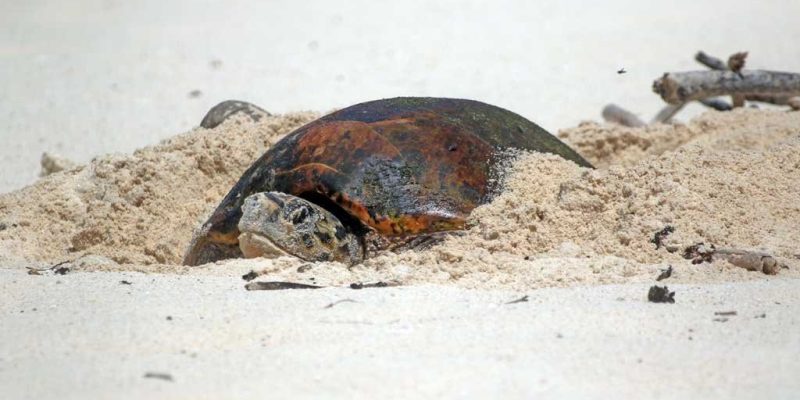
Two hawksbill turtles were taken from beaches in Seychelles in the same week, on Praslin and on Mahe, and both were recovered alive. One is being treated on Mahe for a head injury. The other was released back into the sea.
The Praslin case became public through a video that circulated widely on social media, which appears to show a man dragging a turtle back up the beach as she tried to return to the water. Conservation officers and the Seychelles Coast Guard intervened and the turtle was moved to Mahe for treatment. Authorities say she is responding well to care. In the separate case on Mahe, the Ministry of Environment, Climate, Energy and Natural Resources and the Seychelles Police recovered a second turtle, which was later returned to the ocean.
What the law says
Speaking at a press conference, the ministry’s principal secretary, Indra Gamatis, reminded the public that sea turtles are strictly protected in Seychelles. Under the Wild Animals and Birds Protection (Amendment) Act of 2024, anyone convicted of disturbing, injuring, capturing or killing a sea turtle, or found in possession of live turtles or turtle meat, faces fines of up to one million Seychellois rupees, imprisonment for up to seven years, or both.
The ministry has asked residents and visitors not to disturb turtles coming ashore to nest, and runs a confidential reporting line, the GreenLine, on 2722111.
Why the timing matters
Both incidents fall inside the hawksbill nesting season in Seychelles, and there is a detail of this species’ behavior that makes that worse than it sounds. Most sea turtles nest at night. Seychelles hawksbills typically nest during the day, in full view, which is exactly what makes them easy to watch and easy to take.
Sea turtles can take decades to reach breeding age, and only a small fraction of hatchlings ever get there. Nature Seychelles, which manages the Cousin Island Special Reserve, makes the arithmetic plain: losing a single breeding female is a loss measured in generations rather than in individuals.
What the Red List actually says
Nature Seychelles describes the hawksbill as Critically Endangered on the IUCN Red List, and the assessment agrees. Eretmochelys imbricata is listed as Critically Endangered under criterion A2bd, with a decreasing population trend, assessed by the IUCN SSC Marine Turtle Specialist Group.
Two things about that assessment are worth knowing, because they shape what anyone can honestly claim about this animal. It was last assessed on 30 June 2008 and the Red List carries an annotation on it saying it needs updating, so it is a document nearly two decades old. And it publishes no global count of mature individuals at all. Where a figure for the world population of hawksbills turns up, it has come from somewhere other than the Red List, and should be attributed to whoever produced it. The category itself is not in doubt, and the species is separately listed under the United States Endangered Species Act, where NOAA Fisheries records it has been since 1970. The two are different lists with different vocabularies, and it is worth naming which one a status came from.
The island that shows it can go the other way
Cousin Island lies off Praslin, where the first of these two turtles was taken, and it is one of the better arguments in the world that protection works on this species. The island has been protected since 1968. Its turtle monitoring program began in 1972 and has run continuously since, which Nature Seychelles describes as one of the longest unbroken turtle records anywhere. Over that period the number of nesting hawksbill females has increased eight-fold.
That is the same reserve we wrote about when its hawksbill story was being told in knitted yarn, and it is the reason the poaching cases register as outrage locally rather than as background noise. Seychelles has spent fifty years demonstrating what a protected nesting beach produces.
If you meet a nesting turtle
Nature Seychelles publishes guidance for anyone who encounters a turtle coming ashore, and Chris Tagg, the science officer on Cousin Island, frames it as a matter of what she is there to do.
“Seeing a sea turtle come ashore is a remarkable experience. Remember, though, that she’s there to complete an important part of her reproductive cycle.”
The guidance itself is short. Watch from a distance, and stay behind her and out of her line of sight. Keep the path between her and the water clear, and never stand in front of her. Do not touch or move turtles, and do not disturb nests or hatchlings. Report any injured turtle, or any suspected poaching, to the authorities.
Who funds the work
We look for the accredited zoos and aquariums behind field conservation wherever we cover it, because that money is frequently the quiet reason a program exists. We did not find any here. Nature Seychelles lists its funding partners publicly, and the ones named are the Seychelles Conservation and Climate Adaptation Trust, the Environment Trust Fund and the Jensen Foundation, alongside overseas universities that place research students with it. No accredited zoological institution appears among them. That is a finding rather than a gap, and it is worth stating plainly: the longest-running hawksbill monitoring program in the Indian Ocean is not, as far as its own published record shows, zoo-funded.
Quick answers
- What happened to the two turtles?
One was dragged back up a beach on Praslin as she tried to return to the sea and suffered a head injury. She was taken to Mahe for treatment and is responding well. A second turtle, recovered on Mahe, was released.
- What is the penalty for poaching a sea turtle in Seychelles?
Under the Wild Animals and Birds Protection (Amendment) Act of 2024, a conviction for disturbing, injuring, capturing or killing a sea turtle, or for possessing live turtles or turtle meat, carries a fine of up to one million Seychellois rupees, up to seven years in prison, or both.
- Why are hawksbills in Seychelles especially vulnerable?
They typically nest during the day rather than at night, which makes a nesting female easy to find. Sea turtles also take decades to reach breeding age, so the loss of one breeding female is measured in generations.
- What should I do if I find a nesting turtle?
Watch from a distance, stay behind her and out of her line of sight, and leave the path between her and the water clear. Do not touch or move turtles or disturb nests. Report any injured turtle or suspected poaching to the authorities, in Seychelles on the GreenLine, 2722111.