In the first ten days of November the Sheldrick Wildlife Trust published two field operations drawn from the same Kenyan dry season. On November 2 a team hauled an elephant calf out of a hand-dug well and watched her run back to her mother. On November 10 the Trust reported an aerial operation that moved 18 bull elephants off community land, across a river and back inside a protected area. Neither account runs longer than a few paragraphs on the Trust’s own site. Read together, they describe one problem from two ends.
Why does the dry season push elephants onto farmland?
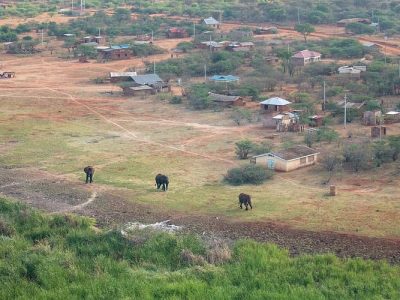
Not because the park has run dry. The Trust is specific about this, and it is the part most accounts of human-elephant conflict leave out: during the dry season food and water are still available inside the park. What changes is the comparison. Crops and stored water on the farms just beyond the boundary are easier, and elephants are good at arithmetic of that kind. “Their presence can be disruptive and dangerous, which is often the catalyst for human-wildlife conflict,” the Trust wrote on November 10.
The boundary is where the problem sits. Much of it cannot be fenced, either because the terrain refuses or because fencing it would cut a migration route. What is left, in the Trust’s words, is the need for “a rapid, reliable response.” That response is an aircraft, and the authority to act on what the aircraft sees comes from the Kenya Wildlife Service, the government agency the Trust flies in partnership with.
The calf in the well
The November 2 account begins with a baby elephant already trapped. Her mother was standing over the well, which the Trust described as frantic but helpless, and the first job was not the calf at all. It was moving the mother far enough away that people could work. Only then could the team get into the hole.
There was no winch and no clever rig in this one. They climbed in and lifted her out by hand. The calf weighed in the region of 200 kilograms, which is roughly 440 pounds, and the Trust’s own write-up is dry about the word “little” doing any work in that sentence. Once she had her feet under her she ran, and she found her mother again at the tree line.
The detail worth keeping is the one about the well itself. These are not natural hazards. The Trust describes “countless wells like these, dotted across private land and not dug with wildlife in mind.” They are water infrastructure for people and livestock, built during the same dry season that drives elephants toward them, and they are open at the top.
The 18 bulls
The November 10 operation is the other end of the same equation: not an animal already in trouble, but a group of animals heading toward it. Eighteen bulls had crossed onto community land. The Trust credits the operation to Taru and reports the outcome plainly, that all 18 went back across the river and into the park.
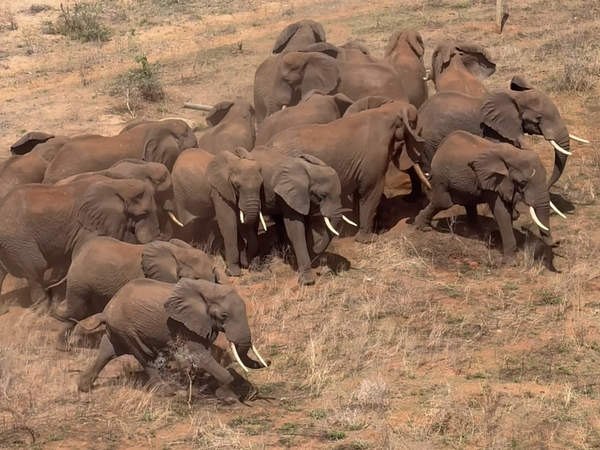
Eighteen is a large number for bulls, who are often solitary or in loose, shifting company, and moving that many at once without scattering them into the farms they came for is the skill being described. The Trust says the operation unfolded a few days before it was published, and gives no further detail.
This is the fourth operation of broadly this kind we have covered from the Trust since late September. In September two fence-breaking bulls were driven deep into Tsavo rather than shot. In October a calf went into a septic tank and was floated out on water, and an adult female and her calf were dug out of setting mud in Samburu. The common factor in every one of them is water, or the lack of it, and something built or dried into a trap around it.
Which zoos pay for this?
We looked, and on this work we did not find any. It is worth saying plainly rather than leaving as a silence, because on this beat the answer is often a zoo and readers are entitled to know when it is not.
The only institutional partner either account names is the Kenya Wildlife Service, which is a government agency rather than a zoological institution. The Trust’s aerial unit is funded from its own donor base, and the November 2 piece closes by thanking donors directly for making the patrols possible. We found no accredited zoological institution named as a funder of the aerial unit, as a provider of staff or expertise on either operation, or as the holder of any animal involved. No zoo has earned a place in this story, so none is claimed here.
For scale on the wider question: the Association of Zoos and Aquariums reports that its 235 accredited members spent roughly $372.4 million on conservation across 139 countries in 2025. No published breakdown isolates how much of that reached Africa, and we will not estimate one. What can be said is that this particular aircraft, on these particular mornings, was paid for by individual donors to a Kenyan trust.
What the two stories have in common
An aircraft is an expensive way to find an elephant. The argument for it, which both of these accounts make without quite stating it, is that most of the value is in the flights where nothing happens. The Trust puts it as being present, in the air and on the ground, so that emergencies can be acted on. The calf in the well was found that way. The 18 bulls were turned before they became a conflict anyone had to resolve afterward.
Neither outcome makes much of a story on its own, which is probably why both were published as short notes rather than features. That is the shape of a good dry season: a series of things that did not become incidents.
Quick answers
- What happened to the elephant calf trapped in the well?
The Sheldrick Wildlife Trust reported on 2 November 2026 that a team found a baby elephant trapped in a hand-dug well. They first moved her mother a safe distance away, then climbed into the well and lifted the calf out by hand. She weighed in the region of 200 kilograms. Once she found her feet she ran off and rejoined her mother at the tree line.
- What was the 18-bull aerial escort?
On 10 November 2026 the Trust reported an aerial operation that moved 18 bull elephants off community land, across a river and back into a protected area. The Trust credits the operation to Taru and says it unfolded a few days before publication. Its pilots fly these operations in partnership with the Kenya Wildlife Service.
- Why do elephants leave the park during the dry season?
Not because the park runs out. The Trust states that food and water are still available inside the protected area during the dry season, but that elephants are tempted by the easy meals in farms and fields just beyond it. It describes that presence as disruptive and dangerous, and as often the catalyst for human-wildlife conflict.
- Are these wells a natural hazard?
No. The Trust describes countless wells dotted across private land and not dug with wildlife in mind. They are water infrastructure for people and livestock, built during the same dry season that drives elephants to look for water, and they are open at the top.
- Which zoos fund the Sheldrick Wildlife Trust aerial unit?
None that we could verify. The only institutional partner named in either account is the Kenya Wildlife Service, which is a government agency rather than a zoological institution. The Trust thanks its individual donors directly for funding the patrols. We found no accredited zoological institution named as a funder, as a provider of staff or expertise, or as the holder of any animal involved.
- How much do accredited zoos spend on conservation worldwide?
The Association of Zoos and Aquariums reports that its 235 accredited members spent roughly $372.4 million on conservation across 139 countries in 2025. No published breakdown isolates how much of that reached Africa, and we do not estimate one.