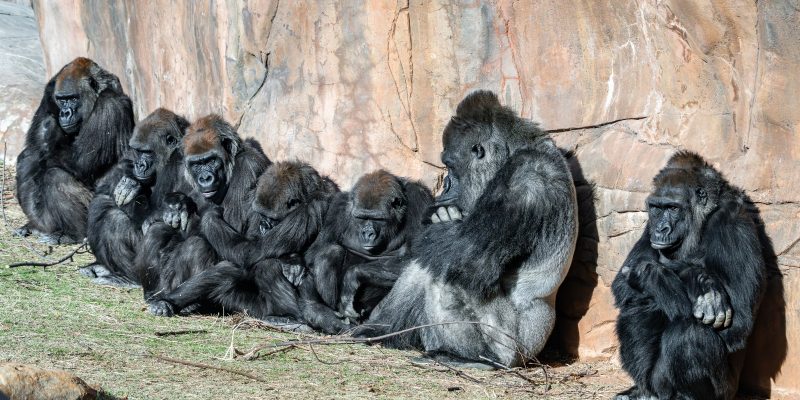
Two western lowland gorillas, a 33-year-old female named Kashata and her 7-year-old daughter Grace, have joined the family troop at the Oklahoma City Zoo and Botanical Garden and can now be seen at Great EscApe, the zoo’s great ape complex. They arrived earlier in the summer of 2026 from an accredited institution in Central Florida.
With the two of them, the family troop stands at seven: the silverback Togo (37) and females Emily (41), Mikella (22), Rubi (11) and Azinza (8), plus Kashata and Grace. The zoo separately cares for a bachelor troop of three males, George (22), Bo (20) and Bakari (20).
Why does moving two gorillas take all summer?
Because a gorilla troop is a set of relationships, not a room with animals in it, and a new arrival has to be written into them.
Gorillas live in cohesive, hierarchical groups led by a silverback, the mature male whose back hair turns gray with age and who holds the group together, settles disputes within it and decides where it goes. Introducing an unfamiliar female to an established troop means she has to find a place in that order, and the other females have to accept it. Keepers run the process in stages, at the animals’ pace, so that the first real meetings happen between individuals who have already seen, heard and smelled each other.
The introduction period does a second job that is easy to overlook. It is also when caretakers learn who they are dealing with.
“The girls are thriving and have successfully integrated into the troop. Kashata and Grace are starting to form relationships with individual troop members which is important for them as they learn their roles within the group and build lasting social bonds.”
That is Pace Frank, the zoo’s assistant curator of primates. Caretakers describe Kashata as confident and intelligent, and Grace, the smaller of the two, as playful, curious and eager to work in training sessions.
Who decides which gorilla goes where?
The move came on a recommendation from the Species Survival Plan for gorillas, a program run by the Association of Zoos and Aquariums. An SSP is a studbook with teeth: biologists track the parentage of every animal of a species across accredited institutions and recommend which individuals should move and breed, so the population in human care stays genetically diverse rather than drifting toward a handful of over-represented bloodlines. No single zoo could manage that from inside its own walls, which is why the animals travel.
Grace carries her name from the conservation side of the same work. She is named for the Gorilla Rehabilitation and Conservation Education Center, known as GRACE, which cares for orphaned Grauer’s gorillas confiscated from the illegal wildlife trade in the Democratic Republic of the Congo and works to protect the forest they came from.
How threatened are western lowland gorillas?
Seriously, and the assessment is blunter than most. The IUCN Red List lists the western lowland gorilla (Gorilla gorilla ssp. gorilla) as Critically Endangered, the highest category before extinction in the wild, under criteria reflecting a projected decline across three generations. For an animal with a generation length of 22 years, that is a long shadow.
Two things about that listing are worth stating plainly, because they are the kind of detail that gets rounded off. The assessment dates to January 2016 and was amended in 2018, so it is approaching a decade old. And it publishes no global population figure at all: the field for number of mature individuals is empty. Widely repeated counts for wild western lowland gorillas are secondary-source estimates, not Red List numbers, and are worth attributing as such. The threats the assessment does name are specific enough: commercial hunting, disease, and habitat loss driven by logging and mining.
Oklahoma City’s conservation money on this species goes to the Dian Fossey Gorilla Fund, one of the zoo’s legacy partners, supporting protection and research for mountain gorillas in Rwanda and Grauer’s gorillas in the DRC. The zoo also runs Gorillas on the Line, which collects old cell phones and small electronics for recycling. The point is coltan, a mineral refined into the capacitors inside those devices and mined in part in gorilla range countries. Recycling what has already been mined lowers demand for digging more of it, and the zoo gives a free general admission voucher to anyone who drops a device off at guest services.
Seeing them
Kashata and Grace are on view at Great EscApe. Gorilla troops spend a good deal of the day sitting, grooming and watching one another, so the thing to do is stop and stay a while rather than pass through, and work out who is attending to whom. Grace is the small one, and by her keepers’ account the one most likely to be doing something.
Oklahoma City’s move is the ordinary machinery of a continental breeding program doing what it is meant to do, which is the same machinery that recently sent two lions from Fresno Chaffee Zoo across the country. The zoo announced the arrival on August 19, 2026.
Quick answers
- Who are Kashata and Grace?
Western lowland gorillas, a 33-year-old mother and her 7-year-old daughter, who joined the Oklahoma City Zoo family troop in the summer of 2026 from an AZA-accredited institution in Central Florida.
- How many gorillas live at the Oklahoma City Zoo?
Ten. A family troop of seven, led by the silverback Togo, and a bachelor troop of three males: George, Bo and Bakari.
- Where can you see them?
At Great EscApe, the zoo great ape complex.
- Why is Grace called Grace?
She is named for the Gorilla Rehabilitation and Conservation Education Center, known as GRACE, which cares for orphaned Grauer gorillas confiscated from the illegal wildlife trade in the Democratic Republic of the Congo.
- What is a Species Survival Plan?
An Association of Zoos and Aquariums program that tracks the parentage of every animal of a species across accredited institutions and recommends which individuals should move and breed, so the population in human care stays genetically diverse.
- Are western lowland gorillas endangered?
The IUCN Red List lists the western lowland gorilla as Critically Endangered. That assessment dates to January 2016, was amended in 2018, and publishes no global population figure: the field for number of mature individuals is empty.
- What is Gorillas on the Line?
An Oklahoma City Zoo program that collects old cell phones and small electronics for recycling, lowering demand for newly mined coltan. Donors receive a free general admission voucher, one per person.