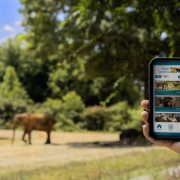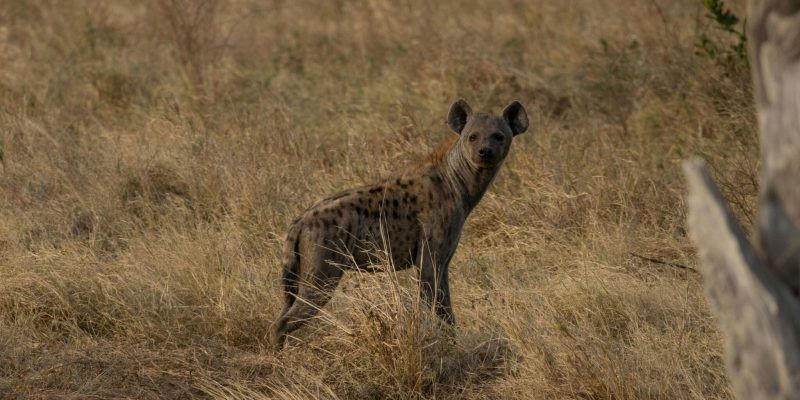
Between the evening of July 13 and the morning of July 14, 2025, researchers in northern Kenya set up 21 loudspeakers across the Lewa-Borana Landscape and the Ngare Ndare Forest, spaced 1.8 kilometers apart, and spent the night broadcasting the sound of a kill.
Each station played a 40-minute sequence: distressed buffalo calls, the whooping and giggling of hyenas feeding, and lion roars over the top. To a spotted hyena within earshot, that combination means a carcass is on the ground and other animals are already at it. The hyenas came, which was the point. Counting what arrives is one of the few reliable ways to count an animal that is nocturnal, wide-ranging and very hard to survey any other way.
The result is the first robust scientific baseline for spotted hyenas in this landscape: an estimated 204 animals.
How a call-up survey works
A call-up survey is exactly what it sounds like. Rather than trying to find the animals, you make a noise they cannot ignore and count the ones that come to it. The method is standard for large carnivores because it produces numbers that can be compared between sites and between years, which chance sightings cannot.
The detail that makes it work is the schedule. Lewa’s teams ran the stations between 6:20 in the evening and 7:30 the following morning, which is the window when spotted hyenas are active and moving. Each station covered a different habitat type, and the 1.8 kilometer spacing is a compromise: close enough to cover the ground, far enough apart that the same animal is unlikely to be drawn to two speakers and counted twice.
From the number of animals responding at each station, researchers calculate a density, and from the density an estimate for the whole area.
What the survey found
The three areas came out quite differently from one another:
- Lewa Wildlife Conservancy: 0.43 hyenas per square kilometer, an estimated 82 animals.
- Borana Wildlife Conservancy: 0.85 per square kilometer, an estimated 104 animals.
- Ngare Ndare Forest: 0.31 per square kilometer, an estimated 18 animals.
Together, an estimated 204 spotted hyenas across the Lewa-Borana Landscape and the neighboring forest. Borana carries almost exactly double Lewa’s density, which is the kind of difference a single survey raises without answering, and the kind that only repeated counts can explain.
Why count an animal nobody is worried about?
This is the part worth sitting with. The IUCN Red List assesses the spotted hyena as Least Concern, which sounds like a species that does not need a census. Read the assessment itself and the picture is less comfortable. The global population trend is recorded as decreasing. The assessment was carried out on October 1, 2014 and published in 2015, by T. Bohm and O. R. Höner, and it carries an explicit annotation on the Red List: needs updating.
So the category says Least Concern, the trend inside the same assessment says the numbers are falling, and the Red List itself flags the whole thing as more than a decade old. That is not a contradiction, it is what a global category is for. Least Concern is a statement about a species whose range the assessment maps across more than three dozen African countries, from Senegal to Somalia to South Africa. It is not a statement about any particular landscape, and it cannot tell a Kenyan conservancy whether the hyenas on its own ground are increasing, stable or quietly disappearing.
Only a local baseline can do that, and until July 2025 this landscape did not have one. Estimates relied on chance sightings, which are useful up to a point and useless for detecting a trend.
What the number is for
Spotted hyenas are more interesting than their reputation. Despite being cast permanently as scavengers, they hunt more than half of their own food, and they are among the most socially complex carnivores in Africa. They are also a predator that lives alongside people, which is the real reason this count matters here.
The Lewa-Borana Landscape is a multi-use place: wildlife conservancies, a forest reserve, and pastoral livelihoods sharing the same ground. Human-carnivore coexistence on that kind of land is managed through specifics, not sentiment. Knowing there are roughly 82 hyenas on Lewa and 104 on Borana lets managers judge whether a livestock loss pattern reflects a growing population or a single problem clan, and gives them a number to measure the next count against.
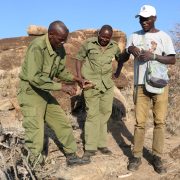
Lewa’s predator monitoring officer, Felix Kasyoki, ran the call-up speakers in the field. The conservancy’s own conclusion is that spotted hyenas are doing well in the region, with the qualification that a first baseline is only a baseline: it tells you where you are standing, not which way you are moving.
Is a zoo paying for this?
We looked, and on this particular piece of work we did not find one. Lewa names no funder for the hyena survey, describing it only as work carried out with partners. The conservancy does have a long-standing zoo relationship, with Zoo Zurich funding its ranger and patrol operations since 1998, but we have no evidence tying that money to this survey, and we are not going to imply one. Several accredited institutions hold and study spotted hyenas, among them Woodland Park Zoo in Seattle, whose work is not connected to this count either.
A survey with no zoo funder behind it is a perfectly ordinary outcome and a more honest one to report than a connection assembled after the fact. What the survey does have is 21 speakers, one long night, and a number that did not exist before.
Quick answers
- What is a call-up survey?
A standardized method for counting large carnivores in which researchers broadcast sounds that suggest a kill, then count the animals that respond, rather than trying to find the animals themselves.
- How was this survey run?
Across the night of July 13 to 14, 2025, at 21 playback stations spaced 1.8 kilometers apart, each broadcasting a 40-minute sequence of distressed buffalo calls, hyena feeding cries and lion roars between 6:20 p.m. and 7:30 a.m.
- How many spotted hyenas were counted?
An estimated 204 in total: about 82 on the Lewa Wildlife Conservancy at 0.43 animals per square kilometer, about 104 on the Borana Wildlife Conservancy at 0.85, and about 18 in the Ngare Ndare Forest at 0.31.
- How is the spotted hyena listed by the IUCN?
Least Concern. The assessment was carried out on October 1, 2014 and published in 2015, it records the global population trend as decreasing, and the Red List annotates it as needing updating.
- Why count a species listed as Least Concern?
Because a global category describes a species across its whole range and cannot say whether the animals on one landscape are increasing, stable or declining. Before this survey the local estimates rested on chance sightings.
- Is a zoo funding this work?
We looked for one and did not find it. Lewa names no funder for the hyena survey, describing it only as work carried out with partners.