Before the Island Conservation Society could begin removing rats from Alphonse Atoll, it had to move the tortoises. All 187 wild Aldabra giant tortoises living on the island were walked or carried into a secure enclosure and held there while the work went on, and the eradication operation that followed has now run most of a year.
The Seychelles organization announced on 19 October 2026 that the program to clear Alphonse of rats, mice, feral cats and feral chickens has moved into its confirmation phase. It is working with the Alphonse Foundation, the Islands Development Company and Blue Safari Seychelles, with technical leadership from Island Biodiversity and Conservation.
What was removed, and when
The sequence matters more than the headline, because an island eradication either finishes completely or does not count. One pregnant rat is a failure.
Preparations began in January 2026 with feasibility studies. An island-wide biodiversity assessment followed in March, establishing the baseline against which any recovery will later be measured. The island itself was then prepared: vegetation trimmed, green-waste areas cleared, staff trained. The tortoises went into their enclosure.
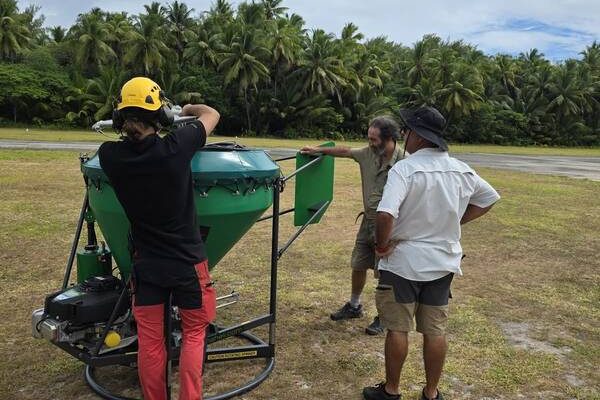
Rat eradication ran from June into July. Intensive trapping and monitoring have continued through October to confirm that no rodents remain. Mice were targeted as well, particularly around buildings and staff areas, where they are hardest to reach and most likely to persist.
Feral cats were worked between 23 June and 2 September using targeted baiting, camera traps and island-wide searches. That part of the operation has now moved into a surveillance phase, which is the stage where a team tries to prove a negative. Feral chickens are the final target, with systematic searches continuing.
Why an atoll needs this at all
Alphonse has been shaped by people for more than two hundred years. From the 18th century it was developed as a commercial coconut plantation, and human activity brought species that did not belong there. Island wildlife is unusually defenseless against introduced predators: rats and cats take nesting seabirds, while rodents and feral chickens work on native vegetation, invertebrates and the rest of the food web.
Dr Gerard Rocamora, who led the work technically and has spent a career on invasive species management in the Seychelles, put the case this way: “Many seabirds, reptiles and invertebrates cannot live in the presence of introduced rats and cats. We need to restore these small islands to create sanctuaries where ecological conditions are as close as possible to those that prevailed before humans arrived. Alphonse is now being given that opportunity.”
The Island Conservation Society has run a permanent conservation center on Alphonse since 2007, with scientists and rangers monitoring seabirds, sea turtles, marine ecosystems and native habitats. That is nineteen years of baseline, and it is the reason anyone can say what recovery would look like here. The same long-run monitoring produced the nesting records behind a hawksbill that dug for three hours on Ile Plate earlier this month.
What recovery would look like
Nesting seabirds are the first expected beneficiaries. Wedge-tailed shearwaters and white-tailed tropicbirds both nest in places a rat can reach, and both should gain from reduced predation. Native vegetation and ground-dwelling invertebrates may respond as pressure from rodents and chickens falls away.
The more interesting effect is slower and runs through the soil. Seabird colonies carry nutrients from the ocean back onto land in their guano, which enriches the soil, stimulates plant growth and feeds a whole web of life above and below ground. On a restored island the seabirds are not only the thing being saved; they are the mechanism by which the rest of it gets saved.
We looked for the zoo money, and did not find it
ZooReviews traces the accredited zoological funding behind field conservation as a matter of course, because it is frequently there and almost never published on the field organization’s side. Here it is not there, or at least not findable. The Island Conservation Society names no accredited zoo or aquarium among the partners on this operation: the organizations credited are the Alphonse Foundation, the Islands Development Company, Blue Safari Seychelles and Island Biodiversity and Conservation. The society’s own partners page, which search engines still index, returns a 404. We checked from the institutions’ side as well and found nothing connecting an accredited facility to the Alphonse work.
That is a finding rather than a gap. For scale, the Association of Zoos and Aquariums reports that 235 accredited and certified facilities spent approximately $372.4 million on conservation across 139 countries in 2025, and no published breakdown isolates what any region received. Some of the best island restoration in the world runs without a zoo anywhere near it, and saying so is more useful than implying a connection that nobody has evidenced.
The surveillance phase is the part that decides whether any of this worked. If the traps stay empty and the cameras stay clear, the tortoises go back out onto an island that has not been free of rats since the plantation era, and the shearwaters get a season with nothing climbing into the burrows.
Quick answers
- What is happening on Alphonse Atoll?
The Island Conservation Society and its partners are removing rats, mice, feral cats and feral chickens from the island, so that native seabirds, reptiles and invertebrates can recover. The society announced on 19 October 2026 that the operation has reached its confirmation phase.
- Why were the tortoises moved?
All 187 wild Aldabra giant tortoises living on Alphonse were temporarily moved into a secure enclosure to keep them safe while the eradication work went on. They were moved before the operation began, as part of the preparation.
- Who is doing the work?
The Island Conservation Society is working with the Alphonse Foundation, the Islands Development Company and Blue Safari Seychelles. Technical leadership comes from Island Biodiversity and Conservation, with Dr Gerard Rocamora, who has long experience of invasive species eradication in the Seychelles.
- What has been removed so far?
Rat eradication ran from June into July, with trapping and monitoring continuing through October to confirm no rodents remain. Mice were targeted particularly around buildings and staff areas. Feral cats were worked between 23 June and 2 September and that phase has moved to surveillance. Feral chickens are last, with systematic searches continuing.
- Which animals are expected to benefit?
Nesting seabirds first, including wedge-tailed shearwaters and white-tailed tropicbirds, which lose eggs and chicks to rats and cats. Native vegetation and ground-dwelling invertebrates should also respond as pressure from rodents and feral chickens falls away.
- How do seabirds change an island beyond their own numbers?
Seabird colonies carry nutrients from the ocean onto land in their guano. That enriches the soil, stimulates plant growth and supports the rest of the food web, so recovering colonies are both the result of a restoration and one of its main mechanisms.
- Is an accredited zoo or aquarium funding this?
Not that we could verify. The Island Conservation Society credits the Alphonse Foundation, the Islands Development Company, Blue Safari Seychelles and Island Biodiversity and Conservation, and names no accredited zoological institution. Its own partners page returns a 404, and a search from the institutions’ side found nothing connecting an accredited facility to the Alphonse work.