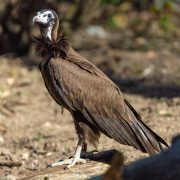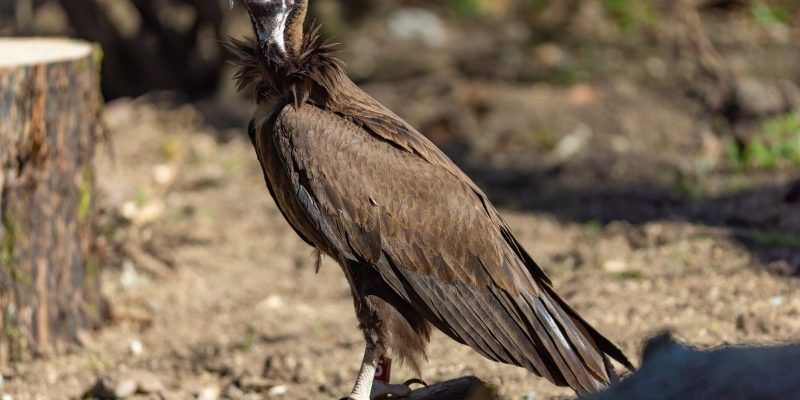
Woodland Park Zoo has hooded vultures for the first time in its 126-year history. A male named Tutaonana and a female named Kiara arrived in Seattle this spring and can be found in a habitat across from the maned wolves, where the zoo reports they have settled in quickly and are working through a standing order of raw meatballs.
Tutaonana (too-tah-oh-NAH-nah) is Swahili for “see you later.” He was not quite a year old when the zoo announced the pair in April. Kiara (kee-AH-rah) is Swahili for “princess,” and she turned two that month.
What is a hooded vulture?
Necrosyrtes monachus is a sub-Saharan African bird with dark brown plumage, a wingspan well over five feet, and thin bare skin across the head and face that reads as a hood and gives the species its name.
It is also an Old World vulture, a distinction worth keeping straight because it changes what you are looking at. Old World vultures, the African and Eurasian ones, sit inside Accipitridae, the family of hawks and eagles. New World vultures, the turkey vulture riding a thermal over an American interstate and the condors, are a separate lineage that arrived at the same profession independently. The bald head, the soaring, the carrion diet: those are the job, not the family. A hooded vulture is closer kin to a red-tailed hawk than to the vulture most American readers have actually seen.
Why the zoo wanted them
Vultures are often called nature’s cleanup crew, and the phrase undersells the work. By finding and stripping animal remains quickly, scavenging birds shorten the window in which a carcass can seed disease into the landscape around it. Where vultures disappear, the job does not disappear with them. It passes to slower scavengers and to bacteria.
“Hooded vultures are remarkable survivors and essential to a healthy ecosystem,” said Shawn Pedersen, Curator of Ornithology at Woodland Park Zoo. “We’re excited to welcome this critically endangered species to the zoo to inspire curiosity in our guests and help ensure the future of these birds.”
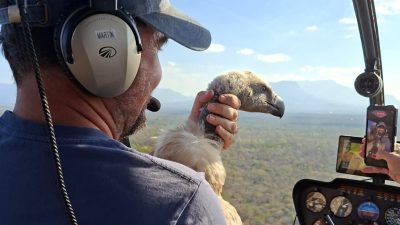
The zoo lists the species as critically endangered on the IUCN Red List, the highest category of threat the Red List assigns to a species still living in the wild. The pressures it names are poisoning, habitat loss, reduced food sources and hunting. Poisoning is the one that does the most damage fastest, because vultures find a carcass together and feed on it together, so a single poisoned animal can bring down a crowd of birds at once. That is the shape of the emergency that vulture teams on the ground spend their days answering. We covered one in August, when the Endangered Wildlife Trust’s Birds of Prey Unit collected eighteen grounded vultures in Limpopo and put sixteen of them back in the sky eight days later.
What you will actually see
Two young birds, close to the path, across from the maned wolves. At under two years old Tutaonana and Kiara are still filling out, and the zoo says the pair have been quick to get comfortable, which in practice means a visitor stands a good chance of seeing them awake and moving rather than parked on a perch with their backs turned.
For a species almost nobody gets to meet, that is the whole argument for bringing them here. A reader who has only ever heard the word vulture used as an insult tends to revise the opinion in about thirty seconds of watching one.
The arrival was announced by the zoo on April 17, 2026, on its own blog and in a press release.
Quick answers
- Has Woodland Park Zoo kept hooded vultures before?
No. The pair that arrived in 2026 are the first hooded vultures in the zoo's 126-year history.
- What are their names?
Tutaonana (too-tah-oh-NAH-nah), a male, and Kiara (kee-AH-rah), a female. Tutaonana is Swahili for "see you later" and Kiara is Swahili for "princess." He was not quite one year old and she turned two when the zoo announced them in April 2026.
- Where are they in the zoo?
In a habitat across from the maned wolves.
- What is the difference between an Old World and a New World vulture?
They are not close relatives. Old World vultures, the African and Eurasian ones including the hooded vulture, belong to Accipitridae, the hawk and eagle family. New World vultures and condors are a separate lineage that arrived at the same way of life independently. The bald head, the soaring and the carrion diet are the job rather than the family.
- How big is a hooded vulture?
It is one of Africa's smaller vultures, with a wingspan well over five feet.
- How threatened is the species?
Woodland Park Zoo lists the hooded vulture as critically endangered on the IUCN Red List, which is the highest category of threat the Red List assigns to a species still living in the wild. The zoo names poisoning, habitat loss, reduced food sources and hunting as the pressures on it.
- Why do vultures matter to an ecosystem?
They find and strip animal remains quickly, which shortens the window in which a carcass can seed disease into the landscape around it. Where vultures disappear, that work passes to slower scavengers and to bacteria.