
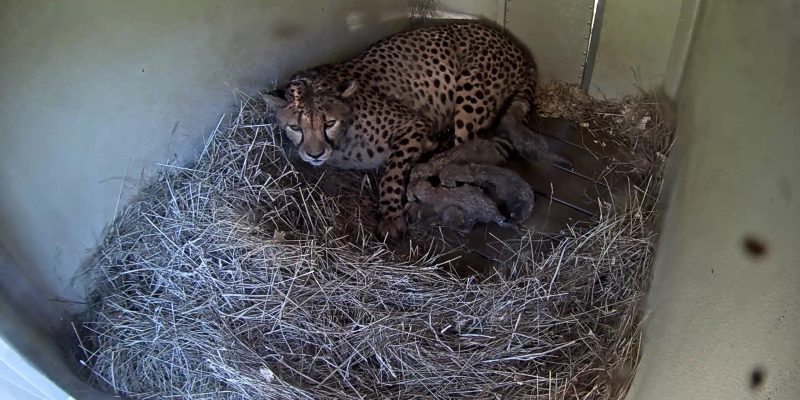
Five cheetah cubs were born on Monday, October 5, 2026 at the Front Royal, Virginia campus of the Smithsonian’s National Zoo and Conservation Biology Institute. Their mother is Zura, five years old and a first-time mother, and the Cheetah Cub Cam is live again so anyone can watch the den from anywhere.
The litter also completes something the campus has been working toward for a decade and a half: four generations of one cheetah family now live there at the same time.
Great-grandmother, grandmother, mother, cubs
The line runs Sanurra, then Rosalie, then Zura, and now these five. Zura is not a new face to anyone who has followed the cam for a while. She and her own littermates were the ones on screen in 2021.
“Cheetahs are notoriously difficult to breed, and our team pours countless hours into each and every surviving cub,” said Adrienne Crosier, the curator of carnivores at NZCBI who leads the Cheetah Species Survival Plan. “Having four generations in our care is proof-positive of our coordinated efforts to preserve this imperiled species.”
The cubs’ father is Flash, a nine-year-old male with seven cubs from earlier litters. He will play no part in raising this one. Male cheetahs do not rear young, and the species is managed accordingly.
Why a cheetah litter takes a coalition
Breeding cheetahs in human care is genuinely hard, and the reason is biological rather than institutional. Female cheetahs cycle unpredictably, and the behavior that signals a female is ready is subtle enough that experienced biologists can miss it. A facility can do everything right for years and get nothing.
So the work is pooled. NZCBI is one of ten cheetah breeding centers in the United States that make up the Cheetah Breeding Center Coalition, a group whose stated aim is a self-sustaining North American cheetah population under human care. The mechanism is the Species Survival Plan, run with the Association of Zoos and Aquariums population management center: scientists and animal care staff look at the genetic makeup, health and temperament of individual animals across every participating institution and decide which pairings should happen. Flash was recommended because he is genetically valuable to the North American population, which means these five cubs are likely to matter to the breeding program well beyond Front Royal.
This is the second litter in under a year at the campus. Last November the zoo announced four cubs born to Amabala, the 20th litter in the program’s history.
What “fewer than 7,000” is actually counting
Cheetahs live in small, scattered populations, mostly in sub-Saharan Africa, with the strongholds in parks in eastern and southern Africa. Conflict with people, poaching, and the loss of both habitat and the prey base have pushed the numbers down to fewer than 7,000 animals in the wild.
That figure is worth unpacking, because it is a specific quantity rather than a round one. The IUCN Red List assessment of Acinonyx jubatus, carried out on May 17, 2021 by Sarah Durant and colleagues, puts the global population at around 6,517 mature individuals and lists the species as Vulnerable. “Mature individuals” is the Red List’s own unit, and it is not the same as a headcount: it counts the animals capable of reproducing, which is the number that decides whether a population can replace itself. Cubs, including these five, are not in it. The assessment itself describes the estimate as extremely tentative, which is honest about how hard cheetahs are to count across that much country.
The Smithsonian’s wording and the assessment agree here, which is not always the case, and the detail the assessment adds is the useful part: the roughly 7,000 figure is a breeding-adult figure, not a total.
Watching a den without being in it
Keepers are staying hands-off for several weeks so Zura and the cubs can bond without interruption. Everything staff know right now comes from the same camera the public is watching: Zura is attentive, and all five cubs are active and nursing frequently.
Anyone planning to sit with the feed should know it is a den camera, not a show. Zura may move the cubs out of the den and around her habitat, so there will be long stretches when nothing is in frame. That is the cam working as intended. A cheetah mother relocating her litter is normal behavior, and a camera that let the public override it would be a worse camera.
The cam runs on the zoo’s website and is free. Five cubs in a straw nest, a mother who grew up on the same feed, and a great-grandmother still living a few paddocks away is a good reason to keep the tab open.
Source: Smithsonian’s National Zoo and Conservation Biology Institute, October 9, 2026.
Quick answers
- When were the Smithsonian cheetah cubs born?
Monday, October 5, 2026, at the conservation campus of the Smithsonian National Zoo and Conservation Biology Institute in Front Royal, Virginia. There are five cubs in the litter.
- Who are the parents?
The mother is Zura, a five-year-old female and a first-time mother. The father is Flash, a nine-year-old male who has seven cubs from earlier litters. Male cheetahs play no role in raising young.
- How can I watch the cubs?
On the Cheetah Cub Cam, a live den camera on the zoo website, free to anyone. It is a den camera rather than a show, so expect long stretches with nothing in frame: Zura may move the cubs out of the den and around her habitat.
- What is the four-generation story?
Four generations of one cheetah family now live at the Front Royal campus at the same time: great-grandmother Sanurra, grandmother Rosalie, Zura, and Zura and Flash’s five cubs. Zura herself appeared on the Cheetah Cub Cam in 2021 as a cub.
- Why are cheetahs hard to breed?
Female cheetahs cycle unpredictably, and the behavior that signals a female is ready to breed is subtle enough that experienced biologists can miss it. That is why ten United States breeding centers pool the work as the Cheetah Breeding Center Coalition, under the Association of Zoos and Aquariums Species Survival Plan.
- How many cheetahs are left in the wild?
The IUCN Red List assessment of Acinonyx jubatus, carried out on May 17, 2021, puts the global population at around 6,517 mature individuals and lists the species as Vulnerable. Mature individuals means animals capable of reproducing, so cubs are not counted. The assessment describes its own estimate as extremely tentative.
- What happens next with the cubs?
Keepers are staying hands-off for several weeks so Zura and the cubs can bond without interruption. As of the announcement, Zura was attentive and all five cubs were active and nursing frequently.