
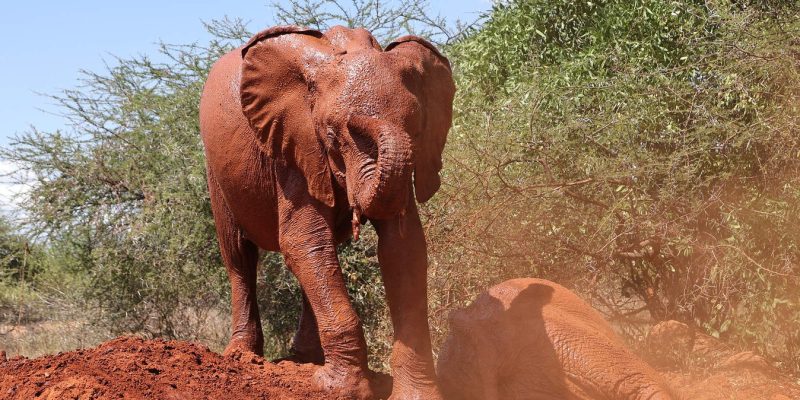
The Kenya Wildlife Service found her on January 19, 2026, near Roaring Rocks in Tsavo West National Park: an orphaned African elephant calf, alone and in very poor condition. The next morning a Sheldrick Wildlife Trust pilot, Neville Sheldrick, went up to look for her. From the air she was unmistakable, skin and bones with curled ears and hollow cheeks, an animal that had been on her own for a while. Nine months later she is the best swimmer at Kaluku, and the only sign left of what happened to her is a faint mark on one shoulder.
The Trust published her story on October 9.
A rescue that outgrew its own vehicles
She was nearly three years old, which made her a serious proposition. Even starving, she was too big for the usual approach. When the ground team arrived she ran, and the capture turned into several kilometers of flat-out pursuit through thick bush before two keepers, Roan and Matt, got hold of her.
Then the logistics failed twice over. She would not fit in a standard field vehicle, so the Trust sent its largest pick-up truck and secured her in the bed. That got her to Kilaguni Airstrip, where a plane was waiting to fly her to Nairobi, and she would not fit in the aircraft either. So she went by road instead, to the Trust’s Kaluku unit, and she was named Sibu after the river she was rescued beside.
What they found once she was in a stockade
She was riddled with worms, emaciated and dehydrated, and all of that was the secondary problem. The primary one was a penetrating wound in her right shoulder. She had been speared, and the spear had gone through the blade of the scapula.
She was too weak to risk anesthesia that day, so the team left her overnight on fluids, greens and supplements. The following morning Dr Lawi darted her in her stockade and examined her properly. The wound was deep and septic. It was cleaned with water, flushed with hydrogen peroxide and infused with tincture of iodine, then packed with antibiotic pessaries and green clay and sealed with a topical antibiotic. She was given antibiotics and anti-inflammatories before she was revived. Her keepers were not sure she would last the night.
Spear wounds are not rare in this caseload. What was unusual, the Trust notes, is seeing one on an elephant that young.
Who she recovered with
A few weeks before Sibu arrived, Kaluku had taken in another orphan, Lamuu, whose foot had been ringed by a snare. Two young elephants of similar age, both hurt by people, in neighboring stockades. They became inseparable, and their recovery ran on the same timetable: bed rest, then short walks around the compound, then finally out into the bush with the rest of the Kaluku herd.
Sibu is the oldest elephant at Kaluku and has no interest in the job that usually comes with that. She defers to Korbessa, who is younger, and spends her days browsing with Lamuu or in the water. By the keepers’ account she has overtaken Korbessa as the unit’s swimming star, going straight from her milk into the pool. She has also refused a bottle since the day she arrived and drinks from her own bucket, guarded by a keeper against Korbessa, who sometimes gets a sip anyway. Sibu shares the dregs without complaint.
Which zoo is behind this work?
None that we can verify, and that remains the honest answer for the Sheldrick Wildlife Trust. We check this on every conservation and rescue story in this region, because the chain from an accredited zoo or aquarium to a field organization is often real and almost never stated. Here it is not there to find. The only institutional partner named in Sibu’s rescue is the Kenya Wildlife Service, a Kenyan government agency, which spotted her and called it in.
There is a further reason the question has an edge in this particular case, and it is better named than written around: the Trust publishes a position opposing the capture of infant elephants for captivity. An organization that holds that view is unlikely to appear on a zoo’s funded-partners page, and zoos are unlikely to appear on its own. That is a genuine disagreement inside the conservation sector rather than a gap in our reporting, and it does not make the veterinary work in Tsavo any less competent. For contrast, when we looked at the Kenya Wildlife Service Mara vet unit’s snare removals, zoo funding was traceable and named.
The African elephant (Loxodonta africana) is Endangered on the IUCN Red List. The Trust’s own write-up assigns no category, so nothing is owed in correction.
Where the Kaluku herd sits now
Sibu and Lamuu are two of a group that this site has been following through a run of arrivals and milestones, including Chaimu’s calf Comet at Ithumba and the Voi drought orphans four years on. An orphan’s journey through this system runs a decade or more before release, so Sibu is near the beginning of hers rather than at the end.
Source: Sheldrick Wildlife Trust, The Rescue of Sibu, published October 9, 2026.
Quick answers
- Who is Sibu?
An orphaned African elephant, nearly three years old when she was rescued. The Kenya Wildlife Service spotted her alone and in poor condition near Roaring Rocks in Tsavo West National Park on January 19, 2026, and the Sheldrick Wildlife Trust recovered her the following day. She is named after the river she was found beside.
- What had happened to her?
She had been speared through the right shoulder, and the spear had pierced the blade of the scapula. The wound was deep and septic. She was also emaciated, dehydrated and carrying a heavy worm burden. Spear wounds are common in this caseload; seeing one on an elephant that young is not.
- How was she treated?
She was too weak for anesthesia on the day of her rescue, so she was rested overnight on fluids, greens and supplements. The next morning Dr Lawi darted her in her stockade. The wound was cleaned with water, flushed with hydrogen peroxide, infused with tincture of iodine, packed with antibiotic pessaries and green clay and sealed with a topical antibiotic. She was given antibiotics and anti-inflammatories before being revived.
- Why did the rescue take so long?
Size. At nearly three years old she was too large for a standard field vehicle, so the team used its largest pick-up truck. At Kilaguni Airstrip she turned out to be too large for the waiting aircraft as well, so she went to the Kaluku unit by road instead. Catching her first took several kilometers of pursuit through thick bush.
- How is she now?
Well. Only a faint scar remains on her shoulder. She is the oldest elephant in the Kaluku herd but defers to the younger Korbessa, browses with her friend Lamuu, and has become the unit's best swimmer. She has refused a bottle since the day she arrived and takes her milk from her own bucket.
- Which zoo or aquarium funds the Sheldrick Wildlife Trust?
None that we can verify, and that has been the finding every time we have checked. The only institutional partner named in this rescue is the Kenya Wildlife Service, a government agency. The Trust also publishes a position opposing the capture of infant elephants for captivity, which makes a zoo partnership unlikely in both directions. That is a real disagreement inside the sector rather than a gap in the reporting.