
The Phoenix Zoo does not own the ground it stands on. It sits inside Papago Park, a city-run park of red sandstone buttes on the edge of Phoenix, which makes the landscape around the zoo somebody else’s responsibility and the zoo’s problem at the same time.
In August 2026 the zoo used Parks and Recreation Month to describe what it does about that: a working partnership with City of Phoenix park rangers that runs through its camps, its teen programs and its public events.
Two organizations teaching the same lesson
The Phoenix Parks and Recreation Department teaches Leave No Trace, the outdoor ethics framework built around staying on trails, packing out what you bring and giving wildlife room. The zoo teaches what it calls being a Planet Protector: habitat helpers, responsible pet ownership, thoughtful outdoor exploring.
Those are the same curriculum aimed at two moments. One reaches people at the trailhead and the other reaches them at an exhibit, and a family in Papago Park on a Saturday is likely to hit both.
“By working together, we are raising awareness and inspiring more people to connect with nature and take an active role in conservation,” said Ruth Allard, the zoo’s senior vice president of conservation science, learning and engagement.
Rangers in the camps
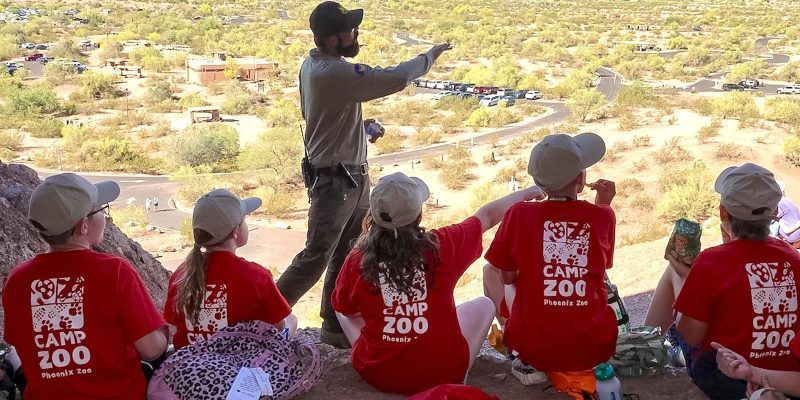
The clearest piece of this is Camp Zoo, the zoo’s youth program. City park rangers come in and work directly with campers, teaching why staying on a trail matters for the plants and animals that live beside it.
The zoo’s teen leadership council, the Trailblazers, worked with rangers to host the Planet Forward Fair in Papago Park itself. That is the shape of the arrangement: the zoo supplies the young people and the programming, the city supplies the rangers and the park, and the desert outside the fence becomes the classroom.
“Having City of Phoenix park rangers engaged with our guests and programs like Camp Zoo helps connect the public to the park system, and to get excited by their connection to the nature in their own city,” the zoo said of the ranger side of the partnership.
What is a zoo for, besides animals?
This is the kind of story that answers a question skeptical readers actually ask, which is what an accredited zoo contributes to the city it sits in when you set the animal collection aside.
The answer here is a straightforward one. The Sonoran Desert immediately outside the Phoenix Zoo’s gates holds the same wildlife the zoo interprets inside them, and the people most likely to walk through it are the families already coming to the zoo. Reaching them with one consistent message about trails, pets and native habitat costs very little and is the sort of thing nobody writes up.
Other accredited facilities have built similar civic partnerships in different directions. Cincinnati Zoo went at its own city through infrastructure, with a community solar and resiliency program serving its surrounding neighborhoods.
The Phoenix Zoo is a private non-profit operated by the Arizona Center for Nature Conservation and is accredited by the Association of Zoos and Aquariums. Papago Park remains a City of Phoenix park, open to anyone, zoo ticket or not.