
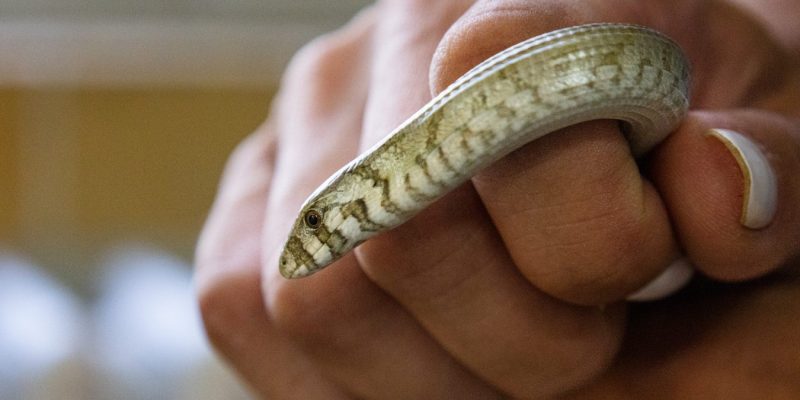
The Buffalo Zoo hatched a European legless lizard on August 1, the first of the species to hatch there since 2022. It weighed 8 grams.
The animal is also called a sheltopusik, and it is the thing people walk past in a reptile house assuming they have seen a snake. It is not one, and the differences are easy to check.
How to tell a legless lizard from a snake
Three features settle it. A legless lizard has eyelids and blinks. It has external ear openings. And it has a long tail it can drop and regrow, which is a lizard trick that snakes do not have. Once you know to look at the side of the head, the resemblance stops being convincing.
The hard part was the thermostat
Legless lizards are notably difficult to breed under human care, and the zoo says the trickiest piece is holding the right temperature through incubation. There is no universal reptile setting: what suits a turtle egg does not suit this one. The herpetology team worked it out by trial and error, and about 65 days after the egg was set, a hatchling arrived.
That is the whole method, and it is worth saying plainly because it is what most reptile breeding actually consists of. Not an intervention, but a number somebody had to find and then hold steady for two months.
Can visitors see it?
Not for a long time. The hatchling is behind the scenes with the herpetology staff, and these lizards take years to mature. Adult European legless lizards are on view in the zoo’s Amphibian and Reptile Center, and they are the better introduction anyway: a sheltopusik can pass four feet in length, which is a lot of lizard to find out is not a snake.
The species itself is not in trouble. Pseudopus apodus is an anguid lizard, a relative of the North American glass lizards, and the Reptile Database records a range running from Greece and the Balkans through Turkey and the Caucasus into Central Asia and south to Israel and Iran. The IUCN Red List assesses it as Least Concern. The achievement here is a husbandry one rather than a conservation rescue, and the zoo frames it that way.
Buffalo’s herpetology department has form. The zoo has spent decades on the harder end of amphibian and reptile work, including forty-two consecutive years of shipping Puerto Rican crested toad tadpoles for release. A single 8-gram lizard is a smaller headline and the same department.
Sources: Buffalo Zoo, “European legless lizard hatched at the Buffalo Zoo,” September 9, 2026; The Reptile Database, Pseudopus apodus.
Quick answers
- What is a sheltopusik?
Another name for the European legless lizard, Pseudopus apodus, an anguid lizard that can pass four feet in length and is often mistaken for a snake.
- How do you tell a legless lizard from a snake?
A legless lizard has eyelids, external ear openings, and a long tail it can drop and regrow. Snakes have none of the three.
- Why is the species hard to breed?
The Buffalo Zoo says the hardest part is holding the right temperature through incubation, and that a temperature suited to another reptile does not necessarily work. Its herpetology team found the right one by trial and error, and the egg hatched about 65 days later.
- Can visitors see the hatchling?
Not for a long time. It is behind the scenes and these lizards take years to mature. Adult European legless lizards are on view in the zoo's Amphibian and Reptile Center.