
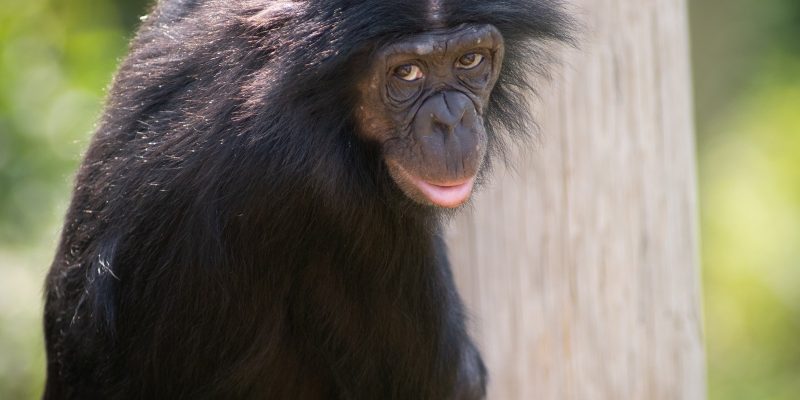
Offer a bonobo a smaller share than its partner gets and it will notice. Researchers put the effect at roughly three and a quarter times.
The finding, circulated by Friends of Bonobos in January 2026 under the heading “Bonobos Prefer Fairness,” comes from work conducted with bonobos at Zoo Leipzig in Germany.
Why the location is the point
It would be easy to file this as a sanctuary story. It is not one. The animals were in a zoo, and that is not incidental to the result.
Inequity aversion experiments require an animal that will participate voluntarily, repeatedly, over months, with a partner it knows, under controlled conditions where the only thing changing is the size of the reward. You cannot run that in a forest. You can barely run it in a rescue center, where the animals are recovering from trauma and the priority is rehabilitation rather than an experimental schedule.
Zoo Leipzig’s primate facility is one of a small number of places in the world set up to do this kind of cognition work with great apes at all.
What inequity aversion is, and why anyone cares
The capacity to notice and object to an unfair distribution was long assumed to be human. It is one of the components you need for cooperation to be stable, because a species that cannot detect being shortchanged cannot punish it, and cooperation that cannot be policed tends to collapse.
Finding it in bonobos places it deeper in the primate lineage than a purely human story allows. Bonobos are also the more interesting test case of the two Pan species, because their social structure runs on tolerance and coalition rather than on the sharper dominance hierarchies of chimpanzees.
A correction we are making up front
This study is frequently associated with Lola ya Bonobo, because Friends of Bonobos published it. The bonobos were at Zoo Leipzig. We are noting it because the attribution matters: it is the difference between a sanctuary finding and a zoo finding, and this one is a zoo finding.
Friends of Bonobos is itself substantially zoo-funded. The Columbus Zoo has given more than 500,000 dollars since 2000, and Twycross Zoo has supported the sanctuary since 2007.
So the chain runs zoo to sanctuary for the animals’ care, and zoo to laboratory for the knowledge. Both ends are institutional.
Source: Friends of Bonobos.