
Buffalo Zoo has been sending Puerto Rican crested toads to Puerto Rico for 42 consecutive years. This June it sent nearly 600 tadpoles by FedEx.
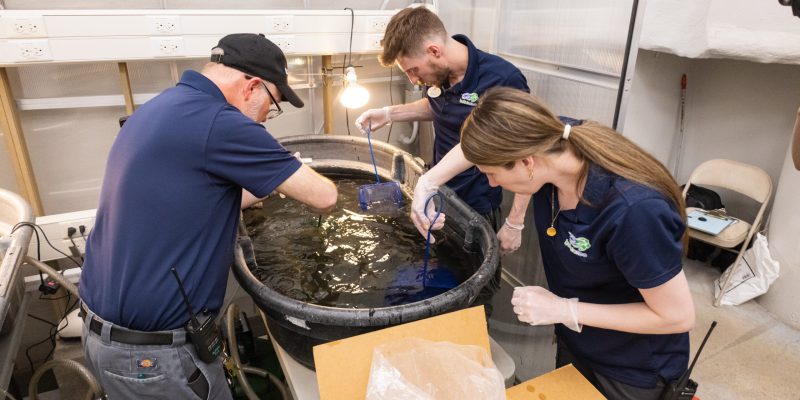
The zoo announced the shipment on June 16, 2026. The tadpoles were packed in a prepared box and flown to the Puerto Rican Crested Toad Conservancy, where they are acclimated in man-made ponds and monitored until they metamorphose and disperse.
A toad that was considered extinct
The Puerto Rican crested toad was thought to be extinct before 1966. The U.S. Fish and Wildlife Service recovery plan records it plainly: historically considered rare, and believed gone until a 1967 paper reported its rediscovery.
The wild population has fluctuated between 300 and 3,000 over the past 35 years, and it is hard to monitor because the animal is fossorial, meaning it spends most of its life underground and surfaces mainly to breed after heavy rain. A species you can only count on the nights it decides to appear is a species that is easy to lose track of and easy to lose.
Forty-two years, and the first of its kind
The recovery effort became the first amphibian Species Survival Plan under the Association of Zoos and Aquariums in 1984. Buffalo Zoo won the AZA’s Edward H. Bean award that same year for working out the husbandry required to keep and breed the species, which is to say the zoo did not join this program. It figured out how the program was possible.
The SSP became the Puerto Rican Crested Toad Conservancy in 2021, a separate nonprofit that now partners with 16 AZA institutions. Across the conservancy and its partners, more than 924,000 tadpoles have been released in Puerto Rico. In-situ work runs with the Puerto Rico Department of Natural and Environmental Resources and the Fish and Wildlife Service Caribbean Field Office.
The tadpoles go to four reintroduction sites in historical habitat, deliberately separated from the last remaining wild population so that a disease event or a storm cannot take everything at once.
The storms are the point
Hurricane Maria flooded the Ciénaga wetlands in Yauco in 2017 and destroyed habitat there. Saltwater intrusion and sea level rise now threaten the Tamarindo pond and the Punta Ventana subpopulation, with no recruitment expected at 8 parts per thousand salinity. Introduced marine toads compete with the crested toads and are removed monthly from reintroduction sites.
None of those problems get solved by breeding more toads in Buffalo. What breeding more toads in Buffalo does is keep the species in existence while somebody else works on the ponds.
The conservancy is currently building a new research and breeding facility.
A note on the listing
The species is Endangered on the IUCN Red List, assessed in 2020, with a decreasing trend and a severely fragmented population. Under the U.S. Endangered Species Act it is listed as Threatened, a determination that took effect in September 1987. Both are true and they are different lists.
Buffalo is running amphibian shipments and red panda births in the same season, which is a fair picture of what a mid-size AZA zoo actually does.
Source: Buffalo Zoo; U.S. Fish and Wildlife Service recovery plan (1992); IUCN Red List. The zoo’s announcement carries no quotations.