
A black-footed ferret cloned from tissue frozen more than thirty years ago has produced kits of her own, and so have two of her offspring. Three litters were born in 2025 at the Smithsonian’s National Zoo and Conservation Biology Institute research campus in Front Royal, Virginia, and with them, genetics that had been sitting in a cell bank for decades re-entered a living population.
The Smithsonian announced the births on September 25, 2025, with the U.S. Fish and Wildlife Service and a group of partners. The kits arrived in the spring and summer at a conservation campus that is closed to the public.
Who Willa was
Black-footed ferrets were believed extinct in the 1970s. A small surviving population was found in 1981, and one of those ferrets was a female named Willa. She died before reproducing, so her genes went out of the population with her.
What did not go was a tissue sample. It was collected and frozen at the San Diego Zoo Wildlife Alliance’s Frozen Zoo, a genetic bank that began storing material fifty years ago on the theory that someone would eventually know what to do with it.
Someone did. Willa’s stored cells produced Antonia, a cloned ferret born in 2023. The Smithsonian says Willa’s clones are bringing her genetics back into the modern population, and Antonia is not the only one: Elizabeth Ann, announced in December 2020, was the first clone of any endangered species in the United States, and a third clone, Noreen, was born in 2023 alongside Antonia. Elizabeth Ann and Noreen both died this year. Antonia bred.
Three litters, and what they prove
The 2025 kits came from Antonia and from Sibert and Red Cloud, two of Antonia’s own offspring born in 2024. Noreen whelped one litter this year as well.
That second generation is the milestone. A clone that survives is a laboratory result. A clone whose offspring are themselves breeding is evidence that the technique puts working, heritable material back into a species rather than producing a single animal that cannot pass anything on. The Smithsonian calls the reproduction of cloned black-footed ferrets a significant step in conservation genetic research, and the reason is that it shows cloning can restore genetic diversity rather than only replicate an individual.
Life underground
Black-footed ferrets are fossorial, which is the word for an animal that lives underground, and they spend most of their lives there. Keepers at Front Royal build that world for them indoors, with artificial tunnels and burrows, because a ferret kept above ground is a ferret living the wrong life.
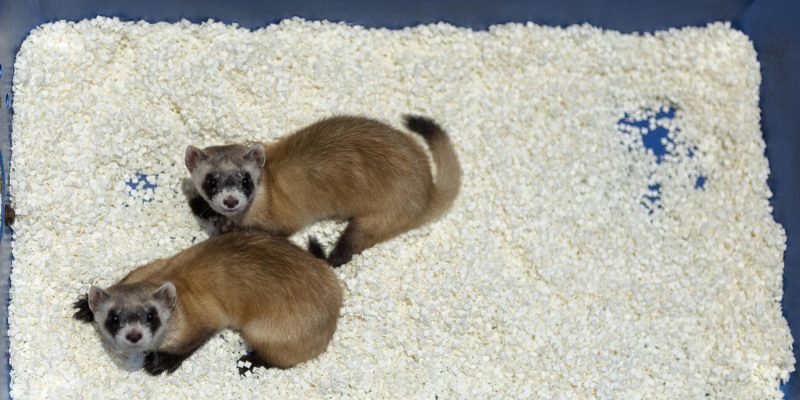
The photographs from the campus show what that means from the human side. Two small tan animals with black bandit masks and black feet look up from a bedding tray, and the rest of the time they are somewhere you cannot see them.
The cloning does not replace the fieldwork
The Smithsonian is direct about the limits. Cloning complements reintroduction, habitat protection and ongoing monitoring; it does not substitute for any of them. The Fish and Wildlife Service is working with states, tribes, landowners and conservation partners on captive breeding, reintroduction into the wild, habitat restoration, disease management and public awareness, and the genetic work sits inside that effort rather than above it.
The partner list is a fair map of what the work takes. Alongside the Smithsonian and the Fish and Wildlife Service are Revive & Restore and ViaGen Pets & Equine, which pioneered this cloning technology for use in endangered species; the San Diego Zoo Wildlife Alliance, whose Frozen Zoo kept the cells; and the Association of Zoos and Aquariums, whose member institutions supply the technical expertise to house and care for the kits and the rest of the breeding population.
Fifty years ago, freezing a ferret’s cells was an act of faith. This year it produced litters.
More from Front Royal: four cheetah cubs and the campus’s twentieth cheetah litter.
Quick answers
- How many black-footed ferret litters were born to clones?
Three litters were born in 2025 at the Smithsonian's Front Royal campus, to the cloned ferret Antonia and to two of her offspring, Sibert and Red Cloud.
- Who was Willa?
A black-footed ferret from the small population found in 1981. She died before reproducing, but a tissue sample was frozen at the San Diego Zoo Wildlife Alliance's Frozen Zoo and later used for cloning.
- Why does cloning matter for black-footed ferrets?
It returns genetic diversity that was otherwise lost to a species that was believed extinct in the 1970s. The Smithsonian is clear that cloning complements reintroduction and habitat work rather than replacing it.
- Can the public see the ferrets?
No. The kits were born at the Smithsonian's conservation campus in Front Royal, Virginia, which is closed to the public.