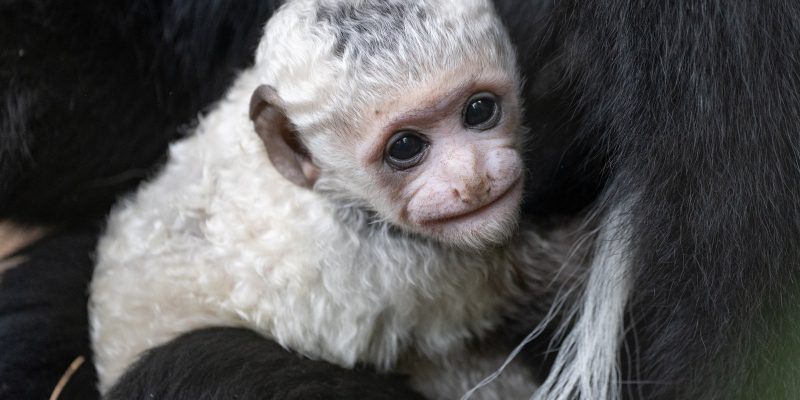
A black and white colobus monkey was born at Woodland Park Zoo on June 15, 2026, the first of its kind born in Seattle in 29 years. On July 31 the zoo gave the infant a name: Ngobi, pronounced en-GOH-bee, a name of Bantu origin used among the Ganda people of Uganda.
The parents are Mokiki, an experienced mother, and Lewis, for whom this is a first. Ngobi is Mokiki’s second infant. Her first, a daughter named Anapenda, was born at Mokiki’s previous home and came to Seattle with her in 2024, which means the baby has an older half-sister in the same group.
Why is the baby white?
Because colobus are born that way. An infant arrives weighing about a pound, entirely white, with a pink face, and takes roughly three months to shift into the black coat with the long white fringe that the adults wear. Against parents who are nearly all black, a newborn is the most visible object in the habitat, which appears to be the point: the family can see at a glance who is holding the baby.
They need to, because a colobus infant is passed around. The whole group takes turns carrying, grooming, babysitting and defending it, a behavior called alloparenting. Young females get their practice this way, and the group’s experienced mothers are watching while they do. We looked at the same white-infant question in more detail when Lincoln Park Zoo had a colobus born in September.
What 29 years means
It means nobody currently working the Tropical Rain Forest loop had done this before. Colobus have been at the zoo across that stretch, but a birth is a different thing from a residency: it requires a compatible pair, a group stable enough to raise an infant in, and a recommendation to breed from the cooperative program that manages the species across accredited institutions.
“It’s been nearly three decades since we celebrated the birth of a colobus monkey at Woodland Park Zoo. We’re so happy about this new baby, another ambassador for their species, and an opportunity for zoo guests to get a peek into the family life of these striking monkeys,” said Arden Robert, Animal Care Manager of Primates at Woodland Park Zoo. “Mom Mokiki is a pro at motherhood and taking very good care of her new infant.”
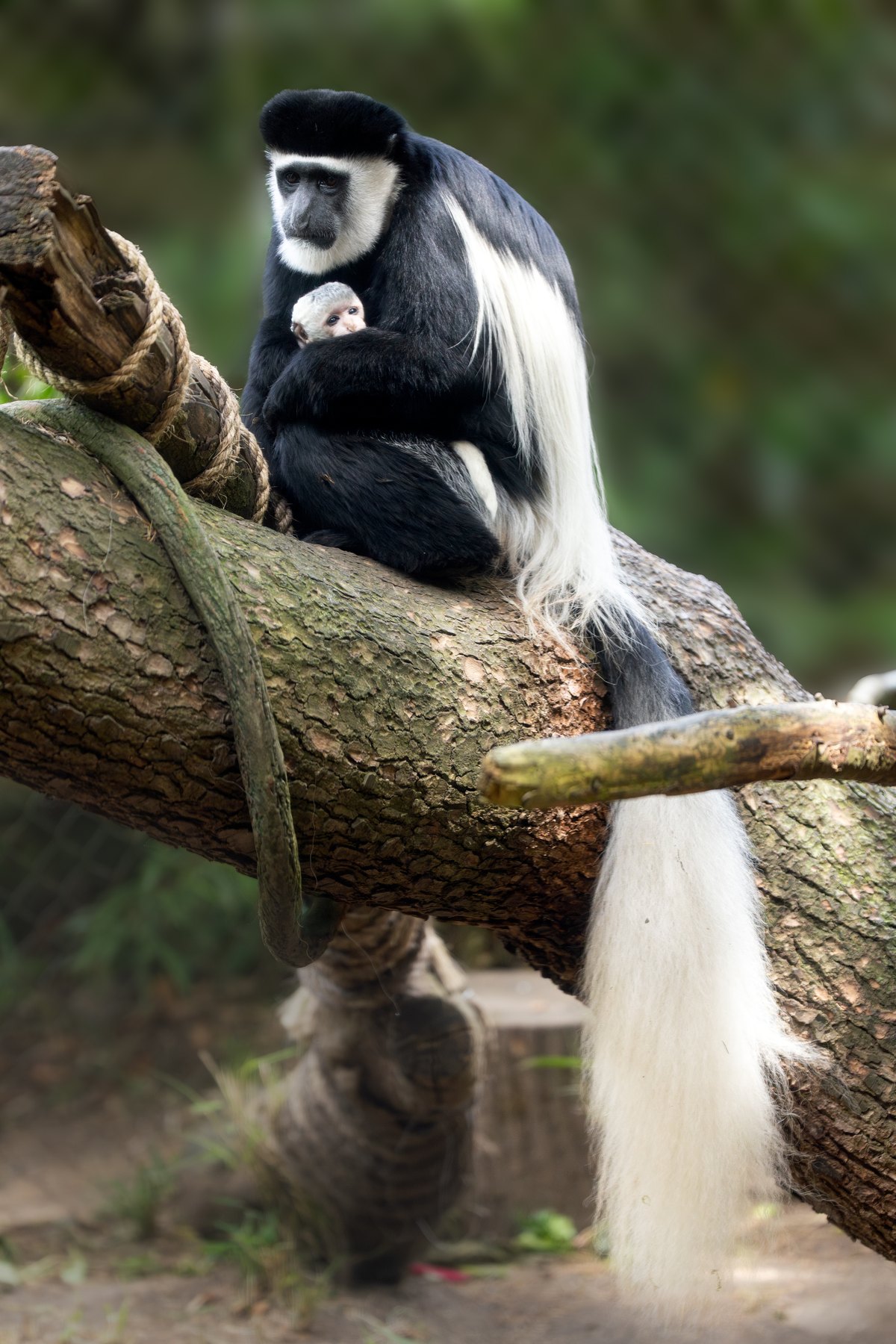
The tail is a parachute
An adult colobus carries a tail of 20 to 40 inches ending in a white plume, and it is not ballast. Colobus move through the canopy in long leaps, and the tail slows and steadies the landing. The common comparison for the adult coat is a skunk, which is unfair to the monkey and roughly accurate: black body, white fringe running the length of each flank, white plume behind.
Gestation runs five to six months. The zoo had not determined Ngobi’s sex at the time of the announcement.
Black and white colobus live in dense tropical forest along the equatorial belt of Africa, and their numbers are under pressure from deforestation and from hunting. Several closely related species share the common name, and the zoo does not specify which it keeps.
Ngobi can be seen with Mokiki, Lewis and Anapenda in the outdoor section of the Tropical Rain Forest loop at Woodland Park Zoo. The birth was announced on the zoo’s blog on June 30, 2026, and the name in a July 31 release.
Quick answers
- When was the baby born?
June 15, 2026, at Woodland Park Zoo in Seattle. It is the first black and white colobus born at the zoo in 29 years.
- What is the baby called?
Ngobi, pronounced en-GOH-bee. The zoo announced the name on July 31, 2026. It is of Bantu origin and used among the Ganda people of Uganda.
- Who are the parents?
Mokiki, an experienced mother, and Lewis, a first-time father. Ngobi is Mokiki's second infant. Her first, a daughter named Anapenda, was born at Mokiki's previous home and came to Seattle with her in 2024.
- Why is the baby white when the adults are black?
Colobus are born entirely white with a pink face and take about three months to shift into the adult black coat with its long white fringe. Against nearly black parents a newborn is the most visible thing in the habitat, which lets the family see at a glance who is holding it.
- What is alloparenting?
Shared care of an infant by the whole group rather than the mother alone. Colobus take turns carrying, grooming, babysitting and defending a baby, and young females get their practice at motherhood that way.
- Why is the tail so long?
An adult tail runs 20 to 40 inches and ends in a white plume. Colobus cross the canopy in long leaps, and the tail slows and steadies the landing.
- Where can I see Ngobi?
In the outdoor section of the Tropical Rain Forest loop at Woodland Park Zoo, with Mokiki, Lewis and half-sister Anapenda.