
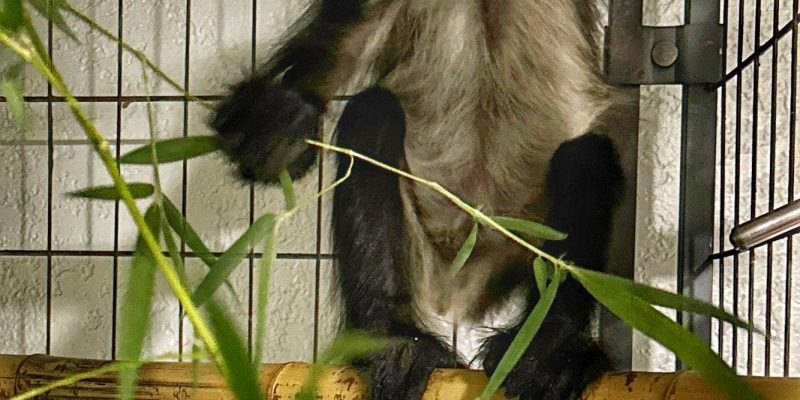
Primarily Primates took in three young spider monkeys this year, all of them confiscated by federal wildlife officers, and all of them what the sanctuary’s staff call border babies.
The term describes monkeys trafficked out of the wild and across the southern border of the United States. They arrive after weeks or months in improper conditions, exposed to viruses, bacteria and parasites, and separated from the troop that would have taught them how to be a spider monkey.
Shep, Hector and the ones before them
Shep is about two years old. He came to the San Antonio-area sanctuary in April 2026 after being held by the U.S. Fish and Wildlife Service and then the Houston Zoo. He had been in the exotic pet trade.
In July, two more arrived together. One of them, Hector, had been found roaming loose around El Paso before Fish and Wildlife took him in.
They join a population of 13 spider monkeys already at the sanctuary, among them Sybil, a two-year-old female found in a front yard in Cibolo, Texas, last year. She was wearing a diaper and had an eye injury. San Antonio Animal Care Services delivered her to Primarily Primates the same day for permanent placement, and the veterinary team treated the eye until she could see out of both again.
Sybil has shown no interest in bonding with the sanctuary’s other spider monkeys. Staff think Shep, close to her in age, may turn out to be a better match.
Where the monkeys are coming from
A U.S. Fish and Wildlife officer told the sanctuary that roughly 90 percent of spider monkeys confiscated in Texas did not come from USDA-regulated primate breeding facilities. They were caught in the wild and smuggled across the border.
The other end of that pipeline is where the animals come from. Zoo Boise partnered with El Salvador to establish a spider monkey sanctuary for animals seized there rather than shipped north.
Spider monkeys (genus Ateles) live in the tropical rainforests, evergreen forests and mangrove swamps of Central and South America. They are arboreal, highly social, and slow to reproduce, which is the combination that makes wild capture so costly to a population.
The Wildlife Confiscations Network
Primarily Primates was selected last year for the Wildlife Confiscations Network, a pilot program built to give law enforcement a coordinated way to place live animals seized at the border and elsewhere.
Before that, an officer with a confiscated monkey had a legal problem and a housing problem at the same time. The network is an attempt to solve the second one in advance, by lining up facilities that can take an animal on short notice and keep it.
The sanctuary has been taking in primates from the pet trade, biomedical research and entertainment for decades. New arrivals are tested for a range of conditions before they go anywhere near the existing population.
Why the damage lasts
The physical side of a confiscation case is the part that resolves fastest. What takes longer is social: a young spider monkey pulled out of a troop misses the period when it would learn how to behave around other monkeys, and the sanctuary’s staff describe the effects of that deprivation as something that can shape an animal’s health for years.
That is the case Primarily Primates makes against the idea, circulated widely on social media, that monkeys make good pets. Spider monkeys do not belong in living rooms, and the ones that end up there generally cannot be sent back.