
Twenty-two vultures, four species, one set of hands that had never done it before. That is the line in the Endangered Wildlife Trust’s September 29 post that is worth stopping on, because the hands belonged to a conservation officer from northern Mozambique who had come to South Africa to learn how.
The trust published two first-person accounts from people who spent time with its Birds of Prey Program this year. Neither is a press release and neither is about an animal. They are about the far less visible thing that has to happen before any of the vulture work the trust publishes is possible, which is somebody being taught to do it.
What an intern actually does
Karen Chiro came to the program after finishing an MSc in conservation biology at the University of Cape Town. She writes that she could identify vultures when she arrived and had never paid attention to their breeding ecology, where they nest, or what drives their numbers.
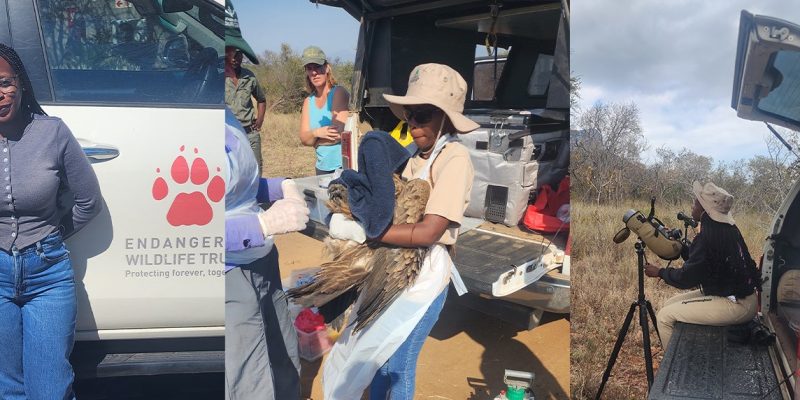
Her work was nest checks: going back to nests already recorded and establishing whether they were active this breeding season. She learned to tell a White-backed Vulture nest from a Hooded Vulture nest by size and placement. She joined the Cape Vulture nest monitoring team and counted nests on cliff faces through a telescope, which is how she came to appreciate, in her words, the scale and the difficulty of monitoring these species in the wild.
The part she calls the highlight was vulture trapping, and specifically holding and releasing the birds. “Holding these magnificent birds made me realize just how large and powerful they are,” she writes.
Her internship was paid for by the Briandez Legacy Trust, which she names and thanks.
The transfer to Mozambique
The second account is Yasalde Massingue, a conservation officer for Limpilichi Wilderness, which holds a long-term management partnership over protected areas in Niassa in northern Mozambique. He spent time with the Birds of Prey team at Hoedspruit to build out his own skills.
His list is specific. More than 300 raptor nests monitored across field expeditions, recording nest structure, position in the tree canopy, which tree species are preferred, and the precautions needed to collect data without disturbing the birds. Patrols looking for snaring areas, checking feeding events and investigating sites at risk of poisoning. Tracking collars fitted to 22 vultures of four species, plus 29 rings assembled, with the biometric work that goes alongside: measuring foot, head, beak, wing and tail, aging individual birds and assessing breeding condition.
He also attended a training course on vulture poisoning and rapid response, alongside conservation managers, veterinarians, researchers and wildlife crime professionals, and took from it the point that responding to a poisoning is a problem of coordination between sectors rather than a problem for any one of them.
All of that is going to Chipanje Chetu, the community where he works in Niassa, where the stated goal is to build the area into a model for conservation, research, monitoring and community engagement.
A release, and a count that does not match
Massingue also describes being present for the release of 15 vultures that had been rehabilitated after a poisoning incident, with more than 250 children from Hoedspruit attending.
We reported a release that looks like this one. Sixteen vultures went back at the Moholoholo Wildlife Rehabilitation Center on September 5, International Vulture Awareness Day, after eighteen grounded birds were collected in Limpopo on August 28 and two died. Moholoholo is in the Hoedspruit area and is a named partner of the trust’s Vulture Safe Zone work.
We are not going to state that these are the same event. The counts are different, 15 against 16, and an internship covers months rather than a day, so the release Massingue attended may be an earlier one. What is new is the attribution of a cause. Our September account said plainly that the trust had not stated what put those birds on the ground and that we were not going to fill it in. In this post the trust publishes a participant saying the birds he saw released had been poisoned. That is the organization’s own account of its own work, and it is worth recording, with the uncertainty about which release attached to it.
Where the collars go
The 22 collars are not a training exercise that ends when the course does. The trust runs a wildlife poisoning and carcass detection system it calls Eye in the Sky, which by its own published account currently has almost 180 vultures of five species deployed across roughly two million square kilometers, pushing alerts into platforms that response teams use across Botswana, Mozambique, Zambia, Zimbabwe and Uganda. A vulture that finds a poisoned carcass first is the fastest detector of a poisoning event anyone has.
That is also why a Mozambican officer learning to fit a collar in South Africa is not a courtesy. Niassa is inside the area that system is meant to cover.
Which zoo paid for this
Not the one you might expect, and the honest answer has a boundary on it.
The internship Karen Chiro describes names its funder, and it is the Briandez Legacy Trust, which is not a zoo.
The trust’s Birds of Prey Program page does carry a funding line, for its Vulture Safe Zone work, and it names Alu-Cab, the Bio-Bridge Initiative of the Convention on Biological Diversity, Cennergi, the Charl van der Merwe Trust, Cleveland Zoo, the Disney Conservation Fund, Puy du Fou, Rand Merchant Bank, the Roy Mc Alpine Foundation, the Rupert Nature Foundation, the SANParks Honorary Rangers and WindLab. Cleveland Metroparks Zoo is the only accredited zoological institution anywhere on it.
That money is scoped to the Vulture Safe Zones, which are defined areas where threats to vultures are identified and removed in agreement with the landowners. It is not scoped to these internships, which name a different funder. We have drawn the same line before, in both directions: Cleveland earned a place on our account of the Olifants River survey as context and not as that story’s funder, for exactly this reason.
For scale, the Association of Zoos and Aquariums reports that in 2025 its 235 accredited and certified facilities spent approximately $372.4 million on conservation across 139 countries. There is no published breakdown of the African share of that figure and we are not going to invent one.
The thing worth noticing is what the sector is not funding here. Equipment gets funded. Releases get photographed. The twelve months in which somebody learns to age a vulture by its beak, and then takes that back to Niassa, is the least visible and most transferable part of the whole operation, and it is running on a legacy trust.
A note on the birds
On the IUCN Red List, the White-backed Vulture, Gyps africanus, and the Hooded Vulture, Necrosyrtes monachus, are both assessed as Critically Endangered. The Cape Vulture, Gyps coprotheres, is Vulnerable. The trust makes no claim about any of these categories in the post, so there is nothing here to correct; we are naming them because a nest check on a cliff face is monitoring a Vulnerable species and a nest check in a tree is often monitoring a Critically Endangered one, and the two jobs read identically in a diary.
Source: the Endangered Wildlife Trust’s Hearing from our interns, published September 29, 2026, and its Birds of Prey program page, both read on October 5.
Quick answers
- What does a conservation intern with the EWT Birds of Prey Programme do?
Nest checks to establish whether recorded nests are active this breeding season, telling White-backed and Hooded Vulture nests apart by size and placement, Cape Vulture nest counts on cliff faces through a telescope, and vulture trapping, which includes holding and releasing the birds.
- Who paid for these internships?
The Briandez Legacy Trust, which the intern names and thanks in her own account. It is not a zoo. Cleveland Zoo appears on the published funding line for the trust's Vulture Safe Zone work, which is a different project in the same programme.
- What is Eye in the Sky?
The trust's wildlife poisoning and carcass detection system. By its own published account it currently has almost 180 vultures of five species carrying tracking units across roughly two million square kilometers, pushing alerts to response teams in Botswana, Mozambique, Zambia, Zimbabwe and Uganda. Vultures find a poisoned carcass before any person does.
- Why does a Mozambican conservation officer train in South Africa?
Yasalde Massingue works for Limpilichi Wilderness, which manages protected areas in Niassa in northern Mozambique, and Niassa sits inside the region the detection network is meant to cover. He monitored more than 300 raptor nests, helped fit tracking collars to 22 vultures of four species and assembled 29 rings, and is taking that work to Chipanje Chetu.
- How threatened are these vultures?
On the IUCN Red List the White-backed Vulture (Gyps africanus) and the Hooded Vulture (Necrosyrtes monachus) are both Critically Endangered, and the Cape Vulture (Gyps coprotheres) is Vulnerable.
- Is the release described here the same one you reported in September?
We do not know and we are not going to claim it. Our September account covered sixteen vultures released at Moholoholo on September 5; this account describes fifteen released after a poisoning incident, with more than 250 children attending. The counts differ and an internship spans months, so it may be an earlier release.