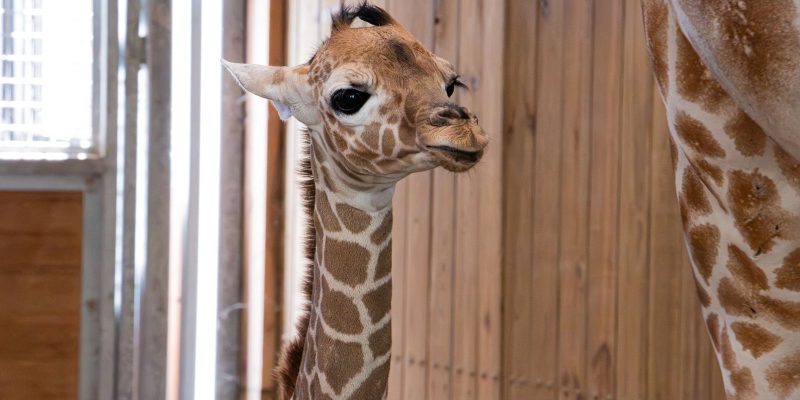
A reticulated giraffe calf was born at Blank Park Zoo in Des Moines at 8:02 a.m. on Monday, August 17, and the zoo put the whole thing on Facebook Live as it happened. The calf is a female. Her name was chosen by strangers at a state fair.
She is the second calf for mother Skye and father Jakobi. Their first, Raza, arrived on January 18, 2021.
Why a zoo livestreams a birth
A giraffe gives birth standing up, and the calf drops roughly six feet to the ground. The fall is not an accident of anatomy: the impact helps break the amniotic sac and start the calf breathing. Within an hour or so a healthy calf is usually on its feet. It is one of the few large-mammal births that is genuinely watchable from start to finish, which is why a zoo with a camera and a due date will point one at it.
“Welcoming a new giraffe calf is one of those rare moments that brings our entire community together,” said Blank Park Zoo President and CEO Anne Shimerdla. “We invited people from across the country to watch this incredible birth unfold live, and now we’re excited to invite the public to become part of the calf’s story by helping choose the baby’s name.”
The fair picked the name
Voting ran at the Iowa State Fair through August 23, at Kid Find Headquarters on the Grand Concourse just outside the West Grandstand gates, with an online ballot for everyone who could not get to Des Moines. The winning name was Kya.
The calf and Skye stayed behind the scenes after the birth while the two bonded and the animal care team tracked the calf’s development, which is standard practice and not a sign of trouble. By the end of September the pair were sharing part of the enclosure with the rest of the herd.
A giraffe is not one species any more
Kya is a reticulated giraffe, and the reticulated giraffe is in worse shape than most visitors assume. The IUCN Red List assesses it as Endangered, in an assessment carried out on March 16, 2018, and counts 11,048 mature individuals across Ethiopia, Kenya and Somalia, with the population still decreasing. That assessment treats the animal as a subspecies, Giraffa camelopardalis ssp. reticulata. Giraffe taxonomy has since moved: the IUCN now recognizes four giraffe species rather than one, and a species-level reassessment of the reticulated giraffe is the next step rather than a finished document. Where you see the name Giraffa reticulata, that is what it refers to.
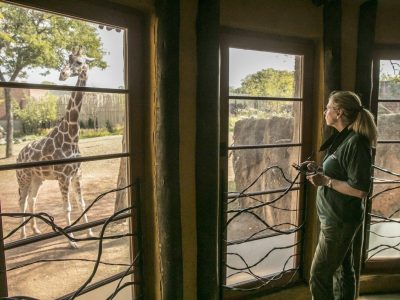
The word reticulated is doing real work here and is worth a sentence. It means net-like, and it describes the coat: large liver-colored patches separated by narrow, sharp-edged white lines, as though someone had drawn a net over the animal. Other giraffes carry blotches with soft or ragged borders. The pattern is also the reason a calf can be identified for life. Giraffe markings are unique to the individual and do not change as the animal grows, so the same photograph that tells a keeper which calf is which is the method field researchers use to census a wild herd.
The calf was born as part of the Association of Zoos and Aquariums’ Species Survival Plan, the breeding program that decides which animals at which accredited institutions should be paired, with the goal of keeping the managed population genetically diverse rather than simply producing babies.
What happened after
Blank Park Zoo was expecting a second calf when Kya was born. Jakobi had also sired a calf with Zola, and the zoo began a second baby watch at the end of September. Zola delivered on October 6. The calf was mispositioned during the birth and arrived without a heartbeat, and it did not survive despite veterinary intervention. Zola came through it well and the zoo said it was continuing to monitor her. We are noting it because the August release looked forward to that birth, and a story left in the archive should not keep promising something that did not happen.
Kya was alive and visible on the zoo’s livestream as of the end of September. The zoo is Iowa’s only AZA-accredited institution and is marking its 60th anniversary in 2026; it opened the Marjorie A. Foster Lion Conservation Center at the end of October. The IUCN Red List assessment is the place to check the reticulated giraffe’s numbers for yourself.
Source: Blank Park Zoo, August 17, 2026. The calf’s name and sex were reported by WHO Des Moines on September 30, 2026, and the October birth by KCRG on October 7, 2026.
Quick answers
- What is the name of the Blank Park Zoo giraffe calf?
Kya. The public voted on the name at the Iowa State Fair and online, and the winning name was announced after the fair closed on August 23, 2026.
- When was the Blank Park Zoo giraffe calf born?
At 8:02 a.m. on Monday, August 17, 2026. The zoo streamed the birth live on Facebook.
- Who are the calf’s parents?
Mother Skye and father Jakobi. Kya is their second calf together; their first, Raza, was born on January 18, 2021.
- Is the reticulated giraffe endangered?
Yes. The IUCN Red List assesses the reticulated giraffe as Endangered, in an assessment carried out on March 16, 2018, with 11,048 mature individuals across Ethiopia, Kenya and Somalia and a decreasing trend.
- Why is it called a reticulated giraffe?
Reticulated means net-like. The coat is made of large liver-colored patches separated by narrow, sharp-edged white lines, which looks like a net laid over the animal. Other giraffes have blotches with softer edges.
- Can you tell individual giraffes apart by their spots?
Yes. A giraffe’s coat pattern is unique to the individual and does not change as it grows, so keepers and field researchers both use photographs of the markings to identify specific animals.