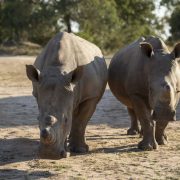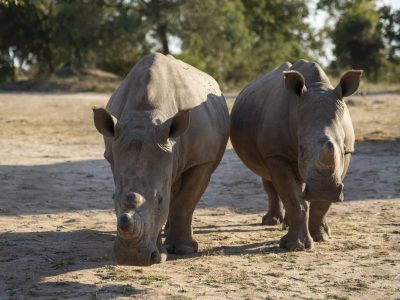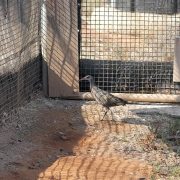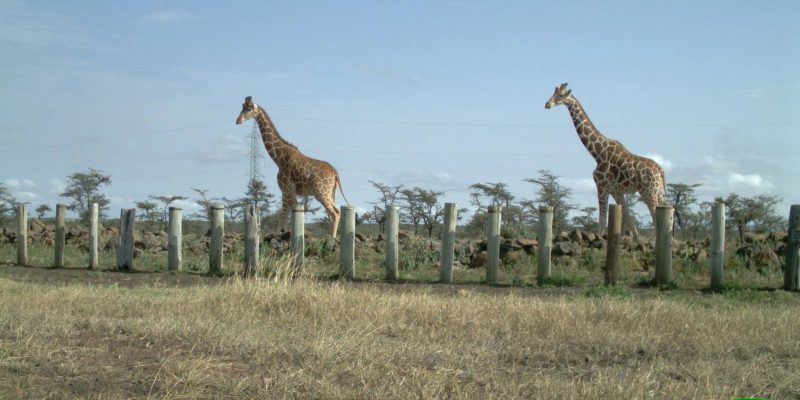
A wildlife corridor at Ol Pejeta is a gap in the fence line with wooden posts set across it. That is the entire mechanism. Most animals walk over or between the posts and carry on. The posts are spaced so that rhinos cannot get through, which is the point: the conservancy in Kenya’s Laikipia County holds a rhino population it has to keep inside a boundary, and a boundary that stops everything else stops the ecosystem too.
The conservancy set out how the corridors work on November 20, together with the monitoring that tells it whether they are being used. Both halves are worth reading, because the second one is the harder engineering problem and the first one is a line of fence posts.
What a gap in a fence is for
Ol Pejeta’s argument is that it is not an island. The corridors link the conservancy into the wider Laikipia landscape and allow continuous movement between the southern and northern parts of it, with Ol Pejeta as one link in a chain rather than a destination. An elephant leaving the conservancy, in the conservancy’s phrasing, is not walking into a dead end.
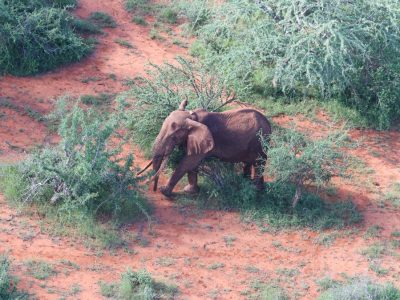
Three things follow from that, and the conservancy names all three. Elephants can follow traditional migratory routes and respond to shifting climate patterns, moving for food and water as conditions change. Wild dogs pass through. New male lions arrive, looking to take over a pride. Movement of that kind keeps populations genetically diverse, which is the quiet long-term argument for connectivity and the one that is hardest to photograph.
The corridors are also sited deliberately away from local communities, so that animals move without being routed into farmland. That is a human-wildlife conflict decision as much as an ecological one, and it is the same thinking behind the conservancy’s experiment with rebuilding a stretch of its fence shorter on purpose, which let elephants cross where people are not.
The cameras are the part that had to be solved
A corridor is only useful if someone knows what is going through it. Every corridor at Ol Pejeta is monitored around the clock by camera traps, developed with a partner the conservancy names as Impact Steps, which transmit images automatically to its conservation teams. There are no memory cards to collect and no wait of several weeks to find out what passed through in the meantime.
That changes what the data is for. A camera trap whose cards are collected monthly produces a historical record. A camera trap that transmits produces something the team can act on: which species are using which corridor, how often, at what hour, and whether anything is happening that needs a response today. It is the same shift the conservancy made in its digital operations room, where rangers watch 90,000 acres on one screen, applied at the fence line.
What the frames actually show
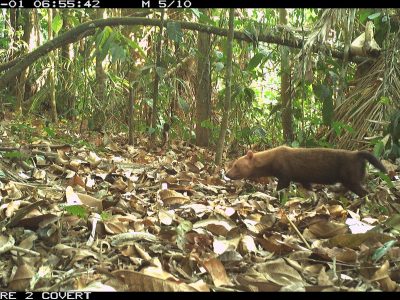
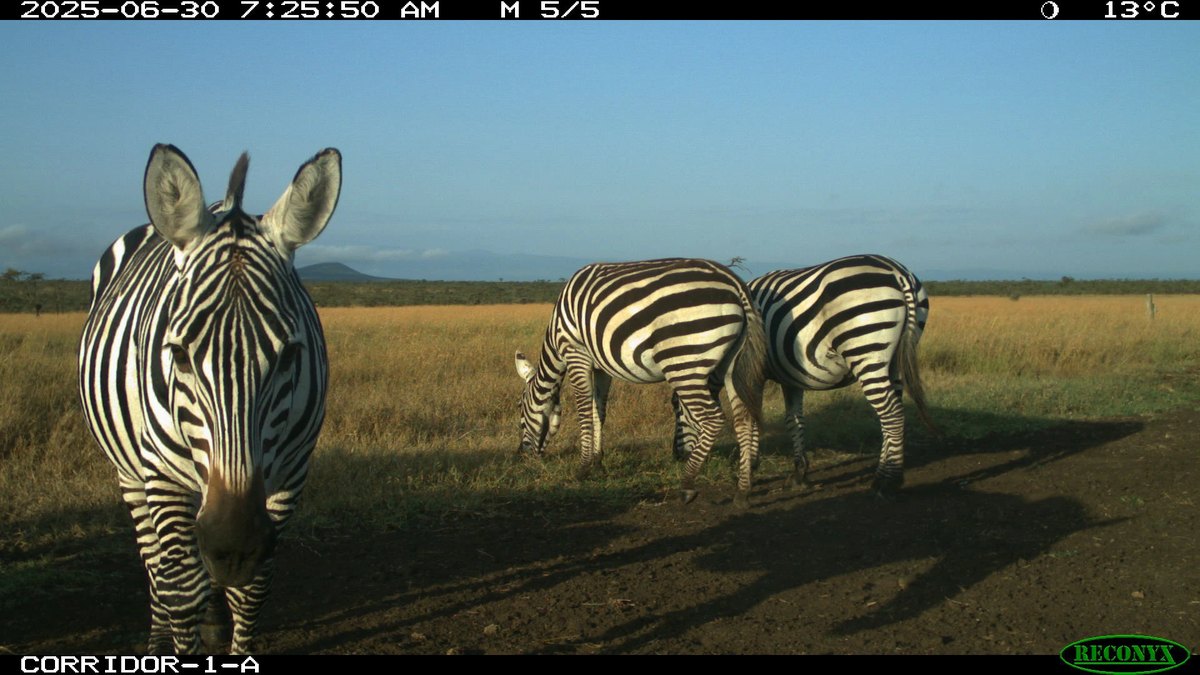
The images the conservancy published with the piece are ordinary camera-trap frames and they are more informative than a staged photograph would be. Each carries a burnt-in header with the date, the time to the second, the temperature and the camera’s name, and a label along the bottom naming the corridor. One shows two reticulated giraffes crossing the line of posts at 9:09 in the morning at 21 degrees Celsius, from the camera marked Corridor 1B. Another, from Corridor 1A, catches three zebras at 7:25 on a 13-degree morning, one of them looking straight down the lens.
Both frames are dated June and July 2025, so they are a record of the system working rather than news from this week. What they demonstrate is the thing the conservancy is claiming: the posts stop a rhino and nothing else, and the camera on the other side of them knows which animal went through and when.
Why this is a story about fences rather than technology
Connectivity is the least glamorous idea in large-mammal conservation and close to the most important. A fenced population is a managed population, with all the genetic and demographic arithmetic that implies. An unfenced one loses its rhinos. The corridor is an attempt to have the second thing while keeping the first, and the test of it is not the design but whether animals use it, which is a question only monitoring can answer.
It is the same argument running through work on the other side of the world: when researchers mapped jaguar movement across Central and South America, the finding that mattered was not where the cats were but which routes between populations were still open.
Which zoos or aquariums paid for this?
Not, as far as we can establish, this particular piece of work. The conservancy names Impact Steps as the partner behind the camera traps and names no funder for the corridors at all, and we found no accredited zoo or aquarium attached to either.
There is zoo money at Ol Pejeta, and it is worth being exact about what it bought, because the honest version of this trace is narrower than a yes. The conservancy’s own 2022 annual report names Australia Zoo among the funders of its high school scholarship program, which went from 124 to 150 students that year, and again among the backers of community trainee placements, a 20,000-tree planting effort and an increase in student and community visits, alongside the US Fish and Wildlife Service, Disney and the Adventure Travel Conservation Fund. The same report records a member of the ecological monitoring team completing training in Bayesian modeling for animal population estimation courtesy of the Zoological Society of London.
Scholarships, tree planting and a statistics course are real contributions and they are not the corridors or the cameras. A zoo that funds a scholarship program has not funded a fence, and saying so is the difference between a funding trace and a logo wall. For scale on the sector, the Association of Zoos and Aquariums reports that 235 accredited and certified facilities spent about 372.4 million dollars on conservation across 139 countries in 2025; no published breakdown isolates an African share, and we are not going to invent one.
Quick answers
- How does an Ol Pejeta wildlife corridor work?
Each corridor is a gap in the fence line with wooden posts set across it. Most wildlife walks over or between the posts. The spacing is chosen so that rhinos cannot pass, which keeps them inside the conservancy.
- Why does Ol Pejeta want animals to leave?
The corridors connect the conservancy to the wider Laikipia ecosystem and allow continuous movement between southern and northern Laikipia. That lets elephants follow traditional routes, lets wild dogs and new male lions move through, and keeps populations genetically diverse.
- How are the corridors monitored?
Every corridor is watched around the clock by camera traps, developed with a partner the conservancy names as Impact Steps, which transmit images automatically to its conservation teams rather than storing them on cards that have to be collected.