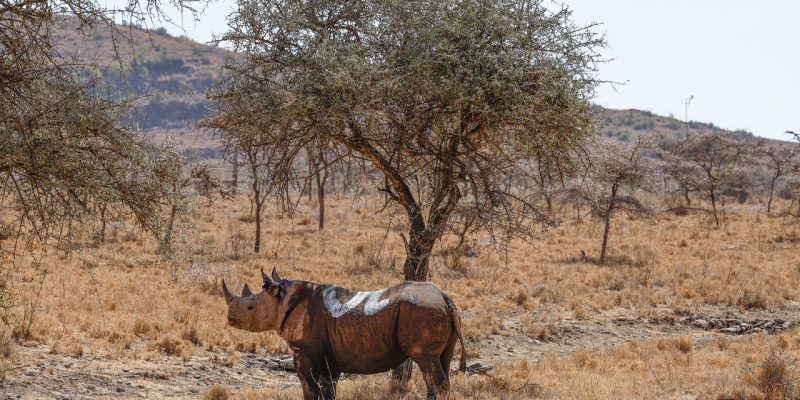
Over eight days in September, a team of veterinarians, rangers and spotters worked across the Lewa-Borana Landscape in northern Kenya with a single job: give 24 rhinos a permanent, readable name. By the time the operation closed, 24 black and white rhinos had been examined, sampled and marked, each one entered into a national database under a code that any ranger can read through binoculars from the far side of a valley.
The Lewa Wildlife Conservancy, which described the exercise on September 10, ran it with its own ground crews and aircraft support alongside local conservation partners. The work is called notching, and it is one of the least glamorous and most load-bearing jobs on the Kenyan conservation calendar.
What a notch actually is
A notch is a small, precise mark cut into the outer edge of a rhino’s ear while the animal is briefly and safely sedated. The technique is used on rhino populations worldwide and it works like a numeral system rather than a label. Each position along the ear edge stands for a specific number, and the combination of marks across both ears produces a code unique to that animal. The code goes into a national wildlife database, tied to the individual rhino’s name and profile.
The payoff is distance. A ranger or a researcher can identify a particular rhino without approaching it, without darting it again and without stressing it, using nothing more than a pair of binoculars. That makes it possible to track one animal’s movement, growth and long-term health across years, which is the raw material of every population estimate Kenya publishes.
Dr Isaac Lekolool, Head of Veterinary and Capture Services at the Kenya Wildlife Service, put the national target plainly. Under Kenya’s Rhino Action Plan, he said, “the goal is to maintain identification marks on at least 60 percent of the rhino population,” so that field teams can recognize animals from a distance without disturbing them.
The sedated minutes are also a laboratory
The window while a rhino is down is short, and Lewa does not spend it only on ears. Veterinary teams use the same minutes to collect small blood, serum and tissue samples that feed a national genetic library. That archive is what lets scientists trace lineage, watch overall herd health and get ahead of disease threats before they move through a population.
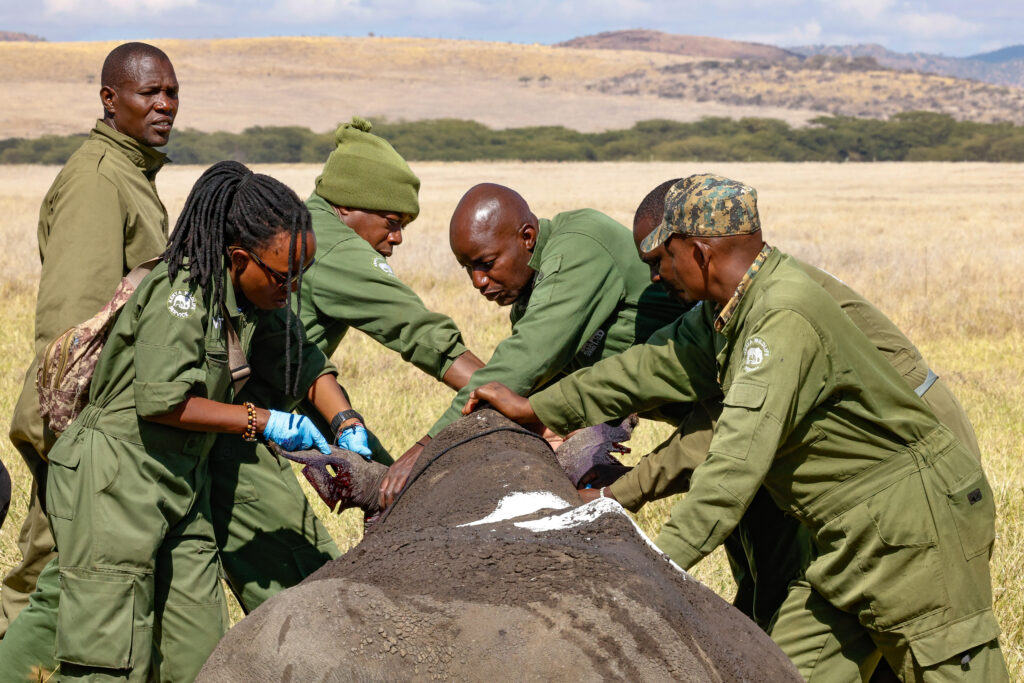
The choreography around those minutes is the reason the day works at all. Spotters scan from the ground and from the air until a target animal is found standing somewhere safe, away from steep slopes and away from water. A field vet then administers a fast-acting, reversible sedative, and the clock starts. The team runs a full health check, takes the genetic samples and cuts the notches, all inside a few minutes, while crews watch the animal’s vital signs throughout. A waking agent brings the rhino back to alertness and it walks off into the bush largely undisturbed.
Who pays for the rangers who do this
Lewa is a Kenyan conservancy, not a zoo, and stories like this one often end without an accredited zoological institution anywhere in them. This one does not. Zoo Zurich has supported Lewa since 1998 and formalized the relationship as a partnership in 2019, and the Swiss zoo describes what the money buys in operational terms rather than general ones: it ensures that patrols and rangers at Lewa are equipped to stand up to poachers, and it funds classrooms, local healthcare and sustainable agriculture projects in the surrounding communities. Rhino protection and rhino monitoring are the same budget line, and a notching operation is monitoring.
Zoo Zurich states on its own conservation page that it has made 6.13 million Swiss francs in direct contributions to the project since 1998. Lewa’s own page about the partnership still carries an older and smaller total, 2.6 million francs over 22 years, which appears to date from around the 2020 opening of the zoo’s Lewa Savanna exhibit. We have used the zoo’s own current figure for the zoo’s own spending. The Lewa Savanna opened on June 6, 2020, covers the largest area of any exhibit at Zoo Zurich and holds 15 species, among them reticulated giraffe, white rhino, Grevy’s zebra and spotted hyena.
Lewa also names San Diego Zoo as a supporter, and refers in general terms to other American zoo association members without naming them. We looked for a more specific list and did not find one.
Why 24, and not 46?
This is the smallest of Lewa’s recent notching totals, and it is worth saying so plainly. The conservancy notched 42 rhinos and fitted seven long-range transmitters in March 2023, and 46 rhinos with nine long-range ear tags in May 2025. This year’s release reports 24 and calls it “a solid win under the circumstances” without saying what the circumstances were. We asked the same question a reader would and the published record does not answer it. No transmitters are mentioned this time either.
What has not changed is the stake. The conservancy holds roughly 15 percent of Kenya’s rhinos. The IUCN Red List assesses the black rhinoceros as Critically Endangered and the white rhinoceros as Near Threatened, and Zoo Zurich, citing the Red List on its project page, sets the recovery against the low point: about 2,500 black rhinos survived in all of Africa in the 1990s, 400 of them in Kenya, against roughly 800 black rhinos in Kenya today plus more than 600 white rhinos.
That is the number the ear notches exist to keep honest. A population you cannot count individually is a population you are guessing at, and Kenya has decided it would rather not guess. Our earlier reporting on Kenya’s Tsavo West rhino sanctuary covers the other half of the same strategy, which is making room for the animals once you know how many of them there are.
Source: Lewa Wildlife Conservancy, September 10, 2026.
Quick answers
- What is rhino notching?
Small, precise marks cut into the outer edge of a rhino’s ears while the animal is briefly and safely sedated. Each position along the ear stands for a number, and the combination across both ears forms a code unique to that animal.
- How many rhinos were notched at Lewa in 2026?
Twenty-four black and white rhinos, over an eight-day operation the Lewa Wildlife Conservancy described on September 10, 2026.
- Why notch a rhino instead of fitting a tag?
A notch can be read from a distance with binoculars, so rangers can identify an individual animal without approaching it or sedating it again.
- What else happens while the rhino is sedated?
The team runs a full health check and collects small blood, serum and tissue samples that feed a national genetic library used to trace lineage, monitor herd health and get ahead of disease threats.
- Which zoo funds the rangers at Lewa?
Zoo Zurich has supported Lewa since 1998 and formalized the partnership in 2019. The zoo states it has made 6.13 million Swiss francs in direct contributions to the project.
- What is Kenya’s national target for marked rhinos?
Under Kenya’s Rhino Action Plan, the goal is to maintain identification marks on at least 60 percent of the rhino population.
- How are black and white rhinos listed by the IUCN?
The IUCN Red List assesses the black rhinoceros as Critically Endangered and the white rhinoceros as Near Threatened.