A tree that botanists once wrote off across most of the Seychelles was standing on a Silhouette hillside this year in flower and in fruit, and an Island Conservation Society survey team walked into it while looking for something else.
The tree is Bouskiya, Trilepisium gymnandrum, an endemic the islands very nearly lost. The sighting came out of the society’s continuing work on Silhouette’s Key Biodiversity Areas, the slow business of walking ground nobody has catalogued and writing down what is on it.
What a Key Biodiversity Area survey actually is
Key Biodiversity Areas are sites identified as mattering disproportionately for species, ecosystems or ecological processes. Seychelles ran a major national assessment of them between 2011 and 2013, funded through a Government of Seychelles, UNDP and Global Environment Facility program, with local organizations, government officers, taxonomic specialists and outside researchers surveying Mahe, Praslin, Silhouette and La Digue.
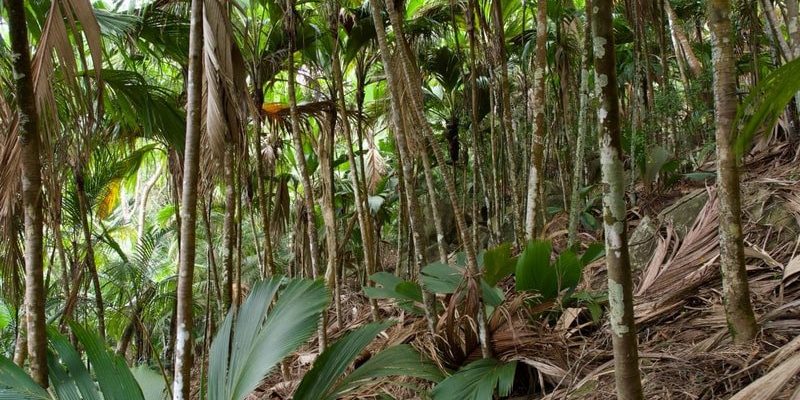
Silhouette came out of that work looking important, and it still does. More than 93 percent of the island’s land sits inside Silhouette National Park, and it holds lowland palm forest and submontane mist forest in a condition that Mahe and Praslin largely no longer have.
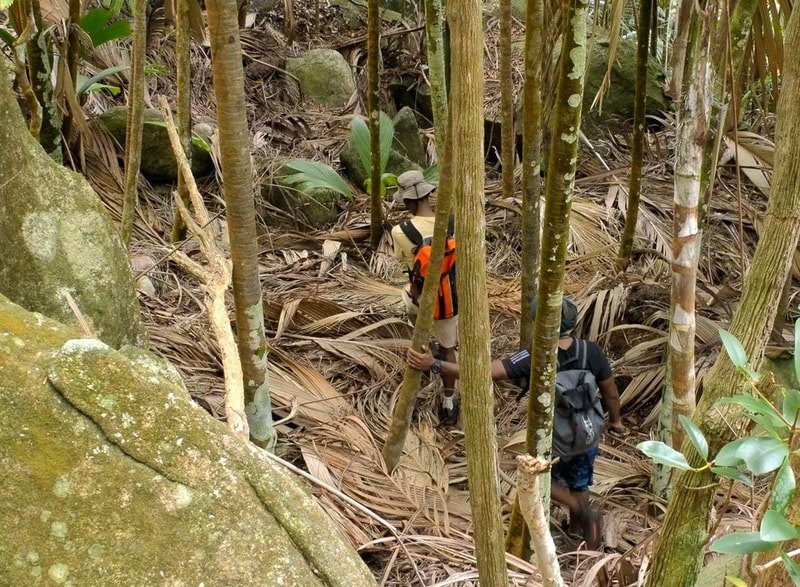
The search that found the tree was looking for a shrub
One recent outing went after Zakobe Marron, an endemic shrub of exposed granite glacis that used to be reasonably common around La Passe and has since gone from there. The team wanted to find any population left that could seed a restoration.
They did not find it. What they walked into instead was a glacis holding a dense set of natives and endemics, among them Orkid Payak, Bwa Ponm, Bwa Gayak, Bwa Zoliker and Bwa Sandal, and then the mature Bouskiya, flowering and fruiting at the same time.
Why that matters takes a moment to explain, because the tree does not look like a headline. A conservation action plan for the species published by Botanic Gardens Conservation International records five known mature trees, all of them on Silhouette: one in the Anse Mondon valley, two at Riviere Machabee and two at Rende d’Avance, spread across six known subpopulations, with fewer than 200 known juveniles. Against a baseline that small, a mature tree in reproductive condition is a meaningful event rather than a pleasant one.
A note on the extinction claim
The society’s own account describes the 2017 rediscovery of Bouskiya on Silhouette as the return of a plant that had been considered extinct in Seychelles. The action plan tells it slightly differently, and it is worth following. The species is considered extinct on Mahe, where Thomasset recorded it early in the twentieth century and later surveys have not found it. On Silhouette, Friedmann saw an adult on the Grand Barbe trail in 1990 and found a few trees in 1994, though those particular trees were never seen again. The 2017 work, led by the botanist Bruno Senterre with the society, located five adults and turned up Rende d’Avance as a population nobody had recorded. So the plant was close to lost rather than gone, which is a smaller claim and an easier one to defend.
The action plan lists the species as Critically Endangered under Criterion D. We could not open the underlying Red List assessment to confirm its date, because iucnredlist.org returned HTTP 403 to us from two different machines today, and the plan’s own link to the assessment is a placeholder. The category given here is therefore the one the action plan states, attributed to it.
The other half of the fieldwork
A second outing went northeast, up the Riviere Patates, a seasonal river running about 1.3 kilometers from a source near Mont Laurant at around 300 meters. Most of its course is underground and only the last 60 meters or so run in the open. The upper reaches had barely been visited.
The forest up there turned out to be dominated by Bwa Fourmi, Wielandia elegans, which is still common on Silhouette and has become scarce on Mahe and Praslin. That is the quieter finding, and the society makes a point of it: a discovery does not have to be a new species. Documenting a healthy population of something that is declining elsewhere is evidence of what the island is for.
Earlier survey effort leaned heavily on vascular plants. The society is now pushing into ferns, insects and fungi, and it offers one example of why that is not box-ticking. The endemic tiger moth Chiromachla seychellensis depends on Zakobe Marron in its early life stages, so the shrub’s decline is not only the shrub’s problem. Staff from Silhouette and other conservation centers recently went through a field training session with Senterre on survey method, data collection and the Bio_Occurrence database he has run since his early Seychelles work.
Who is paying for this
We looked for an accredited zoo or aquarium behind the Silhouette work and did not find one. The Island Conservation Society’s published project funders are the Manta Trust, the Alphonse, Desroches and Farquhar Foundations, Gran Kaz, IBC-UNISEY, the Miguel Torres Foundation and the Seychelles Conservation and Climate Adaptation Trust, with the original Key Biodiversity Area assessment funded through the Government of Seychelles, UNDP and GEF program. The action plan’s named partners are the Ministry of Environment, Energy and Climate Change, the Seychelles National Parks Authority, the society itself, the Islands Development Company and the Silhouette Foundation, with Botanic Gardens Conservation International named for its expertise. Not one zoological institution appears in either list.
That is worth stating plainly rather than glossing. The Association of Zoos and Aquariums reports that 235 accredited and certified facilities spent roughly $372.4 million on conservation across 139 countries in 2025, and no published breakdown isolates what any part of Africa or the western Indian Ocean received. Where we can name a zoo funder, we do. Here there is not one to name, and the work is being done anyway, by a national society and a government agency, on an island most of which is already a national park.
The society has had a busy few weeks on other fronts: in October it began an invasive species eradication on Alphonse Atoll aimed at rats, mice, feral cats and chickens.
Source: Island Conservation Society, “Protecting the Rare and Unknown: Continued Exploration of Silhouette’s Key Biodiversity Hotspots (KBAs) by ICS”, 28 September 2026. Species status and population figures from the Botanic Gardens Conservation International conservation action plan for Trilepisium gymnandrum.
Quick answers
- What is Bouskiya?
Bouskiya is the Seychellois name for Trilepisium gymnandrum, a tree endemic to Seychelles. A conservation action plan published by Botanic Gardens Conservation International records five known mature trees, all on Silhouette Island, across six known subpopulations, with fewer than 200 known juveniles.
- Why does a flowering tree count as news?
Because of how few there are. With five known mature individuals on record, a tree that is flowering and fruiting at the same time is a reproducing adult in a population small enough that each one is tracked. The Island Conservation Society team found it while searching for a different species entirely.
- Was the species really extinct?
Not quite, and the distinction matters. The action plan treats it as extinct on Mahe, where it was recorded early in the twentieth century and not found since. On Silhouette, Friedmann saw an adult in 1990 and found a few trees in 1994, though those were never seen again. Bruno Senterre, working with the society, located five adults in 2017 and 2018.
- What is a Key Biodiversity Area?
A site identified as disproportionately important for species, ecosystems or ecological processes. Seychelles ran a national assessment between 2011 and 2013 covering Mahe, Praslin, Silhouette and La Digue, funded through a Government of Seychelles, UNDP and Global Environment Facility program.
- Why does a moth matter to a shrub survey?
The endemic tiger moth Chiromachla seychellensis depends on Zakobe Marron in its early life stages. If the shrub's populations fall, the moth is affected too, which is why the society is widening its surveys beyond vascular plants into insects, ferns and fungi.
- Which zoo or aquarium funds this work?
None that we could verify. The society's published project funders are the Manta Trust, the Alphonse, Desroches and Farquhar Foundations, Gran Kaz, IBC-UNISEY, the Miguel Torres Foundation and the Seychelles Conservation and Climate Adaptation Trust. The action plan's partners are Seychelles government bodies, the society, the Islands Development Company, the Silhouette Foundation and Botanic Gardens Conservation International. No zoological institution appears in either list.