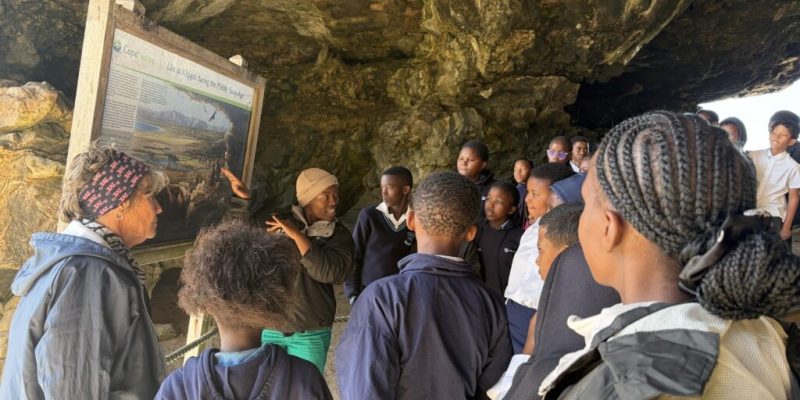
A group of school learners on South Africa’s Overberg coast spent a day in a cave that people lived in during the Middle Stone Age, and then filled bags with 20 kilograms of other people’s litter.
The two halves of that day were not unrelated, which is the point of the program they belong to.
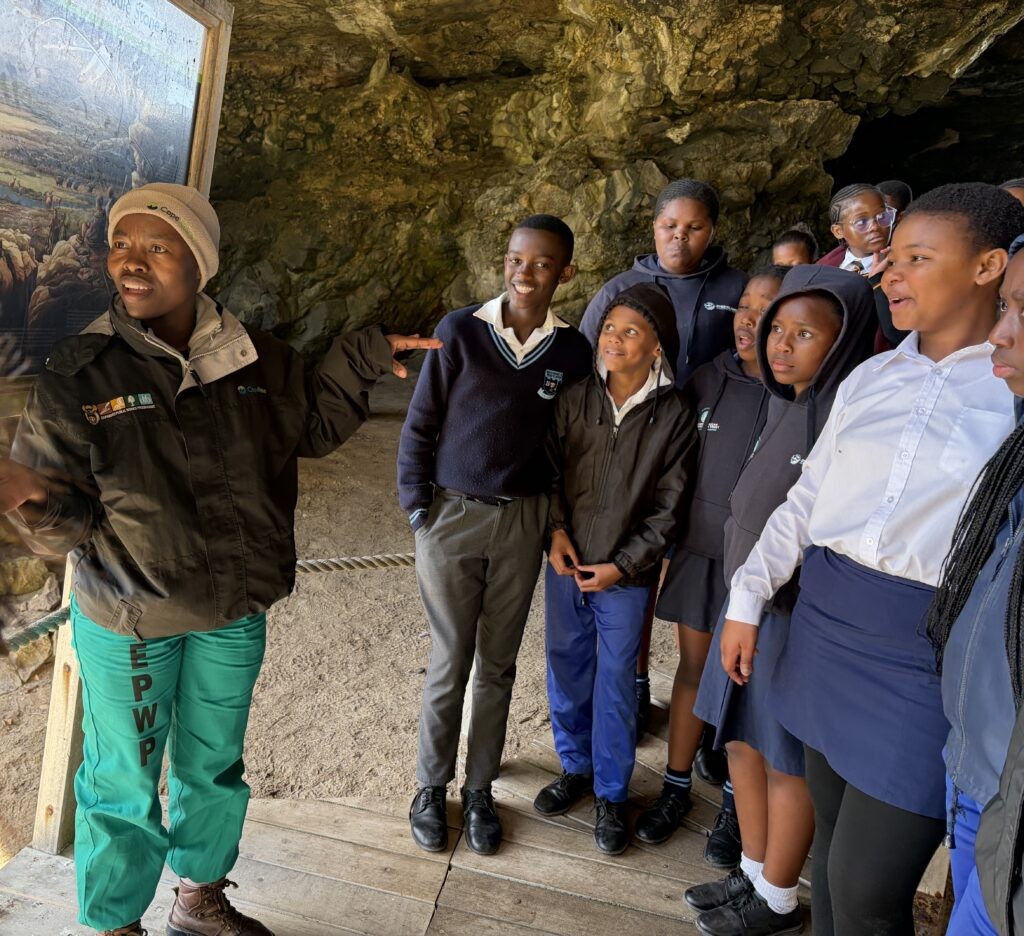
The DEEP Blue Ambassadors are the senior strand of the Dyer Island Conservation Trust’s youth education work in Gansbaai, and on October 26 the Trust reported on their outing to Klipgat Cave and the beach at Die Plaat, run with the CapeNature Walker Bay team.
Klipgat
Klipgat Cave sits in the cliffs along the Walker Bay coastline and is an archaeological site of real significance, carrying evidence of early human occupation. For a group of learners who live along that coast, it is the kind of place that makes an abstraction concrete: people have been getting their food from this shoreline for a very long time, and the shoreline is still here, and it is still being used.
The Trust frames the visit in those terms, as a chance for the ambassadors to connect with the area’s natural and cultural heritage and to see the two as one thing rather than two.
Die Plaat
After the cave the group moved to Die Plaat and collected 20 kilograms of litter from the beach.
That number is worth holding onto, because beach clean-ups are easy to write about badly. Twenty kilograms is not a figure that solves anything. What it does is put a weight on an abstraction for a group of teenagers who had just spent the morning learning how long their coastline has been inhabited, and who now know what a morning’s worth of litter on one stretch of it feels like to carry.
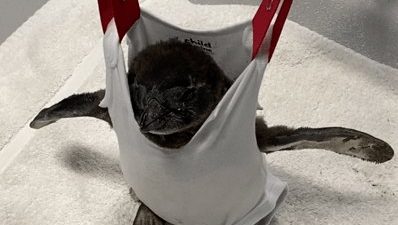
The Trust’s own framing stays on the practical consequence: litter left on beaches enters the marine environment, where it is a risk to seabirds and other marine life. That is not a hypothetical in this particular bay. The Trust runs the African Penguin and Seabird Sanctuary a short distance away, and the seabirds in question are the ones it admits.
This was a separate outing from the Trust’s Kruismansbaai clean-up earlier in October, which targeted ghost fishing gear at a different site. The two together give a fair picture of how much of this organization’s week is spent picking things up off the coastline.
Who made it possible
The outing ran with the CapeNature Walker Bay team, whose involvement is what opened the cave as a teaching site. The Trust thanked the Western Cape Government and the Overberg Municipality for sponsoring promotional packs and catering for the learners.
We looked for accredited zoo or aquarium funding behind the DEEP Blue Ambassadors program and did not find any. The Dyer Island Conservation Trust was founded in 2006 by Wilfred Chivell and is funded in an unusual way for a conservation NGO: its primary partners are Marine Dynamics and Dyer Island Cruises, the ecotourism operators Chivell also owns, which supply both significant funding and the operational platform the Trust works from. Visitor donations from shark viewing, the seabird sanctuary and the eco-cruises make up a further share, with corporate sponsorship including Volkswagen South Africa’s For Good initiative.
No zoological institution appears in that structure. Reporting the absence is more useful than reaching for a connection, and it also explains something about the organization: a trust that is funded by the tourism it generates has a direct financial reason to keep the coastline worth visiting, which is a different incentive from grant dependence.
For sector context, the Association of Zoos and Aquariums reports that its 235 accredited and certified members spent approximately $372.4 million on conservation across 139 countries in 2025. No published breakdown isolates an African share of that total, so we do not print one.
Because no zoological facility is part of this story, it carries no facility hub.
The program it belongs to
DEEP stands for the Trust’s Dyer Island Environmental Education Program, which works with local schools through several age tiers, the ambassadors being the group that takes on the most independent fieldwork. Over the past months the same program has run tree planting for Arbour Week and marine literacy work with local schools, and the Trust’s wider output this year has included African penguin rescues at Struisbaai.
Education stories carry an obvious problem for a news site: the outcome is thirty years away and cannot be measured today. What can be reported is what was actually done, which in this case is a cave, a stretch of beach, a partnership with the provincial conservation authority, and 20 kilograms.
Source: Dyer Island Conservation Trust, “Exploring Klipgat Cave and Caring for Our Coastline: DEEP Blue Ambassadors at Die Plaat,” October 26, 2026. Funding structure from the Trust’s own about page.
Quick answers
- Who are the DEEP Blue Ambassadors?
The senior strand of the Dyer Island Conservation Trust's youth education work in Gansbaai, South Africa. DEEP is the Trust's Dyer Island Environmental Education Programme, which runs with local schools across several age tiers; the ambassadors take on the most independent fieldwork.
- What is Klipgat Cave?
An archaeological site in the cliffs along the Walker Bay coastline, carrying evidence of early human occupation during the Middle Stone Age. The visit was run with the CapeNature Walker Bay team.
- How much litter did they collect?
20 kilograms, from the beach at Die Plaat.
- Why does beach litter matter for seabirds?
Litter left on beaches enters the marine environment, where it is a risk to seabirds and other marine life. The Trust runs the African Penguin and Seabird Sanctuary nearby, which admits birds from this stretch of coast.
- Which zoos fund this program?
None that we could find. The Dyer Island Conservation Trust is funded mainly by Marine Dynamics and Dyer Island Cruises, the ecotourism operators its founder also owns, together with visitor donations and corporate sponsorship including Volkswagen South Africa's For Good initiative. This particular outing was supported by the Western Cape Government and the Overberg Municipality.
- Is this the same as the Kruismansbaai clean-up?
No. That was a separate Trust outing earlier in October at a different site, targeting ghost fishing gear. This one combined a heritage visit to Klipgat Cave with a clean-up at Die Plaat and involved the DEEP Blue Ambassadors.